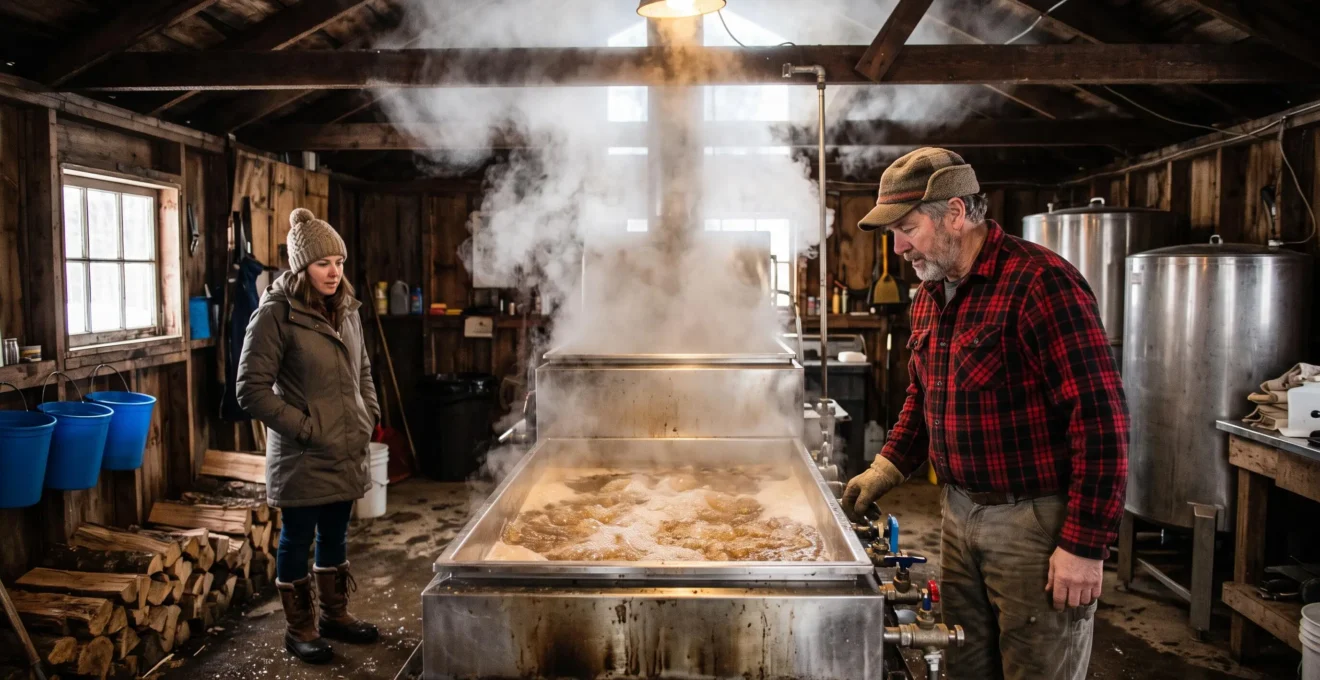
A Canadian sugar shack can be serving a traditional maple feast while its evaporator sits completely still. That distinction matters if your goal is to watch maple sap become syrup rather than simply enjoy a seasonal meal.
Across Québec and Ontario, maple production depends on late-winter and early-spring temperatures. The sap run can begin earlier or later than expected, and the busiest production days do not necessarily coincide with popular tourist weekends. A reservation for a cabane à sucre guarantees only what the operator has actually promised.
The most rewarding approach is to plan around active maple production, check what happens on-site, and choose transport that allows you to reach a working sugarbush without unnecessary complications. Montréal and Ottawa both offer useful starting points, although rural sugar shacks often require more logistical preparation than city attractions.
A good visit combines three experiences: understanding how the trees produce sap, seeing how that sap is concentrated, and tasting the finished syrup in the place where the work happens.
Maple season in Canada: What travellers need to know
- Timing is weather-dependent: freeze-thaw conditions are more useful than fixed calendar dates when planning to see live production.
- A sugar shack meal is not necessarily a production tour: confirm on-site boiling, access to the evaporator and what happens when sap is not flowing.
- Book transport and the experience together: rural access can be difficult without a car, while city markets provide a useful alternative for tasting authentic maple products.
- Why Is Maple Syrup Season in Canada So Short and Unpredictable?
- How to Choose a Sugar Shack Experience Near Montréal or Ottawa Without a Car
- Which Maple Experience Is Better: a Family-Run Sugar Shack or a Big Commercial Site?
- The “Maple-Flavoured” Mistake That Tricks Visitors in Canada
- When Should You Visit a Sugar Shack in Canada to Actually See Syrup Being Made?
- Why Do Public Markets Reveal More About a Canadian City Than Trendy Restaurants?
- How to Build a 7-Stop “Canadian Food” Sampler Without Eating the Same Thing Twice?
- What Even Is Canadian Food When Every Province Tells a Different Story?
Why Is Maple Syrup Season in Canada So Short and Unpredictable?
Canada’s maple syrup season is short because sap production depends heavily on changing temperatures around the freezing point. Cold nights followed by warmer days create favourable conditions for sap movement. Those conditions usually occur during a limited period in late winter and spring, but their timing and duration vary by location and year.
A commonly used planning estimate is roughly four to six weeks of sugaring activity, although this is not a fixed biological calendar. A particular sugarbush may experience several productive bursts separated by days when little sap moves.
Ottawa Tourism describes favourable conditions as daytime temperatures around +5°C and nighttime temperatures around -5°C. The precise temperatures need not match those values every day. What matters is the alternating temperature pattern and the response of the trees.
In a study covering four Québec maple-production sites during 2022 and 2023, researchers found that freeze-thaw events occurred on 64% of days with sap production. On days when production exceeded one litre, that proportion increased to 94%.
94%
At four Québec research sites in 2022–2023, freeze-thaw events coincided with 94% of days producing more than one litre of sap. This describes the study conditions, not every Canadian maple-producing region.
Research on maple sap production and climate warming in Quebec, Frontiers in Agronomy.
Climate warming adds another planning complication. In the same research, a model projected that increasing mean monthly temperatures by 2°C could shift the beginning of the sugar season 17 days earlier and its end 13 days earlier. These were modelled responses, not observed nationwide changes or proof that every future season will be shorter.
Regional differences matter too. A warmer sugarbush in southern Québec may begin producing before a colder location elsewhere in the province or Ontario. Elevation, local weather and the particular season can alter that order, so geographic expectations are only a starting point.
The practical distinction is between two different announcements:
- “Open for sugar season” means the establishment is accepting visitors, serving meals or running advertised activities.
- “Boiling fresh sap today” means the producer is actively operating the evaporator, which is the experience you need to confirm separately.
Steam rising from an operating evaporator, incoming sap being collected and staff explaining an active boiling cycle are stronger indicators of live production than a seasonal opening date. A demonstration using stored sap can also be educational, but it is not the same as witnessing a fresh sap run.
For visitors, the lesson is straightforward: use the calendar to identify a potential travel period, then use actual conditions and producer confirmation to decide whether that period offers the experience you want.
How to Choose a Sugar Shack Experience Near Montréal or Ottawa Without a Car
Visiting a Canadian sugar shack without a car is possible, but the easiest option is not always the most authentic. Organized excursions can simplify transportation, while an urban sugar shack may be easier to reach independently. Most rural working sugarbushes are not designed around frequent public transit, so the return journey deserves as much attention as the reservation.
From Montréal, start by looking for organized seasonal outings to the Montérégie or Laurentians. Some excursions focus on a traditional meal, while others may provide a guided explanation of maple production. Neither an advertised sugar-shack destination nor an attractive tour photograph proves that visitors will watch syrup being boiled.
Seasonal group transportation and private charters can be alternatives when available. Confirm whether the service operates on your travel date, whether the ticket includes a sugar-shack reservation and exactly where passengers are collected and dropped off.
For Ottawa visitors, the choices illustrate why location matters. Ottawa Tourism’s overview of regional sugar shacks identifies the Vanier Sugar Shack as an urban operating site less than five kilometres from downtown Ottawa. It also describes rural options, including Temple’s Sugar Bush and Stanley’s Olde Maple Lane Farm.
Those rural attractions offer different activities, but their approximate driving distances should not be mistaken for verified public transit connections.
The comparison below separates the available transport strategies without assuming specific shuttle schedules or unverified journey times.
| Planning factor | Organized excursion | Transit plus taxi or urban visit |
|---|---|---|
| Door-to-door travel time | Depends on pickup, route and group stops; request the full itinerary. | Depends on transit connections and taxi availability; calculate both directions. |
| Production access | Confirm whether the itinerary includes a working evaporator and guided sugarbush visit. | Ask the destination directly whether visitors may observe production. |
| Group size | Usually determined by the excursion operator; ask about capacity. | More control over your party, subject to the site’s reservation rules. |
| Time on-site | May be reduced by bus travel, pickups and scheduled departures. | Potentially more flexible, but limited by the return connection. |
| Return reliability | Usually arranged as part of the excursion, if specified. | Must be confirmed independently, especially for rural destinations. |
Travel without a car involves an important trade-off. A fixed excursion provides logistical predictability, but it rarely lets you change plans at short notice to follow a sudden sap run. Independent transport may offer more flexibility, provided a taxi or other reliable return option is actually available.
Rural rideshare coverage should never be assumed. Even where a service operates in the wider region, vehicle availability and fares can vary on busy spring weekends.
Before paying, request the operator’s exact address, the expected time at the evaporator, the language of the visit and the return transport arrangements. If your priority is live boiling, ask whether the itinerary changes when weather prevents production.
Once the transportation problem is resolved, the next choice is whether a smaller producer-led visit or a larger tourist-oriented sugar shack better matches your expectations.
Which Maple Experience Is Better: a Family-Run Sugar Shack or a Big Commercial Site?
A family-run sugar shack may be better for visitors seeking a conversation with a producer and a close look at maple production. A larger commercial site may be better for families, organized groups and travellers who need predictable facilities or language support. Neither category guarantees authenticity: what matters is whether maple syrup is genuinely produced and explained on-site.
In Québec, the traditional cabane à sucre is as much a seasonal gathering place as a production facility. A typical visit may feature a generous communal meal, traditional dishes and maple taffy poured onto snow.
Smaller operations can make the relationship between tree, producer and finished syrup easier to understand. Depending on the business, visitors may speak directly with the person managing the sugarbush, collecting sap and operating the evaporator.
However, family ownership alone is not proof that every meal or product comes from the same property. Likewise, large establishments do not necessarily rely on syrup made elsewhere. Ask about the actual production process rather than drawing conclusions from the business’s size.
Larger sugar shacks may offer extensive dining rooms, entertainment, organized children’s activities and more structured visitor services. Those features are valuable when planning with a large group or travellers unfamiliar with the region.
Language is another consideration. Some smaller Québec establishments operate mainly in French, while tourist-oriented venues may offer English-language explanations. Availability varies, and both should be confirmed before booking.
| Priority | What to verify | Why it matters |
|---|---|---|
| Live production | Is syrup boiled on-site, and can guests safely watch? | Distinguishes a working operation from a dining-only visit. |
| Producer contact | Who leads the explanation: a producer, guide or dining-room employee? | Determines how directly visitors can ask technical questions. |
| Sugarbush access | Is a walk among tapped maple trees included? | Connects the forest to the evaporator. |
| Food and activities | What does the reservation include? | A traditional meal, taffy and outdoor activities may be separate offerings. |
| Quiet or lively setting | What are the group size and reservation format? | Helps match the atmosphere to your party. |
Weekend meal services can be busy, especially at popular establishments. A quieter weekday reservation may create more opportunities for conversation, but that depends on staffing and the production schedule. Weekday visits are not inherently more authentic.
Families with young children may value organized activities and predictable facilities more than extended technical demonstrations. Enthusiasts interested in the evaporator might prefer a smaller guided visit with fewer distractions.
Whichever setting you choose, the next authenticity test is the syrup itself. A genuine visit should help you recognize the difference between maple syrup, traditional maple products and foods that merely taste of maple.
The “Maple-Flavoured” Mistake That Tricks Visitors in Canada
The biggest maple-shopping mistake is assuming every product decorated with maple leaves contains pure Canadian maple syrup. Pure maple syrup, traditional maple products and maple-flavoured foods are different categories. Reading the product name, ingredient declaration and origin information tells you more than packaging, colour or the fact that an item is sold in Canada.
Under Canadian food standards, maple syrup is made by concentrating maple sap. Recognized maple products include maple sugar, maple butter and maple taffy, subject to their applicable standards of identity.
By contrast, a maple-flavoured biscuit, candy or table syrup may contain additional sweeteners, flavourings or other ingredients. That does not automatically make it a poor product, but it should not be confused with pure maple syrup.
The Canadian Food Inspection Agency’s maple product labelling requirements explain the official grading and naming distinctions.
Canada Grade A maple syrup has four recognized colour and taste classes:
- Golden, Delicate Taste: a lighter-coloured syrup with a delicate flavour.
- Amber, Rich Taste: a richer flavour profile suited to many everyday uses.
- Dark, Robust Taste: a pronounced maple flavour.
- Very Dark, Strong Taste: the strongest named taste category within Grade A.
These classifications describe colour and associated flavour, not the farm’s identity. A Grade A label does not prove the syrup was made at the sugar shack you visited.
When choosing souvenirs, examine the ingredient list on processed foods rather than assuming that the word “maple” describes their primary ingredient. A maple-flavoured product can be legitimate and enjoyable without being a substitute for pure maple syrup.
Producer identity is a separate question. Ask where the sap was collected, where the syrup was boiled and whether the vendor produced the syrup being sold. Do not rely on an unverified certification logo as a universal authenticity guarantee.
Price also requires context. Ottawa Tourism uses approximately 40 litres of sap to produce one litre of syrup as an industry guideline. The actual amount varies with sap sugar concentration and processing conditions.
That demanding conversion helps explain why pure syrup has considerable production value. Yet a low price alone cannot establish that a product is blended or mislabelled; quantity, quality, packaging and seller pricing also matter.
The simplest souvenir strategy is to purchase directly from a producer whose operation you have visited, while still checking the product label. It creates a meaningful connection between the experience and what you take home.
Once you know what authentic syrup is, the more exciting question is how to schedule a visit when that syrup is actually being made.
When Should You Visit a Sugar Shack in Canada to Actually See Syrup Being Made?
The best time to visit a sugar shack for live production is during an active sap run, not simply on a date advertised as maple season. Look for a sequence of freezing nights and milder days, monitor local producer updates and ask directly whether the evaporator is expected to operate. No advance reservation can fully control the weather.
Across Québec and Ontario, spring sugaring activities commonly occur between late winter and April, depending on the region. Ottawa Tourism describes its regional visitor season as approximately February through April, weather permitting.
For travellers with flexibility, the middle of the local production period is a reasonable planning target. The earliest opening weekend may feature meals and activities before substantial sap production begins, while a late reservation can fall after productive conditions have passed.
Temperature is more informative than the month alone. Producers may collect and store sap before boiling, meaning the evaporator can operate at a time that does not coincide exactly with sap flowing from the trees.
Warm afternoons can favour sap flow after freezing nights, but an afternoon reservation does not guarantee an active evaporator. Boiling schedules depend on sap availability, storage capacity, equipment and the producer’s working routine. Some operations boil later in the day or outside public visiting hours.
Syrup colour can also change throughout the season. Earlier production may yield lighter syrup and later production may produce darker flavours, but these are tendencies rather than guarantees. Grade depends on the finished syrup, and the progression is not identical every year.
Use the following checklist when making a booking. It is a practical traveller’s procedure, not an officially guaranteed production forecast.
Five checks before booking a live maple-production visit
- Review recent temperature patterns: record the expected freezing nights and warmer days for the destination in a short weather note.
- Check producer updates: save a dated announcement showing whether sap collection or boiling is currently underway.
- Confirm access: obtain a written response stating whether guests can see the evaporator and, if offered, visit the tapped trees.
- Ask about the booking date: record the producer’s answer to “Do you expect the evaporator to be running during our visit?”
- Agree on a fallback: keep confirmation of an alternative demonstration, a changeable reservation or another activity if sap conditions prevent live boiling.
For fixed-date travellers, an educational demonstration using stored sap may be preferable to a traditional brunch with no production access. Ask whether the demonstration uses real maple sap, whether the evaporator operates during the visit and whether the process is explained.
Social media updates from individual sugarbushes and regional producer organizations can help identify current activity. Check their publication dates carefully; photos of steaming evaporators may have been posted during an earlier sap run.
If weather or travel arrangements make a working sugarbush impossible, an urban public market offers another way to understand regional maple production through the producers and their products.
Why Do Public Markets Reveal More About a Canadian City Than Trendy Restaurants?
Public markets can reveal a Canadian city’s regional food identity because shoppers can interact directly with vendors, compare different products and ask where ingredients originate. Restaurants offer valuable culinary experiences too, but their menus reflect individual kitchens. A market can make several local producers and food traditions visible in the same visit.
For a maple-focused trip, this distinction is particularly useful. At a market stall, you may be able to compare syrups, examine labels and learn how individual producers make and sell their products.
Montréal’s Jean-Talon Market provides a documented example. On April 11, 2026, the market hosted Les Sucres, a seasonal celebration featuring maple producers, tasting opportunities, maple taffy, beverages and traditional entertainment.
The Les Sucres event at Jean-Talon Market included conventional syrup alongside products such as infused syrups, maple cider and maple desserts.
That event has ended. Its programme illustrates what a maple-themed market gathering can offer, but it does not establish future dates or guarantee that the same vendors and tasting options are available during ordinary market hours.
If you encounter a vendor offering multiple pure syrups, ask to compare their colour classes. Tasting Golden and Dark syrup side by side, when both are available, can help you recognize differences in intensity that packaging descriptions alone cannot fully communicate.
Then move from tasting to investigation. Useful questions include:
- Where is the sugarbush located?
- Does the business collect sap and boil its own syrup?
- Can visitors tour the production area?
- Is there a particular period when live boiling is more likely?
- Does the producer offer direct sales or scheduled visits?
Some vendors may be producers, while others are retailers selling products obtained from different sources. Both can provide useful information, but only the producer can necessarily explain their own production schedule.
Ottawa’s ByWard Market is another possible starting point for exploring regional food. However, maple-specific vendor availability and tasting opportunities should be verified for the dates of your visit rather than assumed.
Markets also extend the value of a maple trip beyond the short sap season. Bottled syrup and preserved maple products may be available after active production ends, although a market purchase cannot replace the experience of watching sap being boiled.
That approach naturally leads to a broader Canadian food itinerary, where maple becomes one important experience rather than the flavour of every meal.
How to Build a 7-Stop “Canadian Food” Sampler Without Eating the Same Thing Twice?
A seven-stop Canadian food sampler works best when each stop introduces a different ingredient, preparation or regional tradition. Start with a genuine sugar-shack experience, then alternate between savoury dishes, baked goods, market tastings and maple products. The aim is to experience variety without turning the trip into seven versions of the same sweet snack.
For travellers based around Montréal and Ottawa, the following is an illustrative food itinerary rather than a list of verified venues or guaranteed product availability.
| Stop | Food experience | What makes it different |
|---|---|---|
| 1 | Traditional Québec sugar-shack meal | A communal seasonal ritual that connects local dishes with maple production. |
| 2 | Maple taffy on snow | Hot concentrated syrup cooled into a chewy treat on clean snow. |
| 3 | Québec poutine | A savoury combination of fries, cheese curds and gravy. |
| 4 | Pure maple syrup tasting | A chance to compare maple flavour intensity across available colour classes. |
| 5 | Ontario butter tart | A pastry centred on a rich, sweet filling rather than a maple-production ritual. |
| 6 | Maple butter or maple sugar | A different texture and culinary use for concentrated maple sap. |
| 7 | Québec tourtière | A savoury meat-pie tradition that introduces another side of regional cooking. |
The first two experiences can occur at the same sugar shack, but they serve different purposes: one is a meal, and the other is a distinctive maple preparation. The remaining stops are best spread across cafés, markets, bakeries or restaurants that actually offer the named foods.
To broaden the itinerary beyond Québec and Ontario, travellers can substitute a specialty from another region, such as a Nanaimo bar from British Columbia or a salmon-based dish associated with coastal Canadian food traditions. This adds geographic variety without pretending all the foods belong to one province.
Maple wine, maple cider or other maple-based beverages can provide an additional tasting category for adults where available. These are optional products, not essential parts of a maple-production visit, and should not displace the central experience of seeing sap processed.
Pacing matters. A full sugar-shack meal and a generous serving of poutine are better enjoyed on separate days. Lighter market tastings and pastries can occupy the spaces between heavier meals.
Seasonality should guide the order as well. Give the working sugar shack priority when sap is running. Most other food stops are less closely tied to that brief production window, though their availability still depends on individual businesses.
Families can divide tasting portions, choose a limited number of sweet items per day and reserve time for activities that do not involve eating. This makes the journey more enjoyable and allows individual foods to remain memorable.
Once these flavours are placed side by side, an interesting pattern emerges: Canadian food makes more sense as a collection of regional and seasonal traditions than as one uniform national menu.
Key takeaways before exploring Canada’s regional food culture
- Follow the producer, not just the product: a working sugarbush reveals the labour and seasonal decisions behind maple syrup.
- Keep regional traditions distinct: Québec’s cabane à sucre culture and Ontario’s sugarbush outings may share ingredients without offering identical experiences.
- Make the short season the priority: arrange weather-dependent maple activities first and fit more flexible food experiences around them.
What Even Is Canadian Food When Every Province Tells a Different Story?
Canadian food is best understood through regional ingredients, communities and traditions rather than one national dish. Maple syrup provides a useful example: the same product connects several provinces, but the rituals around harvesting, preparing and enjoying it vary. Visiting a working sugar shack reveals this relationship between geography, season and local food culture.
Québec’s cabane à sucre is closely associated with communal meals and sugaring-off celebrations. In Ontario, sugarbush outings may combine demonstrations with walking trails, family activities and educational opportunities.
Atlantic Canadian maple traditions also belong to the wider story, although maple production is not equally prominent in every province. Regional climate, forests, agriculture and food customs shape the way maple is produced and experienced.
Other foods tell different stories. Poutine is strongly associated with Québec, butter tarts with Ontario, Nanaimo bars with British Columbia and tourtière with French-Canadian culinary traditions.
None of these examples, alone, defines how everyone in Canada eats. Indigenous foodways, immigrant communities, local agriculture and changing culinary practices all contribute to the country’s food culture. A narrow list of familiar tourist foods leaves out much of that diversity.
Maple syrup is particularly revealing because its production cannot be separated from the environment. A producer depends on the condition of the trees, the temperature pattern and the available sap. The work is concentrated into a brief seasonal opportunity, even though bottled syrup can be enjoyed throughout the year.
This is why a factory-packed souvenir and a visit to a working sugarbush offer fundamentally different experiences. Both may provide genuine maple syrup, but only the latter allows travellers to connect the finished product with the trees, equipment and people involved.
Tourism marketing sometimes presents Canadian food through a small number of recognizable symbols. Those symbols can be inviting introductions, but they become more meaningful when visitors ask who makes the food, where the ingredients come from and which customs surround its preparation.
A market conversation, a producer-led tour or a regional meal can answer those questions in ways that a generic national-food checklist cannot.
For your next Québec or Ontario trip, identify a working sugarbush, monitor current conditions and confirm production access before finalizing your visit. Then leave room for a market tasting or regional meal. That simple sequence gives you the chance to experience Canadian maple culture where it begins: with the trees and the people who turn their sap into syrup.
Can you visit a Canadian sugar shack outside maple syrup season?
Some sugar shacks offer meals, events, retail sales or educational visits outside the active production period. Availability depends on the establishment. A visit outside sugaring season should not be expected to include fresh sap collection or live production unless the operator specifically advertises a demonstration.
Do you need to reserve a sugar shack visit in advance?
Advance reservations are advisable for traditional meals, guided visits and organized excursions, particularly on popular weekends. Some establishments may accept walk-ins, but policies vary. Confirm meal availability, production access and cancellation terms directly with the sugar shack.
Can children watch maple syrup being made?
Children can participate in many maple experiences, including educational visits and family activities, when offered by the operator. Working evaporators contain extremely hot liquid and steam, so observation must follow the producer’s safety instructions. Confirm age restrictions, accessible viewing areas and supervision requirements before booking.
Is maple syrup made from the same type of tree everywhere in Canada?
Sugar maples are especially important to Canadian maple syrup production, but other maple species can also provide sap suitable for making syrup. Producers select trees according to their local forests and production practices. A guided sugarbush visit is an opportunity to learn which species are tapped at that particular location.
What should you do if the evaporator is not running on the day of your visit?
Ask whether the operator can explain the evaporator, show the sap collection system or provide a demonstration using stored sap. If the primary goal is live production, check whether rescheduling is possible. Otherwise, a traditional meal, sugarbush walk or producer tasting can still make the visit worthwhile without misrepresenting it as an active boiling session.