A restaurant in Banff advertises poutine as a Canadian classic. A waterfront café in Halifax promotes the same dish. Both may serve perfectly enjoyable food, but neither menu tells you much about the culinary traditions of its particular region.
That distinction matters when food is one of the reasons you travel. Canada has regional cooking traditions shaped by fishing communities, agricultural landscapes, immigration, Indigenous foodways and local methods of preserving ingredients. Yet menus aimed at visitors often compress that diversity into a handful of recognizable national favourites.
The most useful authenticity test is not whether a menu says “local,” but whether the dish has an identifiable connection to its place, preparation and ingredients. A named producer, a recognizable regional recipe, a relevant harvest season or an informed explanation from the person serving it can provide more meaningful evidence than a decorative maple leaf beside the description.
Learning to recognize these signals makes it easier to decide what deserves a meal, where to spend your food budget and when a market stall might offer a more revealing experience than a celebrated restaurant.
Authentic Canadian regional food: what matters most
- Look beyond national icons: identify dishes associated with specific communities, regional preparations and locally relevant ingredients.
- Match the specialty to its setting: restaurants suit complex cooked dishes, markets reveal producers and seasonal products, and roadside stops can showcase local harvests.
- Check timing and provenance: distinguish fresh seasonal ingredients from preserved specialties, and ask where the food actually comes from before ordering.
- Why Do Canadian Tourist Menus Make Regional Specialties Taste Generic?
- How to Build a Province-by-Province Regional Food Checklist in Canada in 30 Minutes?
- Restaurant, Market, or Roadside Stop: Where Should You Try a Regional Specialty in Canada?
- The Out-of-Season Ordering Mistake That Makes Regional Canadian Food Disappointing
- When Is the Best Season to Travel in Canada for Regional Food Without Paying Peak Prices?
- What Should You Order in Atlantic Canada: Lobster Roll, Whole Lobster, or Chowder?
- Why Do Public Markets Reveal More About a Canadian City Than Trendy Restaurants?
- How to Visit a Canadian Public Market Without Getting Overwhelmed or Overbuying
Why Do Canadian Tourist Menus Make Regional Specialties Taste Generic?
Canadian tourist menus can make regional food seem generic because recognizable national dishes are easier to promote consistently than unfamiliar local traditions. Standardized recipes, broad supplier networks and visitor expectations can encourage restaurants to offer similar selections across different provinces. The result is food that may be enjoyable but reveals little about where you are eating.
Think of a familiar tourist menu: poutine, maple-glazed something, butter tarts and a burger described as Canadian. These dishes may have legitimate culinary roots, but their presence alone does not establish regional relevance.
A kitchen serving a widely distributed version of poutine in western Canada is not necessarily misrepresenting the dish. The problem arises when the menu implies that a broadly available Canadian favourite represents the distinctive food culture of its immediate surroundings.
Large hospitality operations may benefit from dependable purchasing arrangements, repeatable recipes and ingredients available across locations. However, identical dishes do not prove that restaurants share a central kitchen or supplier. Those operational claims require evidence beyond the menu itself.
Look for menu wallpaper: an impressive-sounding regional heading with no meaningful geographical detail underneath.
- Descriptions use “authentic,” “traditional” or “locally inspired” without identifying a community or preparation.
- The same generic dishes appear across unrelated destinations with little regional variation.
- No producer, fishery, farm or ingredient origin is identified.
- Seasonal ingredients remain on the menu without any explanation of their availability.
Compare this with a clearly identifiable regional dish. Tourism Nova Scotia‘s Halifax Metro visitor information describes the Halifax donair as spiced beef served in warm Lebanese pita with onion, tomato and a sweet garlic sauce. Halifax has also declared the donair its official food.
That description gives travellers something concrete to investigate: a particular city, a recognizable preparation and characteristic ingredients. It is more informative than a menu simply advertising “Canadian street food.”
New Brunswick provides another useful contrast. Acadian poutine râpée represents a different culinary tradition from the fries-and-cheese-curds poutine associated with Quebec. Sharing part of a name does not make two dishes interchangeable.
Tourist-oriented cooking can also adapt assertive flavours, textures or unfamiliar ingredients to appeal to a wider audience. Adaptation is not automatically inauthentic, but it becomes worth questioning when a dish is marketed as traditional without explaining the changes.
A useful first move is to look beyond the busiest visitor strip and compare menus with those of community restaurants, neighbourhood bakeries and producer stalls. The next step is turning those observations into a practical food checklist before the trip.
How to Build a Province-by-Province Regional Food Checklist in Canada in 30 Minutes?
Build a Canadian regional food checklist by identifying the provinces on your route, choosing dishes associated with specific communities, checking their preparation and seasonal availability, and assigning a tasting budget. Thirty minutes is enough to create a useful first draft, provided you prioritize a few meaningful discoveries rather than attempting to catalogue every provincial specialty.
Start with your actual itinerary rather than a national ranking of must-eat foods. Canada is too geographically and culturally diverse for a single dish to summarize each province.
Even within one province, coastal and inland food traditions may differ considerably. A seafood-focused visit to coastal Quebec, for example, will naturally produce a different checklist from an itinerary built around Montreal bakeries and urban food traditions.
For each destination, identify the dish and then record the characteristics that distinguish it from a generic interpretation.
New Brunswick offers a particularly useful example. Tourism New Brunswick‘s article on unique dining experiences identifies Acadian dishes such as poutine râpée, fricot and pets de sœur. Its restaurant examples also demonstrate why operating seasons deserve attention when planning regional food stops.
Other possible research starting points include figgy duff in Newfoundland and Labrador, perogy dishes in Prairie communities, and particular preparations of regional seafood. These are leads for further local research, not claims that each dish represents an entire province.
The following example shows how a traveller could organize the research. Seasonal notes identify what should be checked, not guaranteed dates or availability.
| Dish and region | Season and preparation to check | Where to look and what to avoid |
|---|---|---|
| Halifax donair, Nova Scotia | Year-round dish; spiced beef, pita, onion, tomato and sweet garlic sauce | Established local donair shops; avoid assuming any generic kebab is the same preparation |
| Poutine râpée, Acadian New Brunswick | Check restaurant operating dates and the local preparation | Acadian restaurants; avoid confusing it with fries-based poutine |
| Figgy duff, Newfoundland and Labrador | Check availability and the establishment’s traditional recipe | Local restaurants and bakeries; avoid assuming every raisin dessert is equivalent |
| Perogy-based dishes, Prairie communities | Often available year-round; investigate fillings, cooking methods and accompaniments | Community restaurants and specialty vendors; avoid treating every modern variation as the same tradition |
| Fresh seasonal produce, selected Canadian regions | Match the ingredient to its actual local harvest | Producer markets and farm stands; avoid assuming a locally sold product was locally grown |
Use provincial tourism organizations and farmers’ market directories to establish candidates, then compare their descriptions with independent local reporting and detailed customer accounts. Local mentions can help identify community favourites, but reviews are not conclusive proof of a recipe’s history or authenticity.
Build your regional food checklist in five actions
- Map the route: write down every province and major stop on your itinerary. Deliverable: a destination list.
- Select regional candidates: identify two or three dishes or products per stop. Deliverable: a shortlist with the relevant community or region named.
- Record preparation details: note characteristic ingredients and cooking methods. Deliverable: one recognizable preparation description per dish.
- Check season and access: research harvest periods, fishing seasons, market days or restaurant operations. Deliverable: a timing note and potential venue for each tasting.
- Set priorities and spending limits: label each dish essential, optional or replaceable, with a personal budget allowance in Canadian dollars. Deliverable: a usable food itinerary.
Thirty minutes produces a working plan, not a verified gastronomic history. Confirm opening times, ingredient availability and prices closer to the visit.
Once the dishes are selected, the most consequential choice becomes where to try them. A restaurant, public market and roadside stand can offer very different encounters with the same ingredient.
Restaurant, Market, or Roadside Stop: Where Should You Try a Regional Specialty in Canada?
Choose a restaurant for dishes that require substantial preparation or service, a public market for comparing ingredients and speaking with producers, and a roadside stop for products closely connected to a nearby harvest or fishery. The best option depends on the dish, not a universal ranking of venues. Preparation, price, context and reliability all matter.
A good restaurant can preserve an established recipe and provide the cooking equipment, skill and time that a traveller cannot easily reproduce. Whole lobster dinners, substantial stews and certain traditional meals are often more practical in this setting.
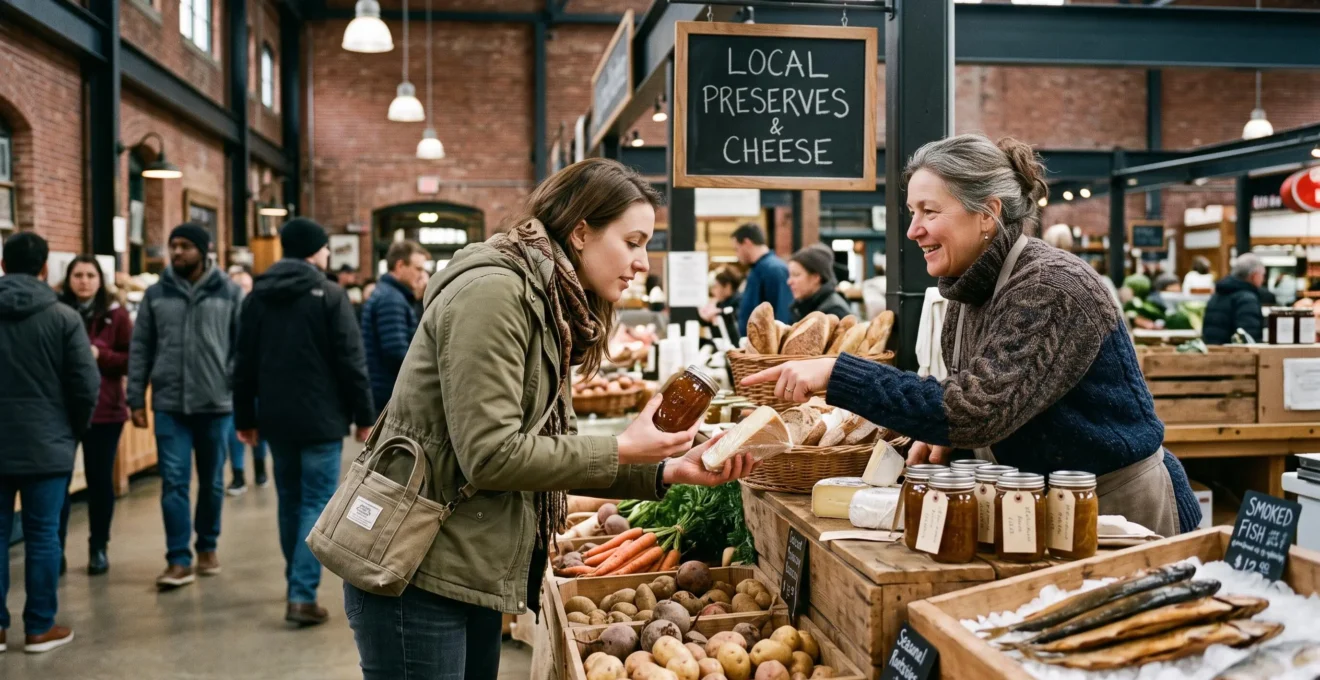
Markets are useful for sampling several foods within a limited time. Depending on the stalls, visitors may compare regional baked goods, preserved products, fresh produce and prepared dishes while asking sellers about their origins.
Roadside stops can be particularly revealing when a locally harvested ingredient is the main attraction. A farm stand selling produce from its own fields may offer stronger geographical context than a city restaurant advertising the same ingredient, although roadside location alone guarantees nothing.
| Criterion | Restaurant | Public market | Roadside stop |
|---|---|---|---|
| Preparation fidelity | Strong potential for complex traditional recipes; chef reinterpretations also occur | Depends on whether food is producer-made or prepared by a reseller | Strong potential for simple, ingredient-led foods; cooking options may be limited |
| Price | Includes preparation and service costs | Flexible purchases and small tastings, but not necessarily cheaper | Can offer direct purchasing; value varies by vendor |
| Regional context | Depends on sourcing transparency and recipe knowledge | Opportunity to question several producers directly | Potentially direct connection to the farm or surrounding area |
| Reliability for a short visit | Often easier to plan around confirmed reservations | Depends on market schedule, vendors and stock | May depend heavily on harvest timing and seasonal operation |
Do not assume that two venues are serving the same experience simply because they use the same dish name. A restaurant chowder might emphasize refined texture and unusual garnishes, while a community seafood stand may follow a more familiar local recipe.
Neither approach is automatically inferior. The question is whether the version matches what you came to discover.
Before spending money, ask a specific question: “Where does the main ingredient come from?” or “Is this the preparation people traditionally serve here?” A confident, detailed answer provides useful context; a vague answer leaves the sourcing claim unverified.
For example, a restaurant naming the fishery supplying its lobster provides more information than one simply describing the dish as Atlantic. The claim is still worth checking when it matters to your decision.
Venue selection becomes even more important when an ingredient is seasonal. A well-chosen establishment cannot necessarily provide the same fresh local product every month of the year.
The Out-of-Season Ordering Mistake That Makes Regional Canadian Food Disappointing
Ordering a seasonal Canadian specialty without checking its production window can lead to a disappointing meal, particularly when freshness is central to the experience. An ingredient may be frozen, stored, sourced elsewhere or replaced with an alternative. Yet out-of-season does not automatically mean poor quality: preserved foods and many prepared dishes are intended to be enjoyed year-round.
Canada’s growing seasons vary greatly by region, and seafood availability follows different rules from agricultural harvests. Restaurant availability also does not necessarily reflect current local production.
Consider fresh fiddleheads. Their association with spring matters because the fresh shoots are a short-season ingredient. A dish featuring preserved or frozen fiddleheads outside that window may still be worthwhile, but it is not the same experience as tasting a recent local harvest.
Fresh corn, summer fruit and fruit pies show another distinction. A bakery can produce excellent pies throughout the year, yet the opportunity to taste a pie made from that week’s local fruit depends on the regional harvest.
Maple products illustrate the reverse situation. Syrup can be stored and enjoyed well beyond the tapping season, while a sugarbush visit during spring sap collection offers a seasonal experience that cannot be recreated simply by ordering maple syrup later.
Lobster requires particular care because the Atlantic coast does not operate under a single uniform fishing season.
Tourism Nova Scotia explains that lobster is available throughout the year in the province while fishing seasons vary between regions. Consequently, a restaurant serving lobster outside the immediate local fishing period does not, by that fact alone, prove that the ingredient is poor-quality or imported.
Distinguish three questions: Is the dish available? Is its main ingredient currently being produced locally? And is the particular preparation best experienced fresh?
- For fresh produce, ask whether the ingredient was harvested locally and when.
- For seafood, ask about the fishing area and whether the product is fresh, held live or previously frozen.
- For maple experiences, distinguish stored syrup from visits centred on active sap collection.
- For baked, smoked, dried or preserved foods, investigate the preparation rather than rejecting them for being out of season.
A quick pre-ordering check is to compare the menu with local harvest information and ask staff whether the specialty is currently being sourced from the region. An establishment’s seasonal menu can be a useful clue, but it does not independently prove that every ingredient is locally produced.
If the ingredient is outside its fresh production window, consider replacing that tasting with a preserved specialty whose character depends on the preservation process itself.
The useful lesson is not to avoid travelling outside harvest season. It is to separate seasonal experiences from regional foods that remain meaningful throughout the year, then decide when the trip offers the best balance of food and cost.
When Is the Best Season to Travel in Canada for Regional Food Without Paying Peak Prices?
The best-value season for a Canadian food trip depends on the specialty you want most. Late spring can suit certain fresh greens and maple-related experiences, while late summer and early autumn can offer strong agricultural harvest opportunities in many regions. Travelling around the edges of busy tourism periods may reduce accommodation costs, but neither lower prices nor seasonal availability is guaranteed.
There is no single Canadian food season. A visit organized around fresh coastal seafood follows different timing from a trip centred on fruit growers, farmers’ markets or maple production.
The common mistake is selecting dates from a general travel guide and only afterward discovering that the desired food experience happens in another season.
Start with the ingredient or event. Identify its local production period, then compare transportation and accommodation options across that window.
| Travel period | Food opportunities to investigate | Cost and availability considerations |
|---|---|---|
| Spring | Regional maple experiences and fresh spring greens where locally available | Check actual tapping and harvest dates; availability changes with weather |
| Early summer | Emerging local produce, seasonal markets and region-specific seafood opportunities | Some destinations are entering their busiest travel period |
| Late summer | Fresh corn, regional fruit, vegetables and harvest-related food experiences | Popular holiday destinations can remain expensive |
| Early autumn | Continuing harvests, regional produce and certain food festivals | Potential shoulder-season value, depending on location and event dates |
| Winter | Preserved and baked specialties, regional restaurant traditions and selected seafood events | Some destinations and venues have reduced seasonal operations |
Nova Scotia demonstrates why food calendars can differ from conventional summer travel advice. Tourism Nova Scotia’s lobster experiences page identifies the province’s Lobster Trail, traditional preparations, and the February Lobster Crawl festival.
February lobster-focused activities show why visitors should not automatically equate Atlantic seafood travel with a summer holiday. However, the presence of a festival does not establish that accommodation or restaurant prices will be lower during its dates.
Festivals are experience opportunities, not automatic bargains. They can justify a trip when tastings, activities and community participation are the priority, while potentially increasing demand for nearby accommodation.
For a budget-sensitive itinerary, compare three alternative date ranges: the beginning of the relevant food window, its busiest expected period and the end. Check whether the priority product remains available on each date before comparing travel costs.
A hypothetical traveller interested in fruit pies might compare a late-summer market weekend with an early-autumn weekday. The weekday could offer better accommodation value, but only if the desired fruit is still being harvested and the vendor is operating.
There is no reliable national rule that shoulder-season travel always saves a particular percentage. Regional events, weather and local tourism patterns can overturn that expectation.
After choosing the right travel window, focus on the dish itself. Atlantic lobster is a useful example because three familiar preparations can deliver different experiences at very different levels of effort and expense.
What Should You Order in Atlantic Canada: Lobster Roll, Whole Lobster, or Chowder?
Order a lobster roll when you want a convenient comparison of lobster meat and preparation, whole lobster when you want the full dining ritual, and chowder when you want to explore a cook’s approach to regional seafood. None is universally the most authentic or affordable. Quality depends on ingredients, preparation, portion size and the establishment serving it.
The lobster roll is the easiest starting point for a traveller with limited time. A good version makes the lobster identifiable rather than hiding it beneath excessive dressing or unrelated fillings.
Look for visible pieces of lobster, a bun that complements rather than overwhelms the filling, and a preparation that allows the seafood flavour to remain central. Light dressing is a useful preference for evaluating the meat, although Atlantic lobster rolls do not follow one mandatory recipe.
A split bun is familiar in many preparations, but its presence does not prove that the meat is locally caught. Ask where the lobster was sourced and whether the filling was prepared in-house.
Whole lobster offers a different experience. The shell, handling and process of extracting the meat are part of the meal. Boiled or steamed preparations served with melted butter allow diners to concentrate on the lobster itself.
They also require time and a willingness to pay for shell weight rather than edible meat alone. If prices are listed by weight, ask whether the quote is based on live weight, what lobster size is available, and whether sides or service are included.
Chowder offers greater variation. Fish, shellfish, potatoes, dairy or broth may appear in different combinations, depending on the cook and local tradition.
Visible seafood and potatoes can make a chowder easier to evaluate, but there is no universal Atlantic recipe requiring identical ingredients or thickness. A creamy chowder is not necessarily less authentic than a lighter one.
Ask which seafood is included, where it comes from and whether the base is prepared in-house. Similar flavour across establishments may raise a question about standardized preparation, but taste alone cannot establish that two kitchens use the same commercial base.
| Dish | Best suited to | What to verify |
|---|---|---|
| Lobster roll | A quick, portable seafood tasting | Meat content, dressing, source and total price |
| Whole lobster | A traditional sit-down seafood experience | Weight, price basis, cooking method and included sides |
| Seafood chowder | Exploring individual and community cooking styles | Seafood varieties, origin, preparation and portion size |
Do not automatically assume that a lobster roll is the cheapest way to eat lobster. A small roll with limited meat may offer poorer value than a larger meal, while a whole lobster carries shell weight and may involve additional dining costs.
The practical comparison is between the actual edible portion, total advertised price and kind of experience you want. Without consistent local prices and portion weights, no reliable universal value ranking is possible.
For a more revealing view of the local catch and its alternatives, visit a seafood market or producer-oriented public market. The ingredients on display can tell a broader regional story than any one restaurant plate.
Why Do Public Markets Reveal More About a Canadian City Than Trendy Restaurants?
Public markets can reveal a Canadian city’s food identity because their stalls may expose the ingredients, producers and preservation traditions behind local cooking. Restaurants primarily present finished dishes, while producer-oriented markets allow visitors to examine what is being grown, caught, baked and sold. The distinction is useful, although famous markets are not automatically representative or locally sourced.
A restaurant tells you what its kitchen has chosen to serve. A farmers’ market can provide a different view: what regional producers have available and which products local sellers consider worth bringing to customers.
Notice patterns rather than individual souvenir items. Several independent stalls selling the same seasonal berry, vegetable or regional preserve may indicate an important local product or strong customer demand.
Repeated products are clues, not proof of regional abundance. Vendors might buy through shared distributors, and a marketplace can contain imported goods alongside locally produced ones.
A more informative signal is repeated specificity: named farms, described harvest areas, identified fishing communities and producers able to explain their products.
Tourism Nova Scotia’s description of Bridgewater Farmers’ Market offers a concrete example. The market is presented as a community-based venue where local vendors sell seasonal produce, seafood, meats, eggs, baked goods and prepared food.
The market operator reports that its vendors live within a 30–45-minute drive of Bridgewater. That is a stated characteristic of this particular market, not an independently audited rule applying to Canadian farmers’ markets generally.
Its tourism listing also includes historical operating dates for 2025, so current opening information must be checked before arranging a visit.
Beyond the products, market conversations offer something restaurant descriptions rarely provide: the opportunity to ask producers directly why a particular ingredient matters locally.
Three questions can make the conversation more useful:
- “Which product is at its best this week?”
- “What would you cook or eat with this yourself?”
- “Where do people from this area usually go for this product?”
The answers may point to unfamiliar preparations, neighbouring communities or seasonal opportunities that were missing from the original itinerary.
Distinguish the person who grew, caught or made the product from someone reselling it. Both can provide useful information, but they offer different forms of knowledge about its origin.
Major city markets can also be highly visitor-oriented. A famous market may offer excellent regional food alongside generic gifts, imported merchandise and products selected mainly for tourists.
Instead of judging credibility solely by the number of tourists, examine vendor transparency, product origins and whether the market contains producers as well as prepared-food retailers. The customer mix can provide context, but it is not a dependable authenticity test on its own.
Once you have identified promising stalls, resist buying immediately. A short, structured market visit can help you taste more relevant products while avoiding purchases that will not survive the rest of your journey.
Key takeaways before your next market visit
- Decide what success looks like: discovering one new regional ingredient may be more valuable than filling a shopping bag.
- Protect your tasting budget: reserve money for products with a clear regional connection rather than buying the first attractive display.
- Plan for storage and transport: a memorable fresh food purchase becomes a problem if you cannot refrigerate or carry it safely.
How to Visit a Canadian Public Market Without Getting Overwhelmed or Overbuying
Visit a Canadian public market in two passes: first explore the stalls without buying, then return for a small number of planned tastings and purchases. Set a budget, prioritize products with identifiable regional origins, and consider storage and travel time before choosing perishables. This simple approach reduces impulse buying without turning the visit into an exhausting research exercise.
On the first pass, walk through the market and observe the range of products. Identify producer-operated stalls, compare similar items, inspect ingredient origins and note anything tied to the current season.
Do not assume the most prominent stall is the most representative. High visibility may reflect market layout, vendor marketing or demand rather than a particularly strong connection to the surrounding region.
Take mental notes or record three promising purchases on your phone. Avoid carrying food while you are still deciding what is worth tasting.
The second pass is for buying. Return to the stalls that offered the clearest answers about provenance, preparation and why their products are relevant to the region.
A useful personal budget has three parts: immediate tastings, portable purchases and a small reserve for one unexpected discovery.
For example, a hypothetical traveller with a CAD 40 market allowance might reserve CAD 20 for ready-to-eat food, CAD 15 for a portable regional product and CAD 5 for an unplanned tasting. These are illustrative spending limits, not verified Canadian market prices.
| Purchase type | Best approach | Main consideration |
|---|---|---|
| Ready-to-eat regional dish | Consume on site while properly served | Freshness, preparation and portion size |
| Fresh seafood or dairy | Buy only with an appropriate cold-storage plan | Temperature control and transport duration |
| Seasonal fruit and produce | Choose quantities you can eat or store appropriately | Ripeness, bruising and perishability |
| Commercially shelf-stable preserves | Check packaging and storage instructions | Seal integrity, ingredients and travel requirements |
| Baked regional specialties | Ask how long they keep and whether refrigeration is needed | Ingredients, freshness and packaging |
Food safety deserves particular attention during road trips. Foods requiring refrigeration should not spend extended periods in a warm vehicle or an unrefrigerated bag. Follow product-specific storage instructions rather than assuming a sealed container is shelf-stable.
Market timing also changes the experience. Early visits may give access to a wider selection of popular products, while late visits may occasionally bring discounts on perishables. Neither outcome is guaranteed: vendors may sell out, maintain fixed prices or close at different times.
Choose an early visit if a particular specialty is essential. Consider a later visit only when flexibility matters more than selection and you are comfortable leaving without the product.
Before paying, ask whether you can taste a small quantity, whether the product was made or grown by the vendor, and how it should be stored. Sampling may not be offered everywhere, and any additional tasting charges should be confirmed.
A successful market visit does not require buying something from every stall. One well-chosen regional dish, a useful conversation and a better understanding of the local food supply can make the visit worthwhile.
For your next Canadian destination, choose one market, identify three foods worth investigating and save room for a single unexpected discovery. Let the ingredients and the people who produce them guide the tasting, rather than relying on the word “local” alone.
Does a locally sourced ingredient make a Canadian dish authentic?
Not automatically. Local sourcing describes where an ingredient comes from, while regional authenticity involves culinary history, community practice and preparation. A restaurant can use local ingredients in an entirely contemporary dish, or prepare a longstanding regional recipe using ingredients obtained outside the immediate area. Both distinctions are worth understanding before judging the menu.
Are traditional Canadian foods always made with ingredients from the same province?
No. Regional food traditions can reflect ingredients and techniques introduced through migration, trade and cultural exchange. Halifax donairs, for example, have a clearly identified local culinary identity even though their preparation reflects wider food traditions. The important question is how a dish became associated with a particular community, not whether every ingredient originated within provincial boundaries.
Can a regional Canadian specialty still be authentic when it is frozen or preserved?
Yes. Smoking, curing, drying, preserving and freezing can all support regional food traditions or practical ingredient availability. Quality depends on the food and its handling. Travellers should distinguish preparations designed around preservation from dishes whose appeal depends on an immediate fresh harvest or catch.
How can visitors find regional food when they do not speak French or a local community language?
Research the dish’s original name in advance and keep a short description of its characteristic ingredients. Show that name to restaurant or market staff, and ask simple questions about preparation and sourcing. In French-speaking areas, recognizing the original dish name can also help avoid confusing different specialties that have similar English descriptions.
Are Canadian farmers’ markets better than grocery stores for discovering regional specialties?
Producer-oriented markets may provide more direct access to farmers, fishers and specialty makers, making it easier to investigate origins and preparation. Grocery stores can also carry genuine regional products, sometimes with clearer packaging or more convenient hours. Neither format guarantees authenticity. Compare producer details, sourcing information, product descriptions and availability rather than judging solely by the type of shop.