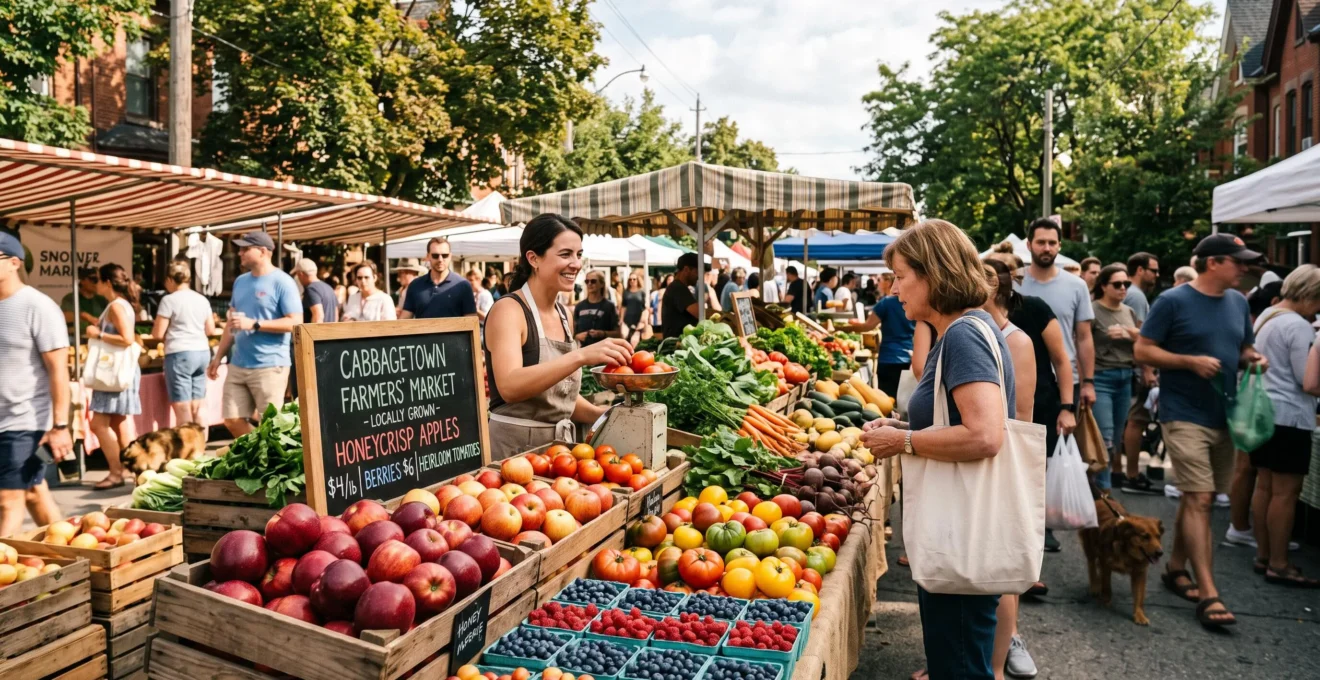
A Canadian farmers’ market can make a three-day cabin or Airbnb stay memorable. Fresh berries at breakfast, local tomatoes with lunch, and vegetables cooked in a rental kitchen sound straightforward. The trouble starts when delicate produce spends several hours in a warm car, gets buried under luggage, or sits forgotten in an unfamiliar refrigerator.
The easiest way to avoid waste is to buy according to your meals, storage conditions, and travel schedule, rather than filling a bag with everything that looks good. Choose fragile ingredients for immediate meals, select sturdier vegetables for later in the stay, and check what is actually in season where you’re travelling.
Canada’s regional growing seasons also matter. A summer market in British Columbia won’t necessarily offer the same local harvest as one in Newfoundland and Labrador. Understanding those differences helps you spend less on unsuitable purchases and enjoy produce while it is at its best.
Three rules for buying fresh produce on a short Canadian trip
- Check the destination province’s seasonal availability guide before deciding which local fruits and vegetables to seek out.
- Buy berries, tender greens, and other fragile ingredients close to when you’ll eat them; choose hardy produce for later meals.
- Protect produce from heat and crushing during transport, refrigerate items that need chilling, and purchase only what your rental can store.
- Why Does “Local Produce” Mean Different Things Across Canada?
- How to Keep Canadian Farmers’ Market Produce Fresh for 72 Hours While Travelling?
- Where Should You Buy Produce in Canada: Farmers’ Markets, Farm Stands, or Grocery Stores?
- The Produce Mistake That Turns a 3-Hour Drive Into a Bag of Mush
- When Is the Best Time to Plan a Canada Trip Around Peak Local Produce Without Guessing?
- Which Is Better in Canada: a Famous Public Market or a Small Neighbourhood Market?
- What Should You Prioritize at a Canadian Farmers’ Market: Produce, Baking, or Ready-to-Eat?
- How to Shop a Canadian Farmers’ Market Without Overpaying or Carrying Too Much
Why Does “Local Produce” Mean Different Things Across Canada?
Local produce in Canada depends on where you’re shopping, how the seller defines local, and when the crop was harvested. Food grown within the same province can qualify as local even when the farm is far away. For travellers, the most useful question is not simply whether something is Canadian-grown, but where and when it was produced.
Canada’s agricultural geography makes a national definition of seasonal freshness impractical. The Okanagan Valley in British Columbia is known for summer tree fruit, while the Prairie provinces and Northern communities operate under different growing conditions. Atlantic Canada’s harvest calendar also differs from that of southern Ontario.
A visitor shopping in July therefore needs a regional perspective. Fruit available at an Okanagan farm stand may not yet be harvested, or may not grow commercially at comparable scale, near a destination elsewhere in Canada.
There are three useful meanings of local:
- Geographic origin: produce grown within a defined region, province, or distance from the retailer.
- Seasonal freshness: produce harvested during its natural regional growing window, rather than held in storage or produced under protected conditions.
- Direct-from-grower: produce sold by the farmer who grew it, whether through a market, roadside stand, or farm shop.
The distinctions matter because a local label isn’t a harvest-date guarantee. According to the Canadian Food Inspection Agency guidance on food-origin claims, food produced within the province or territory where it is sold can be described as local. Certain cross-border provincial sales also qualify within 50 kilometres of the originating province or territory. These claims are voluntary.
Consequently, a grocery-store local program may legitimately include food transported a considerable distance within the province. A direct farm purchase might offer more precise information about harvest timing, but neither channel automatically guarantees superior freshness.
Before leaving, look for a provincial harvest or availability calendar and identify a few crops in season during your travel dates. Distinguish outdoor harvests from greenhouse production and stored crops. For example, a Canadian-grown vegetable available in early spring might have been harvested months earlier.
A seasonal calendar is a guide, not proof that a particular stall will have a particular item. Weather and growing conditions can change what appears on market day.
Once you’ve identified the regional harvest, the next decision is how much of it can realistically survive your three-day stay.
How to Keep Canadian Farmers’ Market Produce Fresh for 72 Hours While Travelling?
To keep farmers’ market produce fresh during a three-day Canadian trip, match each purchase to its storage needs and planned eating day. Refrigerate berries and tender vegetables promptly, keep appropriate storage crops in suitable conditions, and avoid washing most produce until you’re ready to use it. Seventy-two hours is a planning period, not a guaranteed shelf life.
In a short-term rental, the refrigerator may be smaller than expected, crowded with other food, or poorly organised. Start by checking the refrigerator temperature, available shelves, and whether there’s space for containers that allow airflow.
Health Canada recommends refrigerators be maintained at 4°C or below. Its advice on storing vegetables and fruits also distinguishes between crops that benefit from refrigeration and those usually stored at room temperature.
For instance, berries belong in ventilated refrigerated containers, apples are best stored in the refrigerator crisper, and potatoes and onions are generally kept at room temperature. Most produce lasts longer when left unrinsed until use, although leafy greens have different preparation and storage needs.
Use the following three-day eating plan as a practical starting point, adjusting it to the actual condition of your purchases.
| When to eat | Examples | Shopping and storage approach |
|---|---|---|
| Day 1 | Ripe berries, tender lettuce, ripe peaches | Buy close to mealtime; refrigerate items that require chilling. |
| Day 2 | Firm tomatoes, cucumbers, leafy vegetables | Check ripeness and condition; store according to the individual crop. |
| Day 3 | Apples, carrots, potatoes, whole cabbage | Choose sound, relatively hardy produce and use appropriate storage. |
This schedule is a shopping heuristic, not a universal rule for freshness or food safety. A ripe peach may need eating immediately, while properly handled berries can sometimes last longer. Start with the most perishable items you actually have.
Improvised storage requires care. A damp towel can help protect some leafy vegetables from drying out, but prolonged soaking in standing water is not a general storage solution. Likewise, a sealed bag can trap unwanted moisture, while a suitable ventilated bag may be useful for another crop.
On checkout day, avoid buying fragile refrigerated produce unless you can maintain the required conditions through the journey. A chilled bag with suitable cold packs can help during transport, but it doesn’t replace reliable refrigeration for an extended stay in a warm vehicle.
Keeping food fresh becomes easier when you choose a shopping location that suits both your itinerary and the produce you need.
Where Should You Buy Produce in Canada: Farmers’ Markets, Farm Stands, or Grocery Stores?
For a three-day Canadian stay, farmers’ markets are useful for discovering seasonal produce and speaking with growers, farm stands are convenient when they’re along your route, and grocery stores offer predictable hours and broader everyday supplies. None is automatically freshest or cheapest. Choose based on harvest information, available time, quantities, and when you’ll cook the food.
A market stall gives you the opportunity to ask directly about the producer and picking date. A farm stand may offer similar access, especially when operated by the farm itself. Grocery stores generally make it easier to assemble a complete meal when you arrive late or need ingredients unavailable from local growers.
The comparison below reflects common shopping trade-offs rather than guaranteed differences between individual sellers.
| Criterion | Farmers’ market | Farm stand | Grocery store |
|---|---|---|---|
| Freshness information | Ask growers about harvest dates | Potentially direct farm information | Check origin, condition, and available labels |
| Price | Varies by item, season, and vendor | May be competitive for farm-grown crops | Regular pricing and promotions |
| Time required | Depends on market schedule and browsing | Quick if conveniently located | Flexible shopping hours |
| Storage life | Depends on crop and handling | Depends on crop and handling | Depends on crop and handling |
A useful verification question changes with the channel. At a farmers’ market, ask, “Did your farm grow these, and when were they harvested?” At a roadside stand, ask whether the display contains produce from the property or from other suppliers. At a grocery store, check the stated origin and ask staff about any specific local sourcing program.
For many travellers, a hybrid strategy works better than relying on one shop. Pick up dependable cooking essentials at a grocery store, visit a farmers’ market for distinctive seasonal ingredients, and use a genuine farm stand when an existing driving route passes one.
Consider a hypothetical three-night cabin trip: on arrival, you buy potatoes, carrots, and a few pantry basics from a supermarket. The next morning, you visit a nearby market for berries and vegetables to eat that day. On a drive later in the stay, you stop at a farm stand only if you still have a planned meal to cook.
The schedule matters as much as the produce. Some Canadian farmers’ markets operate only on specific weekdays or weekends, while others offer more frequent access. Confirm the actual opening day before committing to a detour.
Whichever channel you choose, the journey from seller to accommodation can determine whether delicate produce arrives in good condition.
The Produce Mistake That Turns a 3-Hour Drive Into a Bag of Mush
The biggest transport mistake is packing ripe, delicate produce in a deep bag beneath other shopping or luggage, then leaving it in a warm vehicle. Pressure can bruise soft fruit, while heat and time make deterioration harder to prevent. A three-hour drive isn’t automatically disastrous, but poor packing and inadequate temperature control can ruin purchases before arrival.
Imagine buying a basket of ripe berries and several soft peaches at a market, sliding them into a shopping bag, and placing a backpack on top. By the time you reach your rental, the fruit may be crushed or leaking, even if it looked perfect when purchased.
Three factors are at work: pressure, temperature, and time. Protecting the produce means reducing all three instead of assuming a reusable shopping bag is sufficient.
Use a rigid, shallow container for easily bruised items, keeping the weight of luggage away from them. Avoid direct sunlight and keep the container in a suitable, cool location. For produce requiring refrigeration, use appropriate chilled transport rather than relying on shade or air conditioning alone.
Health Canada’s produce safety recommendations advise against purchasing bruised or damaged produce and recommend prompt refrigeration of cut fruits and vegetables. Refrigerated produce should be kept cold, including during the trip to your accommodation.
For a lengthy drive without dependable chilling, apples, whole cabbage, and sound root vegetables are generally more practical choices than berries or tender leaves. They’re not indestructible, but their structure makes careful transport easier.
Also consider which produce shares a container. Apples and certain ripening fruits release ethylene, a naturally occurring gas that can accelerate ripening or deterioration in susceptible neighbouring produce. Separating ripening fruit from sensitive vegetables is a sensible precaution, particularly when everything will be stored together after arrival.
A useful timing rule is to buy fragile produce near the destination, rather than carrying it throughout a day of sightseeing. For the return journey, purchase only what you can transport and store properly after checkout.
Even excellent packing cannot turn out-of-season produce into a peak-season purchase, so timing the trip can be just as valuable as timing the shopping stop.
When Is the Best Time to Plan a Canada Trip Around Peak Local Produce Without Guessing?
The best time to plan a Canadian trip around local produce depends on the region and the crops you want to eat. Summer offers many fresh berries and vegetables, while late summer and autumn bring additional fruit and storage crops. Consult a province-specific availability guide, then confirm actual harvest conditions closer to departure rather than relying on a single national calendar.
For example, the official Foodland Ontario seasonal availability guide lists field-grown strawberries from June through October, cherries in July and August, peaches from July through September, and field sweet corn from July through September.
It also lists apples, carrots, and potatoes as available throughout the year, which doesn’t mean they’re all freshly harvested outdoors every month. Storage and different growing methods can extend availability beyond the field harvest.
The following framework helps travellers choose what to investigate, not what every Canadian market is guaranteed to sell.
| Travel period | Regional produce to check | Planning consideration |
|---|---|---|
| Late spring to early summer | Strawberries, early greens, seasonal vegetables in suitable growing regions | Harvest starts vary substantially by location and weather. |
| Mid-summer | Berries, cherries, summer vegetables | Look at provincial calendars and individual farm updates. |
| Late summer | Peaches and other stone fruit, sweet corn, tomatoes | Crop windows differ by province and growing area. |
| Autumn | Apples, squash, potatoes, root vegetables | Some crops remain available well beyond harvest through storage. |
| Winter and early spring | Stored roots, apples, protected-cultivation produce where available | Distinguish fresh outdoor harvests from stored and greenhouse-grown food. |
British Columbia’s Okanagan region is a useful destination to investigate for summer stone fruit. Southern Ontario and parts of Quebec offer their own berry and vegetable seasons, while Prairie, Atlantic, and Northern destinations call for different expectations.
Latitude, elevation, local microclimates, crop varieties, and weather all influence timing. Two farms in the same province can reach harvest at different points, so a province-wide calendar cannot tell you exactly what will be ripe at every stop.
Build a simple produce itinerary by choosing three ingredients you’d enjoy cooking, checking their provincial availability windows, and looking for current updates from farms or local markets. Foodland Ontario, Aliments du Québec, and British Columbia’s regional agricultural resources can help direct the search, although their programs provide different kinds of information.
If your travel dates fall just outside a harvest window, don’t force the original shopping plan. Storage crops may still offer a worthwhile regional option, while a missed soft-fruit harvest may require choosing something else entirely.
After matching your trip to the growing season, choose a market that suits your real purpose: enjoying an attraction or buying ingredients for your rental kitchen.
Which Is Better in Canada: a Famous Public Market or a Small Neighbourhood Market?
A famous Canadian public market is often the better choice for sightseeing, regional food experiences, and browsing a wide selection of vendors. A smaller neighbourhood market may be more convenient for buying a few ingredients from local growers. For a three-day rental stay, the better option depends on vendor mix, travel distance, market hours, and how much food you actually need.
Canada has several well-known food markets, including St. Lawrence Market in Toronto, Granville Island Public Market in Vancouver, Jean-Talon Market in Montréal, and the ByWard Market district in Ottawa. Each has a distinct setting and mix of food businesses, making them worthwhile destinations for travellers interested in local food culture.
However, a public market can include restaurants, prepared-food counters, specialty shops, crafts, and resellers alongside fresh produce vendors. A celebrated market’s reputation doesn’t establish that every fruit or vegetable there was grown nearby.
Nor should visitors assume that famous markets always charge more or neighbourhood markets always offer fresher produce. Vendor pricing, operating costs, quality, and crop origin vary. Compare particular products instead of treating the market’s size as a reliable price indicator.
For a quick evaluation, check the market’s vendor directory and identify how many suitable sellers are actual growers. If direct-origin produce matters to you, ask whether a stall sells its own harvest or sources from multiple farms.
A small market near a cabin or suburban rental can be useful because the journey home is shorter and purchases are easier to match to dinner. But smaller markets may have limited selection and fewer operating days.
One practical approach is to visit a prominent public market for lunch, photography, and discovering regional specialties. Then buy the bulk of your cooking produce from whichever verified seller is closest to your accommodation and offers what you’ll use.
Municipal market directories and local community listings can help identify smaller options. Verify the current location, opening hours, and vendor lineup before leaving.
The same distinction applies inside the market: not everything tempting at a stall belongs in your three-day food plan.
What Should You Prioritize at a Canadian Farmers’ Market: Produce, Baking, or Ready-to-Eat?
Prioritize seasonal produce at a Canadian farmers’ market when it is the main reason for your visit and you have the facilities to prepare and store it. Choose bakery goods or ready-to-eat meals when you need food immediately, cannot cook, or want a regional specialty. For a three-day stay, buying what fits your next meals matters more than favouring one category every time.
Start by identifying ingredients that are particularly interesting in the destination during your visit. A ripe regional fruit or freshly harvested vegetable may be the main reason to visit a grower rather than a grocery store.
A simple decision filter is to ask whether an item is:
- At its seasonal best: does the seller identify it as part of the current regional harvest?
- Connected to the destination: is its origin or preparation meaningfully associated with the area you’re exploring?
- Worth buying here and now: will it be harder to obtain, transport, or enjoy later in the trip?
Use all three considerations rather than assuming that any market-only product is automatically worth buying. A delicate basket of berries may be an excellent purchase if you return directly to your rental, but an unsuitable one before a long excursion.
Bakery products can be especially useful on arrival day, when the kitchen isn’t stocked and you’re looking for an easy breakfast. Ready-to-eat meals can make sense on checkout day, when buying more produce would create leftovers.
Regional baking, smoked fish, and prepared preserves may also offer food experiences that are difficult to recreate with a limited rental kitchen. Store perishable prepared foods according to the vendor’s guidance and applicable refrigeration requirements.
Watch for duplication. If you’ve bought tomatoes, greens, and bread for sandwiches at the rental, purchasing another similar prepared meal may increase spending without adding much to the experience.
A practical division is to let fresh produce supply planned meals, choose one distinctive prepared specialty if it appeals, and buy bakery items in quantities that fit the remaining breakfasts or snacks.
Once you’ve decided which stalls deserve attention, a small shopping limit can help control both your spending and the weight you carry home.
Key takeaways before you shop
- Judge market prices by the item, quantity, and quality rather than assuming one type of seller is always cheaper.
- Set a carrying limit based on your return journey and the actual space in your rental refrigerator.
- Time your visit around your meal plans: early selection and potential late-day discounts offer different advantages.
How to Shop a Canadian Farmers’ Market Without Overpaying or Carrying Too Much
To shop a Canadian farmers’ market efficiently, decide what you’ll cook before arriving, compare prices across a few stalls, and carry only what your accommodation can store. Check units and package sizes rather than judging value by appearance alone. A quick first lap, a realistic food budget, and one manageable bag can prevent unnecessary spending and waste.
Farmers’ markets aren’t uniformly expensive or inexpensive. Prices vary with the harvest, region, seller, grade, and portion size. Compare like with like, including the price per kilogram, per pound, per basket, or per bunch, as appropriate.
Pay attention to quality and intended use. A basket of very ripe fruit may be excellent value for a dessert eaten that evening, but poor value if you won’t open it until two days later.
Some vendors offer larger quantities, cosmetically imperfect produce, or late-day discounts. Those purchases only save money when you can use the amount before it deteriorates. Reduced selection is the trade-off when visiting near closing time, and discounts are never guaranteed.
For travellers without a car, the simplest carrying rule is to shop on the way back to the accommodation. A backpack and a small reusable shopping bag should provide enough space for a deliberately limited purchase. Avoid buying delicate fruit before spending several hours walking around.
Your five-step Canadian market shopping checklist
- Write down your remaining meals. Leave your rental with a list showing what you’ll cook for breakfast, lunch, and dinner.
- Check refrigerator and carrying capacity. Set a realistic maximum shopping volume, expressed as available shelf space and the bags you can comfortably carry.
- Complete one comparison lap. Record the prices and quantities of your two or three priority ingredients before making a purchase.
- Confirm origin and condition. Ask relevant vendors where the produce was grown, check for bruising, and decide when each item will be eaten.
- Pack by fragility and plan the return. Keep soft produce protected, separate heavy purchases, and return promptly to suitable storage with a meal-by-meal use plan.
Payment arrangements also deserve a quick check. Some Canadian market vendors accept cards, while others prefer or require cash. Bringing a modest amount of cash can prevent inconvenience, but verify payment options rather than assuming every stall operates the same way.
Follow ordinary market etiquette: ask before handling delicate fruit, respect display arrangements, and discuss prices courteously. Posted prices are generally the starting point, and an advertised bundle or end-of-day offer is a better basis for saving money than expecting aggressive bargaining.
The final test is practical: can you name the meal for every perishable purchase? If an ingredient has no planned use, consider buying a smaller quantity or leaving it behind.
For your next Canadian rental trip, choose a few seasonal ingredients, find a convenient grower or retailer, and shop for the meals ahead rather than the length of the market stalls. The goal isn’t to bring home the most produce; it’s to enjoy what you buy while it’s still fresh.
Can you buy fresh Canadian produce if your rental doesn’t have a refrigerator?
Yes, but choose carefully. Potatoes, onions, and certain other whole vegetables can be stored at suitable room temperatures, while berries, cut produce, and products requiring refrigeration need appropriate chilled storage. Without a refrigerator or reliable cooler, buy perishable ingredients in small quantities for immediate use rather than planning to hold them for several days.
Does a Canadian-grown label mean produce was harvested recently?
No. Canadian-grown identifies origin, not harvest date. Produce may be freshly harvested, stored from an earlier season, or cultivated in a greenhouse. Ask about the growing location and harvest timing when those details matter to your purchase.
Should you wash farmers’ market produce before travelling with it?
Generally, leave most fresh produce unrinsed until preparation, since added moisture can affect storage. Leafy greens may need different handling. Before eating or cooking fresh produce, follow appropriate washing guidance, normally using cool running water. Pre-washed, ready-to-eat products should be handled according to their packaging instructions.
What should you do with leftover vegetables before checking out of an Airbnb or cabin?
Use leftovers in your final planned meal where practical. If you still have sound, unused produce, take it only when it can be transported and stored properly. You may also ask your host whether unopened or unused items can be left, but don’t assume future guests will receive or use them. Dispose of spoiled food appropriately and observe any applicable restrictions on transporting produce across borders.
Is organic produce automatically more local or fresher in Canada?
No. Organic production, geographic origin, and freshness are different attributes. An organic fruit can be transported from another region, while conventionally grown produce may come from a nearby farm. Check origin and condition separately, and ask about harvest timing if freshness is your main concern.