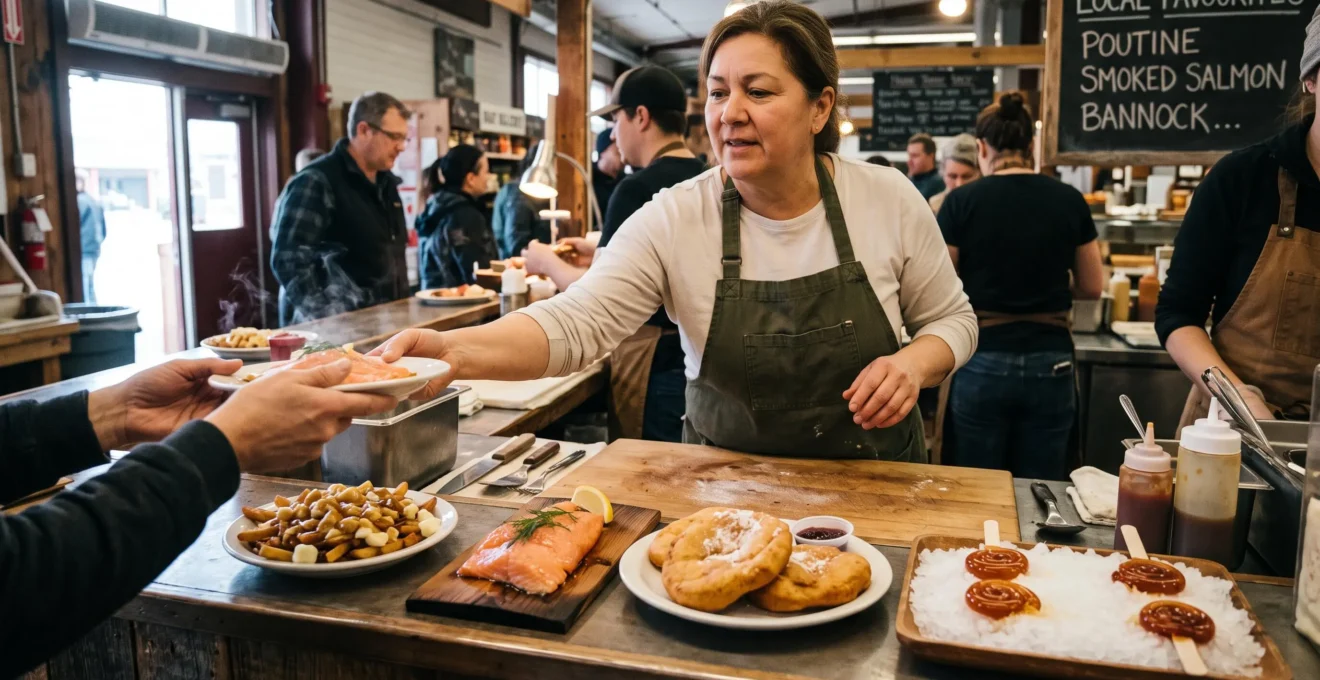
Ask ten Canadians to name their country’s defining food, and the conversation might move from Quebec poutine to Atlantic lobster, Prairie perogies, Pacific salmon and Arctic char. None of these answers is necessarily wrong. Each reflects a different part of a country whose food traditions developed across distinct landscapes, communities and histories.
Canadian food is not simply a collection of maple-flavoured souvenirs or dishes invented within modern national borders. It includes the diverse foodways of First Nations, Inuit and Métis peoples, regional culinary traditions shaped by settlement and agriculture, and foods introduced or adapted by immigrant communities.
For visitors and newcomers, the most useful approach is geographical and cultural rather than encyclopedic. Understanding what people eat in a particular place, why the ingredients matter, and how the dish became part of local life provides a clearer picture than searching for one definitive national meal.
The result is a more rewarding way to explore Canada: follow the food stories, not just the familiar symbols.
Canadian food at a glance
- Canadian cuisine is best understood through Indigenous food traditions, regional specialties and immigrant-influenced cooking rather than a single national dish.
- A varied food sampler should cover different ingredients, cooking traditions and local communities instead of repeating famous Canadian foods.
- Seasonality matters: maple production, seafood fisheries, fruit harvests and other regional food experiences follow different calendars.
- Why Doesn’t Canada Have One Clear National Cuisine Like Italy or Japan?
- How to Build a 7-Stop “Canadian Food” Sampler Without Eating the Same Thing Twice?
- What Represents Canadian Food Better: Regional Dishes, Indigenous Ingredients, or Immigrant Classics?
- The Cliché Mistake That Makes Visitors Miss What Canadians Actually Eat
- When Should You Plan a Canada Trip Around Food So Seasonal Highlights Are Actually Available?
- How to Build a Province-By-Province Regional Food Checklist in Canada in 30 Minutes?
- How to Turn the 7-Stop Sampler Into a Real Route Without Repeating Any Dish?
- How to Spot Real Regional Specialties in Canada When Every Menu Says “Local”?
Why Doesn’t Canada Have One Clear National Cuisine Like Italy or Japan?
Canada does not have one universally accepted national cuisine because its food culture developed through overlapping Indigenous traditions, regional histories and immigration. Its geography also produces very different ingredients and agricultural conditions. Rather than lacking culinary identity, Canada has multiple identities that become clearer when food is explored region by region.
Even countries associated with recognizable national foods contain substantial regional variation. Italy is much more than pasta, and Japan is much more than sushi. Canada’s difference is that its international culinary image has never become as closely associated with one widely recognized family of dishes.
Three historical layers help explain the complexity:
- Indigenous food traditions: First Nations, Inuit and Métis communities maintain diverse relationships with land, waters, harvesting, preparation and food sharing. These traditions cannot be reduced to one Indigenous cuisine.
- Regional settlement histories: French, British and other settlement patterns influenced farming, baking, preservation and everyday dishes, interacting with existing Indigenous knowledge and environments.
- Immigration and adaptation: Communities arriving from different parts of the world introduced and adapted dishes that became embedded in Canadian cities and regions.
Geography makes these differences especially visible. The Government of Canada‘s overview of Canadian regions identifies five broad geographical regions and describes their differing climates, agricultural resources and economic activities.
Atlantic coastal fisheries, Prairie grain production, Ontario fruit-growing areas and the distinct environments of northern Canada all contribute to different local food possibilities. Geography does not make a shared national cuisine impossible, but it helps explain why one menu cannot represent every region equally.
There is also a historical question about whose food receives national recognition. Indigenous foodways predate Canada as a modern state, yet familiar public narratives often foreground settler-era dishes and commercial symbols. Understanding Canada’s culinary identity requires making room for Indigenous perspectives without treating them as interchangeable or merely historical.
That perspective turns an apparently confusing national cuisine into a practical travel question: which different food traditions can a visitor experience along a particular route?
How to Build a 7-Stop “Canadian Food” Sampler Without Eating the Same Thing Twice?
Build a seven-stop Canadian food sampler by choosing seven distinct food families rather than seven famous dishes. Give every stop one regional anchor, such as a Halifax donair or Quebec poutine, and avoid repeating the same primary ingredient or preparation style. The stops can represent either geographical destinations or food experiences within fewer cities.
A useful framework includes seafood, game or land-based foods, grain-based cooking, maple products, immigrant-influenced street food, Indigenous-led cuisine, and regional sweets or baked goods.
The following is an illustrative cross-country sampler, not a prescribed travel itinerary. Each experience introduces a different culinary perspective.
| Food stop | Suggested anchor | Distinct experience |
|---|---|---|
| Halifax, Nova Scotia | Halifax donair | Regional street food shaped by adaptation |
| Quebec | Poutine | Fries, cheese curds and gravy |
| Ontario | Butter tart | Regional baking and sweets |
| Prairie provinces | Perogies | Ukrainian-influenced filled-dough cooking |
| Prairie or northern destination | Bison dish, where responsibly sourced and available | Game-based or land-based cooking |
| British Columbia | Locally sourced salmon | Pacific seafood traditions |
| Indigenous-led food experience | A community-specific traditional dish | Food interpreted through Indigenous knowledge and cultural context |
Halifax offers a particularly clear example of local identity. Tourism Nova Scotia‘s Halifax destination page identifies the donair as the city’s official food. The local version typically combines spiced beef, pita, onion, tomato and a sweet garlic sauce.
Its cultural significance comes not from being a universal Canadian meal, but from its particular association with Halifax.
Apply an anti-repetition rule before confirming each stop. If two experiences emphasize similar seafood preparations, replace one with a grain-based dish, a regional dessert or a different food tradition. A menu’s geographical label alone does not guarantee variety.
Travellers visiting only Toronto, Montreal or Vancouver can adapt the same approach. Instead of seeking seven provinces, find seven contrasting experiences through neighbourhood restaurants, markets, bakeries and Indigenous-owned food businesses where available.
The result will not reproduce the entire country, and it should not pretend to. A city-based sampler illustrates Canada’s culinary diversity while acknowledging that each region’s own food culture is more complex.
Avoid tourist platters that combine disconnected specialties and present them as one timeless national meal. The sampler works best when each dish is encountered in a setting that explains something about its local or cultural meaning.
Once the food families are selected, the next decision is whose stories each meal represents: regional communities, Indigenous peoples, or Canada’s evolving immigrant food cultures.
What Represents Canadian Food Better: Regional Dishes, Indigenous Ingredients, or Immigrant Classics?
Regional dishes, Indigenous food traditions and immigrant-influenced classics all represent Canadian food, but they answer different questions. Regional specialties reveal local preferences; Indigenous foodways connect food with longstanding relationships to particular lands and waters; immigrant cuisines illustrate how communities have shaped contemporary Canada. A balanced understanding includes all three rather than ranking them as competing definitions.
This is more than a question of which dish tastes most distinctive. The categories tell different kinds of stories, and they sometimes overlap.
| Perspective | What it reveals | Best travel approach |
|---|---|---|
| Regional specialties | Food closely associated with a place | Try a dish where it has a strong local following |
| Indigenous foodways | Community-specific food knowledge and relationships with land | Seek Indigenous-led experiences and follow community guidance |
| Immigrant-influenced classics | How migration and adaptation shape Canadian food culture | Explore neighbourhoods, local businesses and regional adaptations |
Indigenous cuisine requires particular care. First Nations, Inuit and Métis food traditions differ across territories and communities, and ingredients cannot be assigned a single cultural meaning across the country.
Health Canada‘s dietary guidance on traditional foods identifies foods including salmon, Arctic char, wild game and shellfish as examples associated with Indigenous food traditions. The examples demonstrate diversity, not an exhaustive list or a universal Indigenous menu.
Contemporary bannock is also worth approaching carefully. Although it appears in many Indigenous food contexts today, recipes and histories differ, and the familiar wheat-flour form should not automatically be described as a pre-contact food.
For travellers who want deeper cultural understanding, an Indigenous-owned restaurant or community-led food experience can offer valuable context. However, ownership, cultural representation and access should be verified rather than assumed from a menu’s use of Indigenous ingredients.
Immigrant food traditions are equally integral to everyday Canadian eating. Prairie perogies, Halifax donairs and regional Chinese-Canadian dishes demonstrate how food changes when people establish communities in new places.
Famous specialties such as poutine, butter tarts and Nanaimo bars also have specific regional histories. Their recognizability should not be confused with proof that they are Canada’s oldest or most representative foods.
Choose based on the question you want your meal to answer: local identity, cultural continuity, or the evolution of Canadian communities.
That broader definition also reveals why relying on a handful of familiar Canadian food clichés causes visitors to overlook much of the country’s actual eating culture.
The Cliché Mistake That Makes Visitors Miss What Canadians Actually Eat
The most common mistake is treating poutine and maple syrup as a complete description of Canadian cuisine. Both matter, but neither explains the range of foods Canadians eat in different communities. Visitors who repeatedly order nationally recognizable specialties may miss regional favourites, neighbourhood food cultures and ordinary meals that reveal how people actually live.
Poutine is strongly associated with Quebec, while maple products carry particular significance in eastern Canadian food culture. Their national recognition does not mean they have identical cultural importance everywhere.
Imagine a visitor who orders poutine in Vancouver, Toronto and Halifax. They may enjoy three different versions, but the experience reveals more about the spread of a popular dish than about what distinguishes each city.
Everyday eating provides another perspective. Coffee-shop routines, diner breakfasts, farmers’ markets, neighbourhood bakeries, takeaway meals and home cooking all contribute to Canadian food culture. These practices are not uniform, and no one chain or dish can speak for all Canadians.
A visitor might encounter Quebec tourtière, butter chicken served with rice, locally baked bread, or Chinese-Canadian restaurant dishes. The meaning of each meal depends on the community and setting, not simply on whether it carries a Canadian label.
The essential distinction is between a national symbol and a local habit. A food can be nationally marketed without being especially characteristic of the province where it is purchased.
Before ordering, ask two questions:
- Does this dish have a particular history or following in the place I am visiting?
- Would residents recommend it as something associated with their community, or is it mainly promoted as a Canadian-themed item?
Neither question requires rejecting popular chains or familiar foods. A chain restaurant can still reflect an important part of everyday life. It simply serves a different purpose from seeking a region-specific specialty.
Similarly, a classic food served outside its region of origin is not necessarily inferior. It just tells a different story from the one a traveller might have expected.
Once that distinction is clear, timing becomes another important factor: even genuinely local dishes may not be equally available or prepared the same way throughout the year.
When Should You Plan a Canada Trip Around Food So Seasonal Highlights Are Actually Available?
Plan a Canadian food trip around the ingredient or experience that matters most, not around a single nationwide food season. Quebec maple production generally centres on late winter and early spring, while regional fruit harvests, salmon fisheries and Atlantic lobster seasons follow different schedules. Availability varies by location, weather, regulations and supplier, so confirm local conditions before travelling.
Canada’s geography creates substantial seasonal differences. A spring food trip in Quebec may emphasize sugar-shack experiences, while a summer visit elsewhere could focus on berries, markets or coastal seafood. Autumn can bring regional harvest foods, orchard produce and preserved preparations.
The following calendar is a broad planning guide rather than a guarantee of fresh ingredients at a particular restaurant.
| Period | Potential food focus | Planning caution |
|---|---|---|
| Late winter to early spring | Quebec maple production and sugar-shack experiences | Sap flow depends on weather and local conditions |
| Spring to summer | Lobster in selected Atlantic fishing areas | Fishing seasons differ by area |
| Summer | Regional berries, fresh produce and farmers’ markets | Harvest timing changes by crop and latitude |
| Summer to autumn | Selected Pacific salmon seasons and regional harvest events | Fishing access and supply can vary by species and location |
| Autumn | Orchard fruit, Prairie harvest foods and seasonal dishes | Not every game ingredient is locally harvested or seasonally available |
| Winter | Preserved foods, stored crops and winter culinary traditions | Local fresh produce may be more limited |
Maple season is a particularly recognizable example of the difference between a product and its seasonal experience. Maple syrup can be purchased throughout the year, but visiting a working sugarbush during sap collection is a time-dependent activity.
The distinction matters because a shop selling a product does not establish that the ingredient is currently being harvested nearby.
Lobster shows why regional checking is essential. Fisheries and Oceans Canada‘s 2026 lobster fishing schedule lists different anticipated seasons for specific Nova Scotia fishing areas. Area 32 was scheduled from April 9 to June 10, while Area 27 was scheduled from May 8 to July 8.
Those dates concerned particular commercial fisheries in 2026, were subject to change, and do not establish restaurant availability or apply to all Atlantic lobster-producing regions.
For an off-season visit, consider traditional preserved formats, seasonal menus, markets or food events. Smoking, drying, canning and freezing can preserve distinctive ingredients without making the resulting food culturally or gastronomically meaningless.
Late autumn and early spring can be challenging for travellers expecting abundant fresh summer produce. Rather than relying on a generic Canadian food calendar, identify one priority experience and check its current availability before building the itinerary.
With seasonality accounted for, the next practical step is choosing which provincial and territorial specialties deserve a place on a realistic travel checklist.
How to Build a Province-By-Province Regional Food Checklist in Canada in 30 Minutes?
Create a regional Canadian food checklist by matching your travel destinations with three categories: one distinctive dish, one locally relevant ingredient, and one drink or sweet. Remove unnecessary duplicates, check which foods are associated with each place, and identify one priority item per destination. Thirty minutes is enough to produce a useful planning shortlist, though not to verify every restaurant or seasonal supplier.
Begin with the provinces and territories actually included in your journey. There is little value in researching distant specialties if your route covers only Ontario and Quebec.
Use the suggestions below as a starting pool rather than treating each food as exclusive to one region. Some have multiple regional associations, while others represent broader traditions shared across provincial boundaries.
| Destination | Dish or food tradition | Ingredient, sweet or drink to explore |
|---|---|---|
| Newfoundland and Labrador | Jiggs dinner | Bakeapple berries |
| Prince Edward Island | Island seafood preparations | Potatoes |
| Nova Scotia | Halifax donair or Acadian rappie pie | Apples or regional seafood |
| New Brunswick | Acadian poutine râpée | Regional seafood |
| Quebec | Poutine or tourtière | Maple products |
| Ontario | Peameal bacon sandwich | Butter tarts or Niagara-area fruit |
| Manitoba | Regional perogy dishes | Wild rice |
| Saskatchewan | Ukrainian-influenced Prairie cooking | Saskatoon berries |
| Alberta | Regional beef or bison dishes | Prairie grains |
| British Columbia | Pacific salmon preparations | Nanaimo bars or regional fruit |
| Yukon | Community-specific northern food traditions | Wild berries |
| Northwest Territories | Local fish or land-based foods where offered | Northern berries |
| Nunavut | Inuit food traditions, explored through community-led experiences | Arctic char |
These pairings are exploratory suggestions. A named food may be historically associated with a region without being easy to find on contemporary restaurant menus, and Indigenous ingredients should not be treated as freely interchangeable commercial attractions.
Separate geographical association from proven origin. A food being popular in a province does not establish that it was invented there. For trip planning, local recognition and availability are often more actionable than an uncertain origin claim.
Build your Canadian food checklist in five actions
- Map the route: Write down every province and territory you will visit. Deliverable: a destination list matched to your itinerary.
- Choose three candidates per destination: Add one dish, one ingredient and one sweet or drink. Deliverable: three labelled food entries per destination.
- Remove unnecessary repetition: Compare ingredients and food families, keeping variety where possible. Deliverable: a shortlist without avoidable duplicates.
- Identify one priority experience: Mark the food that best represents what you want to learn about each stop. Deliverable: one must-try item per destination.
- Check access and seasonality: Verify menus, market dates, sourcing claims or community-led booking requirements. Deliverable: a checklist with an availability status for each priority item.
A two-province trip may reasonably include six or seven food experiences across both destinations. A journey covering much of Canada benefits from stricter priorities so that meals remain enjoyable rather than becoming a competitive checklist.
After choosing your foods, the remaining task is arranging them in an order that creates variety without turning the itinerary into an expensive series of unnecessary detours.
How to Turn the 7-Stop Sampler Into a Real Route Without Repeating Any Dish?
Turn the seven-stop sampler into a route by arranging food experiences around destinations you already intend to visit. Give each stop a distinct food family, primary ingredient and culinary approach, then check that consecutive meals do not feel repetitive. A cross-country route creates geographical contrast, but a shorter multi-city itinerary can demonstrate similar diversity.
Start with travel practicality. Seven food experiences do not need to mean seven provinces, and seven provinces do not automatically guarantee seven different culinary traditions.
For a hypothetical longer journey, an east-to-west progression might look like this:
- Halifax: donair as a regional street-food specialty.
- Quebec: poutine as a familiar but geographically rooted dish.
- Ontario: butter tart as a regional baked sweet.
- Prairie region: perogies as an immigrant-influenced grain-based meal.
- Another Prairie stop: a responsibly sourced bison preparation, where available.
- British Columbia: a locally sourced salmon dish.
- An Indigenous-led experience: a community-specific preparation chosen with cultural context and appropriate access.
This is a conceptual food sequence, not an optimized road or flight itinerary. The final experience must be located and booked according to the actual travel route, rather than assuming it exists in every city.
For a shorter trip, a hypothetical five-city variation could use Halifax, Montreal, Toronto, Calgary and Vancouver, adding different food experiences within cities to reach seven categories.
The shorter approach usually sacrifices some geographical depth. Northern foods, community-specific Indigenous traditions and smaller regional specialties can be overlooked when the route relies primarily on major urban centres. These omissions should be acknowledged rather than hidden behind a claim to have tasted all of Canada.
Use three no-repeat tests:
- Primary ingredient: Avoid making consecutive stops about the same main protein or ingredient.
- Cooking tradition: Contrast methods such as baking, grilling, braising, smoking or assembling street food.
- Food family: Alternate seafood, savoury dishes, sweets, grains and culturally specific experiences.
These are useful planning constraints, not strict definitions of culinary identity. A single traditional meal can involve several ingredients and preparation methods, so classify it according to the aspect you most want to experience.
For example, if one meal already emphasizes salmon and the following stop features lobster, insert a bakery or grain-based experience between them when the route allows. That makes the sequence more varied without rejecting either seafood tradition.
Once the route offers genuinely different experiences, the final challenge is evaluating restaurants and markets that describe their menus as local without always explaining what that word means.
Key takeaways before choosing where to eat
- A regional food label is most useful when it identifies a meaningful connection to a place, not just a national culinary theme.
- Local sourcing, local recipe history and local popularity are different claims that should be evaluated separately.
- Markets, community food events and knowledgeable vendors can provide context that a tourist-oriented menu leaves out.
How to Spot Real Regional Specialties in Canada When Every Menu Says “Local”?
Spot genuine regional specialties by looking beyond the word “local” on a menu. Check whether the food has a recognized regional name, appears in ordinary community food settings, uses ingredients appropriate to the area and season, and has a history staff can explain. Several consistent signals are more persuasive than a single marketing claim.
Restaurant menus can use “local” in different ways. A dish may contain locally sourced ingredients, follow a locally established recipe, or simply be promoted to appeal to visitors. These distinctions matter because they describe different forms of regional connection.
Consider a hypothetical restaurant selling a “Canadian lobster poutine.” The dish might be enjoyable and may even contain regional lobster. But the name alone does not establish that this particular combination is an established local specialty.
Contrast that with a seafood vendor who identifies the fishing area, explains the type of preparation and can discuss seasonal supply. The second experience offers more information that a traveller can assess, although its claims should still be evaluated rather than automatically accepted.
Use five signals to judge whether a food has a meaningful regional connection:
- Recognizable local name: Residents use the name naturally, rather than only as part of promotional wording.
- Everyday presence: The food appears in neighbourhood shops, markets, community gatherings or longstanding local food settings.
- Explainable background: Staff can describe its regional connection, preparation or sourcing with reasonable specificity.
- Seasonal consistency: Fresh-ingredient claims align with the region and time of year, or preservation methods are openly explained.
- Local variation: Different establishments make recognizable variations instead of reproducing one generic tourist product.
None of these signals proves authenticity by itself. A recently created dish can become a meaningful regional food, while a long-established food may be less commercially visible. Some Indigenous food practices also operate outside the assumptions of restaurant marketing and should be understood through community-specific knowledge.
Farmers’ markets, roadside stands, regional bakeries, community suppers and seasonal festivals can be useful places to investigate these connections. They provide opportunities to ask direct questions about production, ingredients and local food customs.
They are not automatically cheaper or more authentic than restaurants. Prices, quality and cultural significance depend on the individual business and experience. A city restaurant that works closely with local producers can provide excellent regional food, while a roadside sign may offer very little reliable information.
For the strongest judgement, distinguish three questions: Was this dish developed or traditionally prepared here? Are its ingredients sourced here? Do people in the area meaningfully recognize and eat it? A meal can satisfy one, two or all three without losing its value.
On your next Canadian food stop, choose one unfamiliar regional dish, ask where its ingredients or recipe come from, and compare what you learn with the place around you. That small habit can reveal more about Canadian cuisine than repeatedly searching for one perfect national dish.
Is there an official national dish of Canada?
Canada has widely recognized foods, including poutine, but there is no single universally accepted national dish that fully represents the country. Different regions and communities identify with different culinary traditions.
Can vegetarian travellers explore Canadian regional food?
Yes. Regional baked goods, berries, maple products, grains, produce and suitably prepared dishes provide many possibilities. Travellers should check ingredients individually because familiar foods such as poutine, perogies and baked specialties may contain meat products, animal-derived fats or other ingredients that affect dietary suitability.
Do you need to travel across Canada to understand its food culture?
No. A major city can offer access to several culinary traditions through markets, neighbourhood restaurants and cultural food businesses. However, tasting a regional dish outside its home region is not identical to experiencing its local setting, producers and community history.
Does locally sourced food always mean a traditional Canadian dish?
No. Local sourcing describes where ingredients come from, while culinary tradition concerns preparation, history and cultural meaning. A restaurant can use Canadian-grown ingredients in a dish originating elsewhere, and a traditional regional recipe may incorporate ingredients from outside the region.
How can visitors explore Indigenous food traditions respectfully?
Look for Indigenous-owned businesses, Indigenous-led culinary events and community-authorized cultural experiences. Recognize that First Nations, Inuit and Métis traditions differ, respect access restrictions, and avoid assuming a single ingredient or recipe represents all Indigenous peoples in Canada.