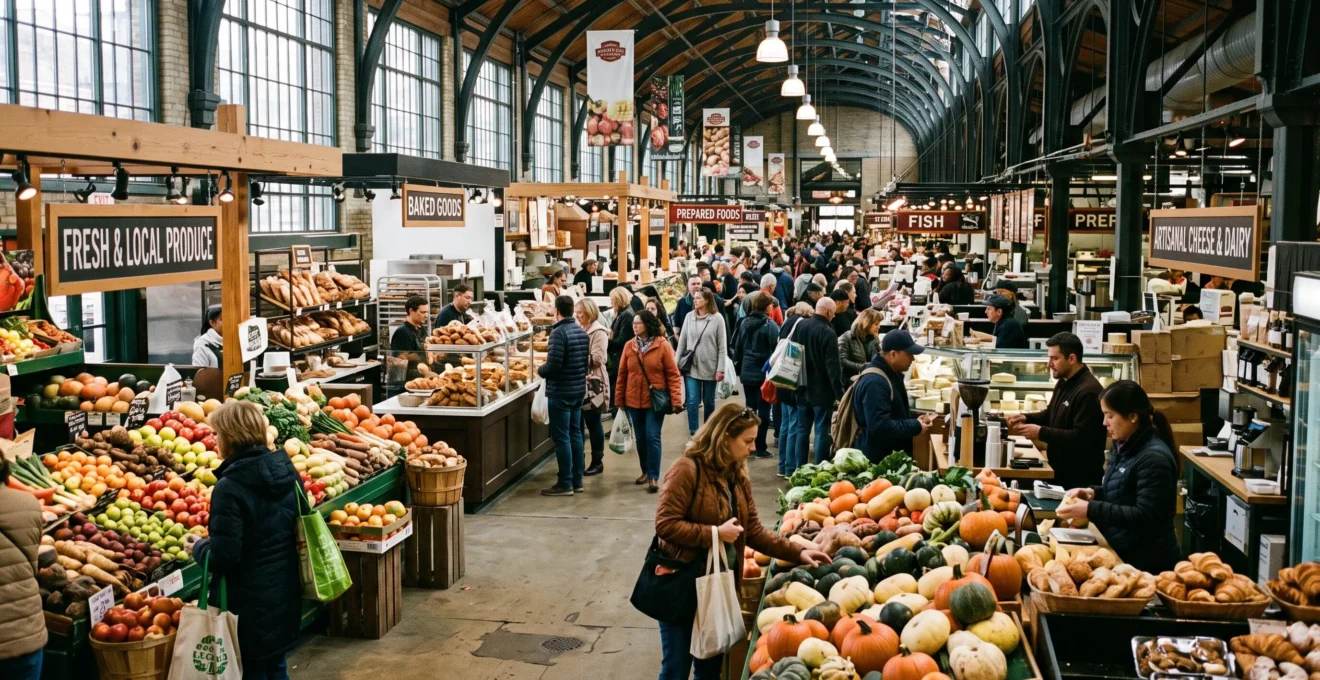
A Canadian public market can introduce you to a city faster than a packed sightseeing schedule. Fresh produce, regional specialties, family-run food businesses and conversations between neighbours all share the same space. But that abundance creates a problem: every stall looks interesting, prices are difficult to compare, and a quick visit can turn into an expensive afternoon carrying food you cannot finish.
The solution is to treat the market as a place to explore before treating it as a place to shop. Start with a short observation loop, decide what you actually want to eat, and choose a spending limit in Canadian dollars before purchasing anything.
Whether you are discovering Toronto’s St. Lawrence Market, exploring Vancouver’s Granville Island or visiting a seasonal neighbourhood farmers market, the same approach helps you experience local food culture without rushing or accumulating unnecessary purchases. A market visit becomes more rewarding when curiosity, rather than the number of things bought, determines its success.
Canadian public markets: the essentials
- Walk through the market before buying. Compare products, prices, vendors and the overall atmosphere.
- Use a flexible 45-minute visit plan and set a spending limit in CAD based on what you can realistically consume or carry.
- Choose markets according to your interests, the season and opening schedules—not simply their popularity with tourists.
- Why Do Public Markets Reveal More About a Canadian City Than Trendy Restaurants ?
- How to Do a 45-Minute Public Market Loop in Canada Without Blowing Your Budget ?
- Which Is Better in Canada: a Famous Public Market or a Small Neighbourhood Market ?
- The Market Overbuying Mistake That Wastes Food and Money on Canadian Trips
- When Should You Visit Canadian Public Markets for the Best Selection Without the Weekend Crush ?
- How to Plan a 4-Hour Neighbourhood Food Walk in Toronto or Vancouver Without a Car ?
- How to Scan a Market in Canada in 10 Minutes Before You Buy Anything ?
- How to Explore Multicultural Canadian Cities Without Defaulting to Downtown
Why Do Public Markets Reveal More About a Canadian City Than Trendy Restaurants ?
Canadian public markets can reveal aspects of a city’s everyday food culture that a trendy restaurant cannot show in one sitting. Markets bring different ingredients, food traditions, vendors and shopping habits into a shared setting. Observing what people buy, asking about products and noticing how stalls serve customers can offer a useful introduction to local life.
A restaurant presents one business’s interpretation of food, often shaped by its menu, atmosphere and target customers. A public market offers several perspectives at once. Fresh fish might sit alongside baked goods, imported spices, locally grown vegetables and prepared dishes inspired by different culinary traditions.
Toronto’s St. Lawrence Market illustrates this variety. According to the City of Toronto‘s City of Toronto’s St. Lawrence Market District information, the South Market contains more than 60 specialty vendors offering categories including produce, meat, fish, baked goods and dairy products. This describes the breadth of its food offering, not the demographic composition of its visitors.
Direct conversations with vendors can be particularly informative. When a producer or knowledgeable seller is available, ask which products are currently in season, where they come from and how local customers typically prepare them. Not every vendor is the original producer, so the distinction is worth checking.
To understand a market as a window into a neighbourhood, pay attention to three things:
- Shopping behaviour: Are people purchasing groceries for several meals or choosing individual snacks and souvenirs?
- Product mix: Which ingredients appear repeatedly, and which are identified as local, regional or imported?
- Everyday interactions: What languages, questions and conversations can you hear without intruding on anyone’s privacy?
These observations provide clues rather than reliable demographic evidence. A busy tourist market is not a representative sample of a city’s population, and a product’s presence does not prove that everyone in the surrounding community regularly eats it.
Granville Island in Vancouver is a useful example of a destination serving both food shoppers and visitors. Its indoor market includes produce, food businesses and artisan offerings. That combination makes it attractive for exploration, but the tourist experience should not automatically be mistaken for a complete picture of residential shopping habits.
Signs of a market oriented toward everyday customers might include practical grocery quantities, repeat customer interactions and sellers answering routine questions about ingredients. Souvenir-focused displays and people carrying single takeaway meals suggest a different shopping purpose. Neither type is inherently better.
The richest cultural insight often comes from a short conversation about an unfamiliar ingredient, not from buying the most photogenic product. Once you know what to observe, the next challenge is using your time effectively.
How to Do a 45-Minute Public Market Loop in Canada Without Blowing Your Budget ?
A 45-minute Canadian public market visit works best as a flexible three-pass loop: observe first, shortlist appealing vendors second, and purchase only after comparing your options. Give yourself roughly 10 minutes to scan, 20 minutes to explore selected stalls and 15 minutes to buy or eat. Adjust the schedule for market size, crowds and your priorities.
Forty-five minutes is a planning example, not a recommended duration established by market operators. A large destination such as St. Lawrence Market or the broader ByWard Market district can demand significantly more time if you intend to browse multiple areas or stop for a meal.
Before entering, decide on your main purpose. A market visit focused on one snack requires a different budget from one intended to replace lunch or purchase food souvenirs.
- First pass: explore without spending. Locate produce stalls, prepared-food counters, bakeries, washrooms and entrances. Check posted prices and identify anything worth revisiting.
- Second pass: compare a shortlist. Return to two or three promising vendors. Compare serving sizes, ingredients, quality and whether a product requires refrigeration or preparation.
- Third pass: purchase deliberately. Choose the items that fit your meal plan and available cash or payment method. Avoid another complete circuit unless there is something specific you still need.
Consider a hypothetical traveller with a CAD $25 market budget. They could reserve CAD $15 for a substantial prepared meal, CAD $6 for a snack and CAD $4 as an unspent buffer. These are illustrative spending allocations, not verified Canadian market prices. Actual costs depend on the city, vendor and products selected.
Prepared dishes may cost more than raw ingredients because preparation and service are included, but the comparison needs to account for portion size and the facilities available to a traveller. A large bag of inexpensive raw produce is not necessarily a bargain if you have nowhere to wash, cook or store it.
Some vendors offer samples, but sampling is neither universal nor an entitlement. Ask politely before tasting. Likewise, do not assume that stalls near a main entrance charge more than those farther inside; compare displayed prices instead of relying on location.
Smaller outdoor farmers markets may require only a brief circuit. On an active harvest-season day, the same market could justify more time for conversations with producers or a community event. The right duration follows the actual experience.
A budget-conscious visit should leave room for curiosity, but not for purchases made purely because time is running out. Choosing the right kind of market makes that balance easier.
Which Is Better in Canada: a Famous Public Market or a Small Neighbourhood Market ?
Choose a famous Canadian public market when you want a broad food selection, recognizable landmarks and multiple eating options in one destination. Choose a neighbourhood market when you want a more focused experience with local producers or community food businesses. Neither is automatically cheaper or more authentic; the best choice depends on your interests and schedule.
Large destinations can simplify a first visit. Toronto’s St. Lawrence Market offers numerous specialty food vendors, while Vancouver’s Granville Island Public Market combines food retail with artisan products. These settings can introduce travellers to several types of food shopping without requiring multiple journeys across the city.
Smaller neighbourhood markets have a different appeal. They may operate as regular gathering places for residents or provide access to farmers, seafood harvesters and small-scale food producers. The City of Vancouver specifically recognizes farmers markets and community food markets as distinct formats, each contributing to local food access and neighbourhood connections.
A smaller market is not necessarily inexpensive. Directly marketed, specialty or small-scale products can cost more than comparable goods elsewhere, and vendors may serve a different customer base from large grocery retailers.
The following comparison is a practical decision guide, not a measured ranking of Canadian markets.
| Consideration | Famous public market | Neighbourhood market |
|---|---|---|
| Food variety | Often broad, with multiple specialties and prepared-food options | Depends on the participating vendors and season |
| Local interaction | Possible, although vendors may handle many visitors | May offer opportunities for conversations with recurring community sellers |
| Budget | Compare prices and portions across stalls | Do not assume prices are lower |
| Opening schedule | Some operate multiple days or year-round | Some operate only on specific days or seasonally |
| Best suited to | First-time visitors seeking variety and convenience | Curious travellers interested in neighbourhood routines and producers |
A practical compromise is to visit one well-known market early in your stay, then choose a neighbourhood market later. The first helps you recognize foods, vendors and typical product categories. The second gives you another perspective on how a particular community shops and gathers.
One important distinction is between a market that sells groceries to local households and a destination whose commercial activity centres on visitors. Both may contain excellent food businesses. Rather than assigning an authenticity score, look for the type of interaction you personally want.
Also consider the opening calendar. A famous indoor market might offer more opportunities to visit, while a neighbourhood farmers market could operate for only part of the week. Weekend crowds and seasonal cancellations can affect either option.
Visiting two contrasting markets can provide a broader perspective than attempting to see every famous one. It also reduces the temptation to treat each stop as another mandatory shopping opportunity.
The Market Overbuying Mistake That Wastes Food and Money on Canadian Trips
The biggest market-shopping mistake for travellers is buying food as though they were stocking their own kitchen. A tempting selection of fresh produce, pastries and prepared dishes can quickly exceed what you can eat or store. Without refrigeration, cooking equipment or several days to use leftovers, even apparently good-value purchases can become expensive waste.
Travel changes the consequences of ordinary grocery decisions. At home, extra vegetables can become tomorrow’s dinner and leftover bread can be stored. In a hotel room with no cooking facilities, those options may disappear.
Markets also encourage several psychological triggers. Attractive displays make products feel immediately desirable. Limited seasonal availability can create fear of missing out. Shopping with friends may encourage everyone to buy something simply because other people are doing so.
Separate curiosity from a purchase decision. You can appreciate how something looks, ask how it is made or photograph a display with permission without taking the product back to your accommodation.
Before buying, divide potential purchases into two categories: food you will consume today and food you can safely transport or store. Then compare each item with your available budget and travel arrangements.
Your five-step market buying checklist
- Write down your budget. Record one maximum amount in CAD before entering the market.
- List your food needs. Identify the meals or snacks the purchase will actually replace and create a short shopping list.
- Check your storage options. Record whether you have access to refrigeration, cooking equipment or suitable food containers.
- Compare your shortlisted vendors. Note at least two available options and their posted prices before making a discretionary purchase.
- Complete a final purchase check. Review your planned items against your remaining budget, consumption schedule and transport constraints.
Food souvenirs require additional consideration. Shelf-stable packaged products may be easier to carry than fresh or refrigerated foods, but packaging alone does not guarantee that an item can legally cross an international border.
The Canadian Food Inspection Agency‘s Canadian Food Inspection Agency’s food import requirements for travellers explain that requirements for bringing food into Canada depend on the product and its origin. Travellers entering Canada must declare the food they bring, and applicable restrictions and quantity limits vary.
These federal import rules should not be assumed to apply unchanged to travel between Canadian provinces. If you are leaving Canada, consult the destination country’s authorities for the relevant import rules. For domestic travel involving animal or plant products, check whether any specific movement restrictions apply to your route.
Even when a purchase is legally transportable, consider how long the journey will take and whether the food can remain safe at the required temperature.
The most economical market purchase is one you genuinely enjoy and fully use. Knowing when to visit can make those decisions more comfortable, especially when crowded aisles add pressure.
When Should You Visit Canadian Public Markets for the Best Selection Without the Weekend Crush ?
For a calmer Canadian market experience, consider a weekday morning when the market operates regularly. Arriving near opening may improve your chances of finding a broad selection of fresh products, while a mid-morning visit allows you to observe everyday activity. These are practical strategies, not guarantees: crowd patterns, vendor schedules and seasons vary by market.
Weekend mornings can attract people completing their regular food shopping as well as visitors exploring the city. Saturdays may feel especially busy at popular destinations, but there is no universal Canadian attendance pattern that applies to every market.
Your ideal arrival time should reflect your priority. If a specific seasonal ingredient matters most, an early visit may be sensible. If you want to observe neighbourhood life without rushing, a quieter weekday period may be more enjoyable.
Late visits can present different trade-offs. Some vendors may offer reductions on selected perishable goods toward closing, but discounts are never guaranteed. Stock may already be limited, and sellers may be focused on packing up rather than extended conversations.
Seasonality is just as important as the hour. Vancouver, for example, distinguishes between farmers markets and community food markets. The City of Vancouver‘s City of Vancouver’s information on food markets identifies farmers market operations from spring through fall as well as selected winter markets. Individual locations have their own schedules.
Indoor destinations can provide a more predictable option in cold or wet weather, but year-round operation should never be assumed without checking the specific market.
For Granville Island Public Market, the official Granville Island Public Market visitor information publishes general opening hours of 9 a.m. to 6 p.m., with specified holiday closures and January maintenance exceptions. Individual businesses may have different schedules. Confirm the current information shortly before visiting.
Before leaving your accommodation, check the market operator’s latest announcements and, where available, the participating vendors’ social media pages. This is especially useful outside the main growing season, when vendor participation and operating days may differ from a general market listing.
A well-timed visit is not necessarily the earliest or quietest possible visit. It is the one when the vendors and products you want are available, with enough space in your schedule to enjoy them. That principle also helps when combining a market with a neighbourhood food walk.
How to Plan a 4-Hour Neighbourhood Food Walk in Toronto or Vancouver Without a Car ?
A four-hour food walk in Toronto or Vancouver is easiest to organize around one public market and two or three nearby stops. Use the market as your starting point, then connect a café, community food shop or neighbourhood street using walking routes and public transit. Allow extra time for browsing, queues, weather and spontaneous discoveries.
The goal is not to visit as many food businesses as possible. It is to spend enough time in one neighbourhood to notice how its shops, streets and gathering places relate to one another.
In Toronto, St. Lawrence Market can serve as an anchor for exploring surrounding streets and nearby food businesses. Downtown streetcars and subway connections can support longer movements, although the most suitable route depends on your chosen starting point and current service.
In Vancouver, Granville Island can anchor an exploration of its surrounding waterfront and nearby urban areas. False Creek passenger ferries provide an additional transport option for some connections, while SkyTrain and buses can help travellers reach other neighbourhoods. Check current routes, accessibility and service before setting off.
Instead of building a rigid itinerary, use the following hypothetical time allocation. It is a planning model rather than an operator-recommended tour.
| Time allocation | Activity | Purpose |
|---|---|---|
| 45 minutes | Explore the public market | Observe vendors, compare products and make one planned purchase |
| 45 minutes | Walk through nearby streets | Notice local shops, businesses and public spaces |
| 60 minutes | Enjoy a meal or tasting stop | Experience food without rushing or buying excessive snacks |
| 45 minutes | Visit another neighbourhood stop | Explore a complementary food or cultural setting |
| 45 minutes | Transit, queues and flexibility | Handle delays, weather changes or an unexpected discovery |
These allocations total four hours, but the order can change. Consider starting with the market when fresh-food shopping matters or placing your main meal first if you expect to arrive hungry.
Build the route around geographic clusters. Two nearby stops with time for conversation often provide more useful experiences than five locations connected by lengthy journeys.
Weather deserves its own contingency plan. During rain or winter conditions, prioritize an indoor market, sheltered food businesses and short outdoor transfers. In Toronto, parts of the downtown indoor pedestrian network may be useful depending on your route. In Vancouver, choose sheltered destinations rather than assuming all waterfront connections are comfortable in poor weather.
Transit schedules, seasonal ferry operations, construction and accessibility conditions can change. Verify the journey before travelling rather than relying on an assumed fare or travel time.
Keeping the walk compact also reduces decision fatigue. The same principle applies inside the market, where a short observation routine can make dozens of choices easier to manage.
How to Scan a Market in Canada in 10 Minutes Before You Buy Anything ?
Scan a Canadian public market in 10 minutes by making three quick checks: understand the layout, identify promising vendors and compare visible signs of quality and value. Do not purchase anything during this first look. The scan helps you decide where to spend your time; the longer market loop is where you evaluate specific items and make purchases.
The purpose is to replace an overwhelming collection of stalls with a manageable mental map. A small outdoor market may be easy to scan in less than 10 minutes. A large multi-building district may require a preliminary scan of only the area you plan to visit.
Begin by identifying three broad zones: fresh ingredients, prepared food and artisan or specialty products. Not every market separates them clearly, but recognizing the types of vendors helps you navigate without repeatedly retracing your steps.
Next, notice where customers appear to be making routine purchases. A queue of people buying similar grocery items may indicate an established vendor or desirable product. However, queues are imperfect signals: they can also reflect slow service, a temporary promotion or tourist popularity.
Finally, look at product presentation and prices. Fresh produce that appears well maintained, clear product identification and visible pricing can make comparison easier. When price information is missing, ask before purchasing rather than treating the absence of a sign as an invitation to negotiate.
Signs of replenishment may indicate active stock turnover, but a full stall does not prove freshness. Similarly, a market containing many sellers does not automatically mean that every product is locally produced. Check origin labels or ask the vendor directly.
During the scan, consider three simple questions:
- Which stalls match the food or experience I came for?
- Where can I compare the price, size or origin of similar products?
- Which vendors deserve a longer conversation during the second pass?
Sampling opportunities can help with unfamiliar food, but they should be treated as optional and offered at the vendor’s discretion. A friendly conversation may be just as useful as a sample when evaluating something new.
The most common scanning mistake is stopping at the first attractive display. This establishes an emotional preference before you have seen the alternatives, making every later comparison harder.
Even when you eventually buy from the first stall, taking the initial tour means the decision has context.
Once you can read a market without feeling pressured to buy, that same observational approach can guide you through the surrounding neighbourhood.
Key takeaways before exploring beyond the market
- Choose one neighbourhood with food businesses and public spaces that interest you, rather than automatically heading to the most famous downtown attraction.
- Use the market as an entry point, then investigate the surrounding streets to understand the broader community context.
- Allow enough time for observation and conversation; a shorter itinerary explored carefully can be more informative than a rushed tour of several areas.
How to Explore Multicultural Canadian Cities Without Defaulting to Downtown
To explore multicultural Canadian cities beyond the usual downtown attractions, choose a neighbourhood with a distinctive mix of food businesses, community spaces and local shops. Start at a market or food-shopping street, then walk through the surrounding area. This approach connects what you eat with the people, businesses and everyday routines that shape the neighbourhood.
Central landmarks are natural starting points because they are visible, accessible and frequently recommended in travel guides. But they represent only part of urban life. Exploring neighbourhoods beyond the main tourist circuit can reveal different food traditions, commercial histories and community activities.
In Toronto, Kensington Market offers an example of a neighbourhood where independent food shops and varied culinary influences can form the basis of a walking exploration. Nearby Chinatown provides another setting in which to observe the relationship between food businesses, community services and streetscape.
In Vancouver, Commercial Drive offers a different type of neighbourhood food experience from a major destination market. The Punjabi Market area provides an additional perspective on the city’s South Asian cultural and commercial history. Do not assume that a neighbourhood’s historic name perfectly describes its current residents or businesses.
These places should not be reduced to fixed cultural labels. Neighbourhoods change, businesses move, and the residents of any area may have a wider range of backgrounds than its most recognizable storefronts suggest.
A useful exploration method begins with a food-related anchor and gradually broadens:
- Choose a market, food-shopping street or group of independent food businesses.
- Observe the products, services and languages visible in public commercial spaces without making assumptions about individuals.
- Continue into nearby streets to find community bookshops, cafés, public spaces or other independently operated businesses.
- Use conversations and locally published information to understand the history or present-day role of places that interest you.
- Return to your original route only after deciding whether the neighbourhood deserves more time.
There is also a practical trade-off. Adding a neighbourhood exploration to a half-day itinerary may mean skipping another major attraction. If the purpose of your trip is cultural understanding rather than landmark collection, that can be a worthwhile choice.
Depth matters more than the number of neighbourhoods visited. Spending several hours in one area provides opportunities to compare food shopping, social spaces and local businesses without constantly checking transport connections.
The market skills developed earlier transfer directly to this broader exploration. Scan the surroundings before selecting a restaurant, compare alternatives without rushing, and resist buying every interesting product you encounter.
Respect matters too. A multicultural neighbourhood is a place where people live and work, not a staged attraction. Ask permission before photographing individuals or private spaces, avoid interrupting businesses solely for content, and support local sellers when their products genuinely interest you.
For your next Canadian city visit, choose one market, establish a manageable food budget and leave time to walk beyond its entrances. The result is not necessarily more purchases or more stops, but a clearer understanding of the everyday urban culture you came to discover.
Do Canadian public markets usually accept credit or debit cards?
Payment methods vary by vendor and market. Do not assume every stall accepts the same cards or contactless payments. Check the market’s visitor information and ask vendors about accepted payment methods before ordering. Carrying an appropriate alternative can be useful, particularly at smaller temporary markets.
Can you visit a Canadian public market without buying anything?
Many public markets can be explored simply by browsing their publicly accessible areas during operating hours. You can observe products, compare prices and learn about food traditions without making a purchase. Respect any posted access rules and avoid occupying a vendor’s time unnecessarily during busy periods.
Are Canadian public markets suitable for travellers with dietary restrictions?
Market offerings vary widely, and individual vendors may provide ingredient information. If you have allergies, intolerances or other dietary requirements, ask about ingredients, preparation and potential cross-contact before purchasing. Never assume a food is suitable based on its appearance or a general product description.
What should you bring to a Canadian farmers market?
A reusable shopping bag, a weather-appropriate layer, your planned spending limit and a short list of food needs can make the visit easier. Bring suitable temperature-controlled storage if you plan to transport perishable food. For outdoor markets, check the forecast, location and operating schedule before leaving.
Can you bring food purchased at a Canadian market on an international flight?
That depends on the product, the destination and applicable transport and customs rules. Food permitted for purchase in Canada is not automatically permitted for import into another country. Consult your airline’s baggage requirements and the destination country’s food import authority before packing fresh produce, meat, dairy or other restricted products.