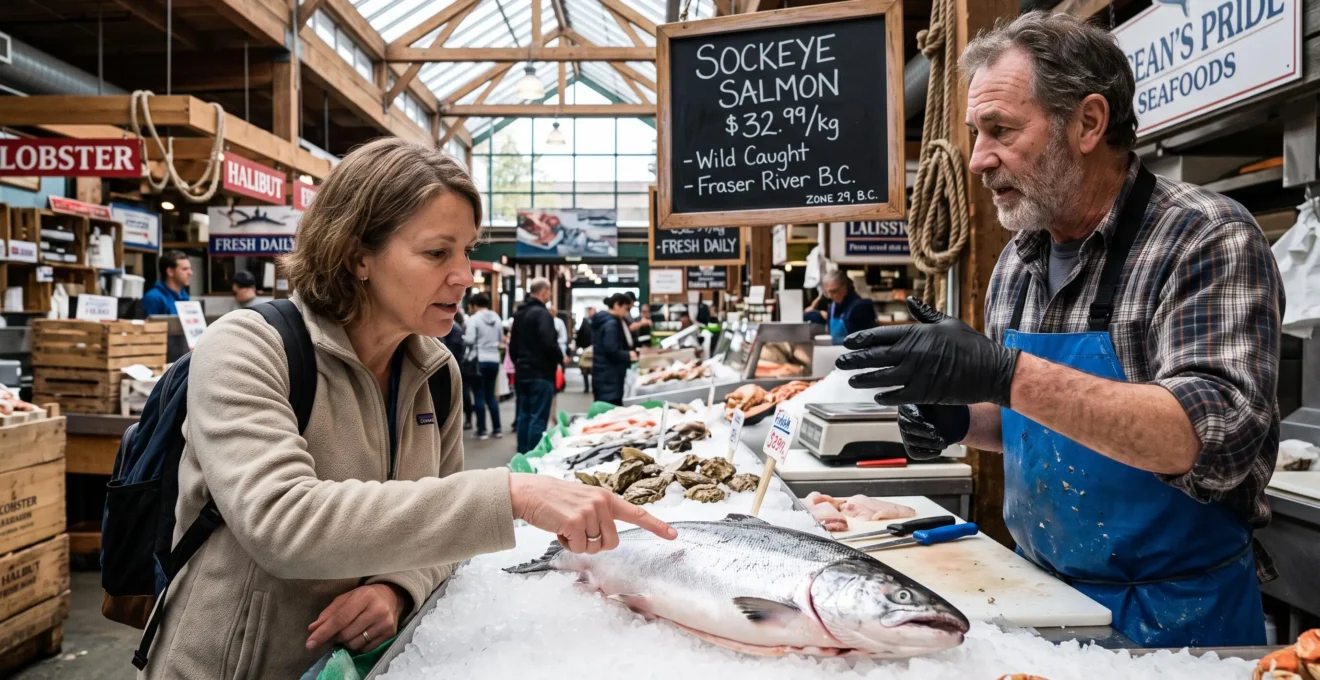
Wild salmon can be a worthwhile purchase in Canada, but the word “wild” alone does not justify a premium price. A carefully frozen sockeye fillet may deliver better eating quality than an expensive, poorly handled fresh-looking product. A cheaper pink salmon can be exactly right for fish cakes, while premium Chinook may be unnecessary for a heavily seasoned recipe.
The challenge is that Canadian seafood counters bring together different Pacific salmon species, farmed Atlantic salmon, previously frozen products and imported seafood. Similar-looking packages can represent very different fish, processing histories and culinary uses.
The most reliable buying decision starts with five questions: What species is it? Where was it harvested? Has it been frozen? Is its present condition good? What does the edible portion actually cost in Canadian dollars?
Those questions also help when ordering seafood in Vancouver, Halifax or other Canadian cities, where market reputation, tourist demand and menu presentation do not automatically translate into better value.
Wild salmon in Canada: the essential buying rules
- Pay for a clearly identified species and good handling, not simply a “wild” or “fresh” claim.
- Compare prices in CAD per kilogram and consider frozen, canned and less expensive species before choosing a premium fillet.
- Ask about harvest origin, freezing history and receiving date. Treat vague answers as reasons to investigate, not automatic proof of mislabelling.
- Why Does Wild Salmon Taste So Different in Canada Depending on the Species?
- How to Buy Wild Salmon in Canada Using a 60-Second Fish-Counter Checklist?
- Which Wild Salmon Format Makes Sense in Canada: Fresh, Frozen, Smoked, or Canned?
- The “Fresh Is Best” Mistake That Leads to Bad Salmon Purchases in Canada
- When Does Wild Salmon in Canada Offer the Best Value Without Compromising Quality?
- What Should You Order in Atlantic Canada: Lobster Roll, Whole Lobster, or Chowder?
- Which Is Better in Canada: a Famous Public Market or a Small Neighbourhood Market?
- How to Buy Fresh Lobster in Atlantic Canada Without Paying Tourist Prices in $CAD
Why Does Wild Salmon Taste So Different in Canada Depending on the Species?
Wild salmon tastes different across Canada because several distinct species are sold under the same broad seafood category. Chinook, sockeye, coho, pink and chum differ in their typical fat content, flesh colour, texture and flavour. Harvest timing and handling also matter. A higher price may reflect the species or availability rather than demonstrably better quality.
Canada’s Pacific salmon fisheries include five species identified in Fisheries and Oceans Canada’s northern Pacific salmon management plan. Knowing their names makes it easier to evaluate an offer without assuming that all wild Pacific salmon are interchangeable.
| Species | Typical eating characteristics | Practical cooking choice |
|---|---|---|
| Chinook (king) | Often comparatively rich and fatty, with a tender texture | Pan-searing, roasting or grilling |
| Sockeye | Distinctive red flesh, pronounced flavour and comparatively firm texture | Grilling, roasting or smoking |
| Coho | Generally moderate richness and a less assertive flavour than sockeye | Baking, poaching or grilling |
| Pink | Typically leaner, lighter-coloured flesh and a milder flavour | Fish cakes, salads or gentle baking |
| Chum | Generally leaner flesh, with characteristics that vary by harvest condition | Smoking, marinating or cooking in sauce |
These are useful culinary tendencies, not fixed grades. Individual fish vary, and processing can influence the finished meal as much as the species name.
Wild Pacific salmon is also different from farmed Atlantic salmon. Atlantic salmon sold through ordinary Canadian retail channels is commonly farm-raised, although the species name does not itself certify how a particular fish was produced.
The commercial importance of that distinction is clear in Fisheries and Oceans Canada’s 2026 aquaculture briefing, which reports that farmed Atlantic salmon represented CAD 945 million in Canadian aquaculture export value in 2024. That is an export figure, not a measurement of the share of farmed salmon sold in Canadian supermarkets.
CAD 945 million
Reported value of Canadian farmed Atlantic salmon exports in 2024. The figure demonstrates the sector’s economic importance but does not establish domestic retail prices or product quality.
Fisheries and Oceans Canada, 2026 aquaculture briefing, reporting 2024 data.
Harvest condition adds another variable. Salmon approaching spawning may have allocated more energy to reproduction, affecting flesh condition. A fish harvested in good ocean condition can therefore differ substantially from another of the same species encountered later in its life cycle.
At the counter, look for flesh that holds together, assess visible fat where possible and ask about the fish’s intended cooking qualities. A mild, fresh smell is reassuring; sour or ammonia-like odours are reasons to reject the product. Colour alone is not proof of either freshness or species authenticity.
A richer fish may tolerate strong direct heat better, while a leaner fillet benefits from careful temperature control, poaching or a moist cooking method. Those differences should guide the purchase before the highest price does.
The next step is to connect species knowledge with evidence available at the fish counter, where condition and labelling can be checked before money changes hands.
How to Buy Wild Salmon in Canada Using a 60-Second Fish-Counter Checklist?
A useful 60-second salmon inspection checks the species label, visible flesh condition, odour, freezing history and the seller’s knowledge of origin. These checks cannot independently prove species identity or guarantee food safety, but they can identify weak information, questionable handling and purchases that do not justify a premium price.
Start with the name. “Wild salmon” is a harvesting claim, not a complete species description. Canadian fish-labelling guidance requires appropriate identification of Pacific salmon species rather than relying on the generic name “Pacific salmon.”
The Canadian Food Inspection Agency fish-labelling requirements also address fish that has been frozen and subsequently thawed. Such products must carry a conspicuous previously frozen declaration, including when sold unpackaged.
That distinction is important: previously frozen salmon is not automatically inferior, but the information allows a shopper to compare like with like.
The Canadian guidance also addresses country-of-origin information for imported prepackaged fish. A country of origin can reflect the place of last substantial transformation rather than the precise fishing location. Scientific names, FAO fishing areas, DFO catch zones and fishing methods should therefore not be assumed to appear on every retail label as mandatory fields.
Ask three direct questions: “Which salmon species is this?”, “Where and when was it caught?” and “Has it ever been frozen?” A knowledgeable seller may not know the exact harvest date, but should distinguish documented information from an estimate.
Inspect the flesh next. It should generally look moist without appearing excessively watery or disintegrating. Natural colour varies by species, so a darker red fillet should not automatically outrank a healthy-looking lighter one.
For whole fish, clear-looking eyes, sound skin condition and appropriately coloured gills can provide additional clues. None is a complete safety test. With vacuum-packed portions, those whole-fish indicators are unavailable, and package integrity and storage information become more important.
Your five-action salmon counter checklist
- Identify the species. Read the product name and record whether it is Chinook, sockeye, coho, pink or chum. Your result is a specific species name, not just “wild salmon.”
- Inspect the visible flesh. Look for intact texture and unusual pooling or discolouration. Your result is a clear accept-or-question decision about appearance.
- Check the odour appropriately. Ask the seller to assess or present the fish without unnecessary handling. Your result is confirmation of a mild smell or a reason to reject it.
- Verify handling and origin information. Ask for the receipt date, stated harvest origin and any previously frozen declaration. Your result is an identifiable processing history, with any unknowns acknowledged.
- Compare the actual offer. Record the CAD-per-kilogram price and whether the portion includes skin, bones or trimming loss. Your result is a comparable price for the product you will use.
A practical hygiene rule is to avoid squeezing or touching unpackaged fish yourself without the seller’s permission. Ask the fishmonger to demonstrate texture or show a cut surface instead.
A vague answer about origin is a reason to seek better documentation, not proof of fraud. Likewise, a fillet can look appealing while still requiring proper refrigeration and safe cooking.
Once the label and handling history make sense, the next decision is the format. That choice often has a greater effect on value than the difference between two attractive fresh fillets.
Which Wild Salmon Format Makes Sense in Canada: Fresh, Frozen, Smoked, or Canned?
The best wild salmon format depends on how soon it will be eaten, the recipe and the usable quantity obtained for the price. Fresh salmon offers immediate cooking flexibility, frozen salmon supports planned meals, smoked salmon provides convenience and distinctive flavour, and canned salmon is practical for inexpensive everyday dishes. No format is inherently the best purchase.
A fair comparison begins with unit prices. Fresh and frozen fillets can be compared in CAD per kilogram, while smoked products often require converting a small package price into the same unit. Canned fish also needs an examination of drained weight and edible contents.
| Format | Main advantages | Points to check before paying |
|---|---|---|
| Fresh or never-frozen | Ready to cook; easy to inspect at a staffed counter | Receiving date, storage, species, short remaining shelf life |
| Frozen | Convenient storage; portion control; potentially excellent quality | Packaging integrity, freezing history, ice buildup, thawing instructions |
| Smoked | Ready-to-use flavour; useful for appetizers and prepared dishes | Species, processing method, unit price, sodium and storage instructions |
| Canned | Long unopened shelf life; easy storage; minimal preparation | Species, drained weight, added ingredients, skin and bone content |
Frozen-at-sea salmon can be an excellent purchase because prompt freezing helps preserve the condition of the fish. However, the production method alone does not prove superiority over every chilled product. Temperature control, packaging and thawing still matter.
Buy frozen portions when the fish will not be cooked immediately, when wild salmon is not readily available locally, or when a larger purchase allows better portion planning. Thaw fish under refrigeration according to its packaging instructions, paying particular attention to vacuum-packaged products.
Smoked salmon requires a different comparison. Cold-smoked salmon is generally not fully cooked by the smoking process, while hot-smoked salmon is exposed to cooking temperatures during processing. Check product-specific instructions rather than assuming every smoked item is ready for the same use.
Smoked-style products, sliced portions and preparations using different salmon species can also differ considerably. Read the ingredient and species information before comparing packages that merely share shelf space.
For canned salmon, compare pink and sockeye options based on recipe, drained weight and preference. Soft, edible canned bones can contribute calcium, while skin and bones change texture and convenience. Nutritional value depends on the actual product, not simply the presence of the word “wild.”
Canning also removes some challenges associated with storing raw fish, although it does not eliminate the possibility of inaccurate labelling. An identifiable brand, clear species information and sound packaging remain relevant.
For shoppers who prioritize flavour and price over presentation, good frozen salmon is frequently worth considering before paying extra for a product described as fresh.
The “Fresh Is Best” Mistake That Leads to Bad Salmon Purchases in Canada
The mistake is assuming that a “fresh” salmon label guarantees better eating quality than frozen fish. Fresh describes a selling condition or handling history, not a complete quality assessment. Never-frozen salmon can be excellent, but promptly frozen fish that has remained properly stored may outperform chilled fish that has spent longer in distribution.
Wild Pacific salmon supply follows fisheries that vary by stock, region, species and management decisions. Summer can be an important harvest period, but there is no single Canadian salmon fishing season that determines whether every retail product is fresh.
Outside a particular local harvest window, wild salmon may come from frozen inventory, other fisheries or imports. It would be incorrect to assume that every wild salmon fillet offered outside summer was previously frozen, even though that history is important to verify.
A shopper in Vancouver may have access to different products from someone visiting a seafood counter in Toronto or Halifax. Geographic distance can affect distribution time and cost, but it does not establish the age of an individual fillet.
Temperature management and the seller’s receiving records provide better evidence than an assumed number of days in transit.
Previously frozen salmon can sometimes release liquid during thawing. Excessive pooling, fragile flesh or discoloured edges warrant closer inspection, but none independently establishes that the seller misrepresented the product. Some moisture loss is normal, and visual clues cannot reliably reconstruct an item’s complete processing history.
Canadian labelling rules distinguish previously frozen fish, so the appropriate response is to inspect the declaration and ask about handling rather than guessing from appearance.
| Buying situation | Better decision | Reason |
|---|---|---|
| Documented local harvest, good condition, immediate cooking | Consider fresh | Freshness and convenience may justify the premium |
| Unclear receiving date and comparatively high price | Compare alternatives | The premium lacks a clear handling advantage |
| Cooking later in the week | Consider frozen | Storage and portion planning become important |
| Already-thawed fish sold appropriately as previously frozen | Judge condition and price | Thawing history alone does not determine quality |
The sensible approach is to pay for verified handling and useful quality, not for an attractive description. Ask when the fish was received, how it was transported and whether it was previously frozen.
A seller who can answer those questions offers more information than one relying on the word “fresh” as a complete sales argument.
This leads directly to timing: the best value can arise when local supply is strong, but price, availability and product condition need to be evaluated together.
When Does Wild Salmon in Canada Offer the Best Value Without Compromising Quality?
Wild salmon offers the best value when a suitable species is available at a fair price, its handling history is clear and its format matches the intended meal. Seasonal supply can improve buying opportunities, particularly near fisheries, but a peak harvest period does not guarantee discounts. Frozen inventory and less expensive species can provide better value at other times.
Pacific salmon harvesting opportunities change according to species, stock condition, geographic area and conservation management. Sockeye, pink, coho and chum do not share one uniform schedule across British Columbia.
That makes a simple national buying calendar unreliable. A seasonal claim should be checked against the species and fishery being discussed, rather than treated as a guarantee that the same fish will be abundant everywhere.
The species-to-recipe match is the strongest starting point. Chinook may appeal to shoppers looking for rich texture and willing to pay more. Sockeye can be attractive for grilling or roasting when its price is reasonable. Pink and chum can be excellent practical choices for dishes where moisture, seasoning and cooking method matter more than a luxurious texture.
These are purchase strategies, not a fixed ranking of quality or a claim that sockeye always delivers the lowest price for a given level of flavour.
Consider a purely hypothetical comparison between two correctly labelled products. A sockeye fillet costs CAD 36 per kilogram, while a pink salmon option costs CAD 20 per kilogram. The difference is CAD 16 per kilogram.
For a 500-gram purchase, that means CAD 18 for sockeye versus CAD 10 for pink. The shopper saves CAD 8 by selecting pink, provided both products are appropriate for the recipe and have acceptable handling histories. These are illustrative prices, not verified Canadian market quotations.
Hypothetical buying decision: grilled fillets versus fish cakes
Two shoppers encounter the hypothetical CAD 36/kg sockeye and CAD 20/kg pink salmon offers. Both products are properly identified, stored and suitable for cooking.
The shopper planning minimally seasoned grilled fillets may prefer sockeye’s pronounced flavour. The shopper preparing fish cakes can reasonably choose pink salmon and save CAD 8 on a 500-gram purchase. The better value depends on the finished dish, not merely the price difference.
In coastal British Columbia, direct fish sales and local seafood cooperatives may offer additional ways to compare inventory and provenance. Check that any seller is operating through an appropriate lawful channel, and confirm species, storage conditions and packaging before buying in quantity.
Bulk frozen purchases can reduce shopping frequency and make portion planning easier, but a case discount is only useful when the fish can be stored correctly and consumed without substantial waste.
End-of-season promotions also deserve scrutiny. A discount may be legitimate, yet the original harvest period, remaining shelf life and package condition should be considered separately from the promotional sign.
A wild salmon offer in January or February is not inherently suspicious. Frozen inventory and fish from other places can legitimately be sold then. The question is whether the species, origin, condition and freezing history are represented accurately.
The same value discipline applies when eating seafood away from home, particularly in Atlantic Canada, where the presentation of lobster can change both the price and the amount of seafood received.
What Should You Order in Atlantic Canada: Lobster Roll, Whole Lobster, or Chowder?
Choose whole lobster when the priority is experiencing the animal and judging its presentation, a lobster roll when convenience matters, and chowder when a warming seafood dish is more important than receiving a substantial portion of lobster meat. The best value depends on portion size, preparation and the actual menu price in CAD.
These dishes are not directly interchangeable. Whole lobster involves shell removal and an uncertain edible yield. A lobster roll provides prepared meat in a bun, usually with dressing or other ingredients. Chowder combines seafood with broth or dairy and other components.
| Dish | What the diner gets | Value question to ask |
|---|---|---|
| Whole lobster | A shell-on lobster, often with sides | Is the quoted price per pound or per serving, and what weight is served? |
| Lobster roll | Prepared meat in a bun with accompaniments | How much lobster meat is included? |
| Chowder | A composed soup with varying seafood content | Is lobster a substantial ingredient or mainly a flavour component? |
A roll can offer better convenience than a whole lobster because the diner does not pay for the experience of shelling it. Conversely, a generously sized whole lobster may provide an appealing portion when the restaurant’s price and preparation are reasonable.
Neither is consistently cheaper. Without current menu prices and specified meat quantities, any general claim about which dish delivers the lowest cost per edible serving would be speculative.
A useful restaurant question is whether the lobster roll contains a stated weight of meat. For whole lobster, ask about the animal’s weight and whether the price includes preparation and accompaniments.
Seafood seasonality adds another consideration. Fisheries and Oceans Canada explains that lobster fishing seasons vary across different fishing areas, with management reflecting biological events such as moulting and reproduction.
Lobsters generally develop softer shells after moulting, which harden over subsequent weeks and months. Shell condition can influence the eating experience, but the official source does not establish a universal relationship between shell hardness and restaurant value.
It is also important to distinguish commercial fishing seasons from recreational fishing arrangements. One should not be used as a substitute for the other when evaluating restaurant supply.
A short, seafood-focused menu and a clearly described supplier can provide useful clues, but neither guarantees fresh local lobster. Tourist-area restaurants should be evaluated through portion transparency, menu pricing and preparation quality rather than location alone.
For a quick coastal lunch, a well-prepared lobster roll may be the most satisfying decision. For a fuller seafood experience, whole lobster may justify its cost when weight and pricing are transparent.
Which Is Better in Canada: a Famous Public Market or a Small Neighbourhood Market?
A famous public market is often useful for discovering products, comparing stalls and experiencing a city’s food culture. A smaller neighbourhood market may be better for repeat purchases and conversations with familiar sellers. Neither category guarantees lower prices, stronger sourcing or fresher seafood. The best choice depends on the actual vendors and products available.
Canada’s established public markets offer a convenient starting point for exploring local and imported food. Vancouver’s Granville Island Public Market, Toronto’s St. Lawrence Market, Ottawa’s ByWard Market and Montréal’s Marché Bonsecours are recognizable examples of urban market destinations, although their current tenant mixes and seafood availability should be checked individually.
These venues differ substantially. They should not be treated as equivalent seafood markets simply because they are well known.
Large markets can make comparison easy when several seafood merchants operate nearby. They may also offer prepared foods, smoked fish and specialty products that a smaller shop does not carry.
Operating costs, location and visitor demand can influence prices, but a tourist-oriented setting does not establish a measurable markup without direct comparisons.
Neighbourhood sellers may develop longer-term customer relationships, creating opportunities to ask about receiving dates, suppliers and preferred species. Yet a small shop can buy from the same wholesale distribution network as a prominent public-market stall.
To make an objective comparison, select a clearly specified product, such as skin-on sockeye fillets or a particular packaged smoked salmon. Compare its species, processing history, net weight, storage condition and price in CAD per kilogram.
| Decision factor | Famous public market | Neighbourhood market |
|---|---|---|
| Variety | May offer several stalls and specialty products | May have a narrower but more focused selection |
| Seller familiarity | Depends on repeated visits and individual vendors | Potentially easier to build through regular shopping |
| Pricing | Must be checked vendor by vendor | Must be checked vendor by vendor |
| Buying convenience | Useful for browsing multiple categories | Potentially convenient for regular local purchases |
The same principle works for lobster and other seafood. A cheaper cooked lobster is not necessarily better value if its weight or meat yield differs substantially from the alternative.
Time of day can affect what remains in stock. Some sellers may discount selected perishable items near closing, but end-of-day bargaining is not a universal practice and should not be assumed.
Late-day purchases also require particular attention to refrigeration and remaining shelf life. A discount does not compensate for questionable storage conditions.
For a first visit, a large public market may be an efficient place to learn what species and preparations are available. For regular purchases, compare those findings against trusted local merchants rather than assuming that reputation predicts value.
Once the buying venue is chosen, understanding edible yield becomes especially useful for larger purchases such as whole Atlantic lobster.
Key takeaways before buying whole lobster
- A low advertised price per pound does not reveal the cost of the edible meat.
- Shell condition, animal size and preparation method should be considered alongside the quoted price.
- Local fishing seasons differ by area, so ask about supply and origin rather than assuming all Atlantic lobster follows the same calendar.
How to Buy Fresh Lobster in Atlantic Canada Without Paying Tourist Prices in $CAD
To buy fresh lobster in Atlantic Canada without paying an unnecessary tourist premium, compare prices per unit of weight, confirm whether the lobster is live or cooked, and estimate the cost of edible meat. Ask about shell condition and sourcing, then compare seafood markets with prepared-food sellers. No single purchasing channel guarantees the lowest price.
Atlantic lobster can pass through several commercial stages: a fishing operation, dealer or wholesaler, local seafood retailer and finally a restaurant or prepared-food vendor. Each stage can provide services such as transportation, storage, grading, cooking or customer convenience.
Buying closer to a fishing community may reduce some costs, but direct purchasing is not necessarily available, cheaper or appropriate in every location. The seller must also operate through lawful channels.
Begin with a consistent unit price. Lobster offers in Canada may be quoted in CAD per pound or CAD per kilogram. Compare equivalent product types using the same weight unit and identify whether the price covers live lobster, cooked lobster or prepared meat.
The most important distinction is between the weight purchased and the meat actually eaten.
For an explicitly hypothetical calculation, consider a live lobster weighing 1.5 pounds and priced at CAD 15 per pound. The purchase price is CAD 22.50.
If the usable meat obtained after cooking and shelling were hypothetically 0.30 pounds, the effective cost of meat would be CAD 75 per pound. That assumed yield is solely for illustrating the calculation; it is not an established average.
Now consider another hypothetical lobster priced at CAD 18 per pound with a greater edible yield. A higher purchase price per pound could still produce a lower cost per pound of usable meat, depending on the actual yield.
Hypothetical lobster value comparison
Offer A: a 1.5-pound lobster at CAD 15/lb costs CAD 22.50. Assuming 0.30 pounds of edible meat, its effective meat cost is CAD 75/lb.
Offer B: a 1.5-pound lobster at CAD 18/lb costs CAD 27. Assuming 0.45 pounds of edible meat, its effective meat cost is CAD 60/lb. Under these hypothetical assumptions, the higher-priced lobster provides better meat value.
These examples show why yield matters, but they do not establish the actual meat yield of any hard-shell or soft-shell lobster. Size, biological condition, handling and preparation may all affect the final result.
In seafood markets, the terms hard-shell and soft-shell describe shell condition related to moulting. Harder shells are often discussed in connection with meat fullness and handling, but the precise economic advantage of either type must be assessed for the specific products offered.
Ask the seller whether the lobster is hard-shell or recently moulted, whether the weight is measured before cooking, and whether cooking is included in the stated price.
Fishing seasons also differ among Atlantic lobster fishing areas, commonly called LFAs. Availability can change between regions and seasons, including fisheries operating during different parts of the spring, autumn or winter.
Without identifying the relevant LFA and current management rules, a province-wide or Atlantic-wide harvest calendar would be misleading. Local commercial fishing activity and retail availability are related but not identical, because stored and transported lobster can also enter the market.
Comparing a seafood shop with a busy tourist restaurant therefore requires considering the complete offer: animal weight, preparation, side dishes, service and the convenience of eating on site.
A restaurant is not necessarily overcharging merely because its lobster costs more than a live animal sold by a fishmonger. It is selling a different combination of food and services.
For the next seafood purchase, record the species or product type, processing history, total price, weight and intended use. Comparing those details in CAD will usually lead to a more defensible choice than relying on labels such as “premium,” “fresh” or “local” alone.
Does wild salmon always cost more than farmed salmon in Canada?
No fixed price relationship applies to every species, format and retail offer. Wild salmon prices depend on species, origin, availability, processing and seller. Compare clearly identified products in CAD per kilogram before deciding whether a particular wild option deserves its premium.
Can previously frozen salmon legally be sold at a Canadian fish counter?
Yes. Previously frozen fish can be sold in Canada, subject to applicable requirements, including disclosure of its previously frozen condition. Thawing history does not automatically indicate poor quality. Proper handling, current condition and truthful labelling remain essential.
Is the darkest red salmon fillet always the best choice?
No. Flesh colour differs naturally among salmon species and individual fish. Sockeye is known for its pronounced red colour, while other species may have lighter flesh. Species, storage condition, texture and cooking suitability are more informative than choosing solely by colour.
Does an MSC label prove that salmon is fresh or better tasting?
No. An MSC certification claim relates to applicable fishery sustainability and chain-of-custody standards, not a guarantee of sensory quality or freshness. Certification, species identification and product handling answer different consumer questions. Verify the specific certification claim rather than assuming every wild Pacific salmon product carries it.
Should seafood buyers trust a Canadian country-of-origin label as the exact catch location?
Not necessarily. Country-of-origin rules for imported prepackaged fish can reflect the location of the last substantial transformation, which may differ from the harvesting location. Buyers who want precise provenance should ask for additional documented catch information and avoid treating the origin declaration as a complete traceability record.