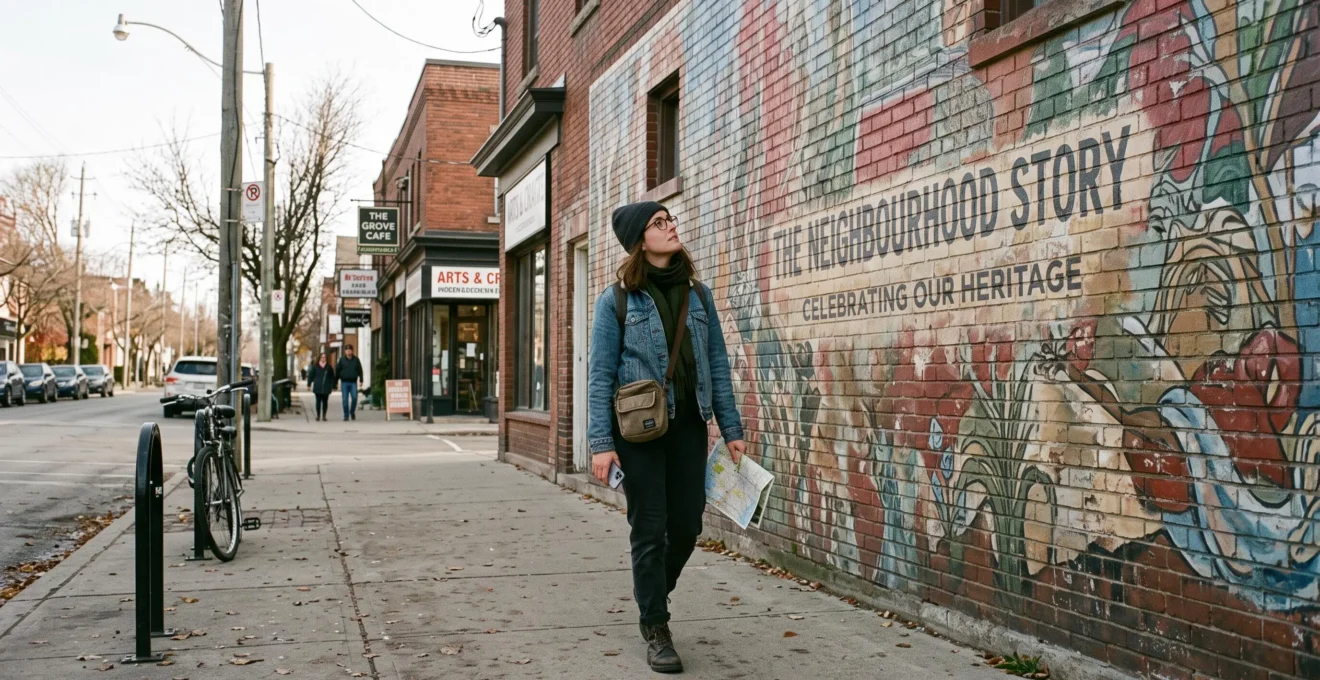
A spectacular sculpture can occupy an entire plaza yet leave you with nothing to think about. A weathered mural on a residential street might hold your attention for twenty minutes because it tells you something about the people who live there.
Finding worthwhile public art in Canada is less about identifying the most photographed installations and more about understanding where a work belongs. Toronto, Montréal, Vancouver and Calgary offer opportunities to explore art in everyday streets, transit corridors, commercial districts and public spaces. The challenge is choosing which installations deserve time away from an already busy itinerary.
A useful approach combines municipal public art maps, neighbourhood context, realistic walking distances and seasonal checks. Instead of treating installations as isolated sightseeing stops, build a short route around a district that interests you. Give yourself time to understand one substantial work, discover a few others along the way and experience the surrounding community.
The result can be a genuinely memorable cultural outing without committing to an entire museum day.
Finding Canadian public art worth your time
- Prioritize artwork connected to local history, community identity or its specific location rather than choosing solely by popularity.
- Build a focused two-hour walk around one transit-accessible neighbourhood, with one major installation and a few shorter stops.
- Verify artwork availability, photography rules and seasonal conditions before travelling, particularly for temporary or illuminated installations.
- Why Is the Most Interesting Public Art in Canada Often Outside the Main Tourist Core?
- How to Build a 2-Hour Public Art Walk in a Canadian City Without Spending All Day?
- Which Public Art Format Hits Hardest for You: Murals, Sculptures, or Light Installations?
- The Public Art Mistake That Can Get You Fined in Canadian Cities
- When Is the Best Time to See Public Art Outdoors in Canada Without Bad Light or Big Crowds?
- When Is the Best Time to Visit Cultural Neighbourhoods in Canada to Actually See Them Alive?
- How to Meet Locals in Canada Using 3 Places That Don’t Feel Like Networking?
- How to Explore Multicultural Canadian Cities Without Defaulting to Downtown
Why Is the Most Interesting Public Art in Canada Often Outside the Main Tourist Core?
Public art worth exploring often appears outside established tourist districts because Canadian cities commission and support artworks in many types of public spaces, including development sites, neighbourhood streets and transit corridors. These locations can give an installation a richer relationship with its surroundings, although artistic quality depends on the individual work, not its distance from downtown.
One reason is how public art is commissioned. Municipal funding, private-development contributions and cultural initiatives can place artworks in areas that visitors would not ordinarily identify as sightseeing destinations.
For example, Toronto’s Percent for Public Art Program encourages public art associated with significant private developments. Contributions may fund commissions on or near development sites or support city-initiated projects through a municipal reserve fund.
This does not mean Toronto’s outer neighbourhoods necessarily contain better art. It means travellers should not assume that the city’s most important installations are concentrated around familiar landmarks.
The distinction becomes clearer when considering how an artwork interacts with its location. A sculpture in a central plaza might make an immediate visual impression. A mural depicting industrial heritage, neighbourhood migration or community identity may become more meaningful when viewed alongside the buildings, businesses and streets that explain its subject.
Site-specific meaning is therefore a stronger selection criterion than simple visual impact. When evaluating a possible detour, ask whether the installation would lose something important if it were moved elsewhere.
- Community connection: Does the work reflect local histories, identities or experiences?
- Interpretive value: Is information available about the artist, commission or subject?
- Viewing context: Does the surrounding street, courtyard or waterfront add to the experience?
- Neighbourhood interest: Is there another worthwhile reason to explore the area?
Pay particular attention to Indigenous commissions and community-led projects, while avoiding assumptions about their meaning based on appearance alone. Artist statements and interpretive materials provide a more responsible starting point.
A practical complication is that neighbourhood artworks are not always permanent. Murals may be replaced, temporary commissions removed and construction sites fenced off. An outdated photograph is not proof that a work remains accessible.
Once a work passes that contextual test, the next challenge is turning scattered locations into a manageable walking route rather than another exhausting sightseeing checklist.
How to Build a 2-Hour Public Art Walk in a Canadian City Without Spending All Day?
Build a two-hour Canadian public art walk by choosing one transit-accessible neighbourhood, identifying a major installation and adding two or three nearby artworks. Reserve time for walking, interpretation and an unexpected stop. The objective is a coherent encounter with a place, not the largest possible number of pins on a map.
Start with municipal resources rather than a generic ranking of attractions. The City of Vancouver‘s public art registry and walking tours help visitors identify artworks by location, neighbourhood, artist and type.
Vancouver also offers a self-guided Yaletown–False Creek public art tour described as taking approximately one or two hours. It provides a useful example of how a municipal collection can become a focused walking experience.
For a route in Toronto, Montréal or Calgary, look for the relevant municipal art map or cultural programme, then compare the locations against current transit and pedestrian access information.
As an editorial planning rule, consider artworks within roughly a 15–20-minute walking radius of your chosen transit hub. This is a starting point, not a universal standard: bridges, steep streets, weather and pedestrian crossings can make nearby points surprisingly inconvenient.
Choose an anchor installation that deserves 15–20 minutes of attention. Add two or three passing works, then keep one alternative available in case a site is inaccessible.
For a hypothetical two-hour itinerary, this division keeps the experience balanced:
| Activity | Suggested time | Purpose |
|---|---|---|
| Arrive and orient yourself | 10 minutes | Check the route and surroundings |
| Explore the anchor artwork | 20 minutes | Understand the artist and location |
| Walk between smaller works | 45 minutes | Discover the neighbourhood |
| Visit an optional artwork | 15 minutes | Allow for curiosity or a substitution |
| Finish at a local café or cultural stop | 30 minutes | Connect the art to everyday neighbourhood life |
The key is to finish somewhere enjoyable and transit-accessible, not at an isolated final artwork that forces you to retrace the entire route.
Your five-step public art detour checklist
- Choose a neighbourhood and transit hub. Record one starting station or stop on your map.
- Find one anchor installation on a municipal public art resource. Save its name, artist and location.
- Add two or three walking-distance artworks. Produce a route with an estimated total duration.
- Check current access, seasonal operation and any construction notices. Record one alternative stop.
- Select a nearby café, market or cultural venue for the finish. Save the destination and your return transit option.
Apply the 30-minute detour test before adding a distant stop: is the work site-specific, can you understand its context and does the neighbourhood offer something beyond the installation itself? If the answers are mostly no, it may not justify abandoning your planned route.
A workable route also depends on what kind of art you want to encounter. Murals, sculptures and illuminated installations place very different demands on your time.
Which Public Art Format Hits Hardest for You: Murals, Sculptures, or Light Installations?
Murals are often the strongest choice for travellers interested in neighbourhood stories, sculptures suit visitors who want a concentrated encounter with form and space, and light installations work best as scheduled evening experiences. None is inherently more meaningful. The most satisfying format depends on how you explore a city and when the artwork is available.
A mural changes how you read an ordinary street. Its scale, subject, architectural setting and relationship to nearby businesses can turn a routine walk into an investigation of local identity.
Murals are especially useful when the neighbourhood itself is the attraction. You can encounter them while exploring independent shops, historic buildings or food streets without organizing an entirely separate activity.
However, painted walls are vulnerable to redevelopment, repainting and physical deterioration. A mural featured in an old travel article may no longer exist in the photographed form.
Sculptures offer a different experience. Because you can often walk around them, they reward attention to shape, material, position and surrounding architecture. The changing viewpoint can be as important as the artwork’s subject.
Accessibility still needs checking. Temporary fencing, maintenance work or winter conditions may prevent close viewing.
Light installations are different again: their operating schedule is part of the artwork’s practical identity. A striking photograph taken during a festival does not mean the same illuminated work is available on an ordinary evening.
Toronto’s 2026 Nuit Blanche illustrates the distinction. The municipal programme announced more than 70 projects for an overnight event scheduled from 7 p.m. on October 3 to 7 a.m. on October 4, 2026. The programme included immersive installations, large-scale sculptures and participatory works. Those event dates have passed; the announcement does not establish continued availability.
When combining formats, plan around viewing conditions rather than simply connecting the nearest dots. A daytime mural district can lead to a sculptural anchor, while an illuminated work belongs at the end of the itinerary only if its actual operating hours permit it.
Social media should help identify potential interests, not serve as a reliable availability calendar. Dramatic images frequently depend on a particular viewpoint, weather condition or lighting setup.
For a meaning-focused visitor, the most useful question is not which format looks best in photographs. It is which format encourages the kind of attention you want to give.
After choosing a format, think about how to interact with it appropriately. Outdoor accessibility does not mean an artwork is exempt from site rules or photography requirements.
The Public Art Mistake That Can Get You Fined in Canadian Cities
The public art mistake most worth avoiding is assuming that public accessibility gives visitors unrestricted permission to use an installation or its surroundings. Ordinary sightseeing photographs are generally straightforward, but climbing, damaging or modifying artworks and organizing commercial productions can raise safety, property or permitting issues. Actual restrictions and penalties depend on the municipality and location.
Public artworks are designed to be experienced, but that does not necessarily mean they are designed to be touched, climbed or used as equipment for a photoshoot.
A useful distinction is between observing an artwork and interfering with it. Standing nearby to appreciate or photograph a sculpture is different from attaching decorations, placing equipment against it or entering a restricted section of the site.
Do not assume that chalk marks, stickers or other temporary additions are acceptable simply because they can be removed. Read posted rules and avoid altering the artwork or its setting without authorization.
Commercial photography introduces a separate issue. Toronto’s official commercial filming and photography guidelines explain that the municipal Film Office handles commercial still photography permits for city streets and sidewalks, while municipal park photography is administered separately.
The guidelines identify a minimum processing period of two full business days, excluding the submission day, for filming permits handled by the Film Office. Park filming requests have a stated minimum of three full business days, also excluding the submission day.
These are Toronto-specific requirements, not rules that automatically apply to Montréal, Vancouver, Calgary or every Canadian municipality. Nor does earning money from online content automatically establish that every photograph requires a film permit.
Property permissions, commercial-use restrictions and copyright questions may also be separate from municipal permitting. A permit to occupy a location is not necessarily permission to reproduce every artwork for every commercial purpose.
Indigenous public artworks deserve particular contextual attention. Read any interpretive signage and follow locally stated expectations concerning photography, cultural significance and respectful access. Do not assume that all Indigenous works share the same protocols.
Before a planned photo session, take two minutes to inspect the plaque, check site notices and identify whether your activity is ordinary personal photography or an organized production. For uncertainty about permits, consult the appropriate municipal public art or permitting office; Toronto visitors can also use municipal 311 services for direction.
The available municipal documentation does not establish a single Canada-wide fine for climbing artwork, attaching objects or photographing installations. Specific penalties should never be assumed without checking the applicable local rules.
Respectful viewing protects the artwork, the surrounding space and other visitors. It also makes it easier to concentrate on the installation rather than turning the encounter into a production.
When Is the Best Time to See Public Art Outdoors in Canada Without Bad Light or Big Crowds?
The best time to see outdoor public art in Canada depends on the artwork’s orientation, the season and its surroundings. Morning and late-afternoon light can reveal mural texture and sculptural detail, while illuminated installations require darkness and confirmed operating hours. For smaller neighbourhood works, weekday visits may offer a calmer experience than busy weekend periods.
Canada’s seasonal daylight differences make a fixed sightseeing schedule unreliable. A comfortable late-afternoon mural visit in summer may become impractical in winter when darkness arrives much earlier.
Start with the direction the artwork faces. East-facing walls can receive direct morning light, while west-facing surfaces may be illuminated later in the day. North-facing walls may offer relatively even light without strong direct sun, depending on the season and surrounding buildings.
These are useful photographic considerations, not guarantees. Tall buildings, shade, weather and reflective surfaces can change the actual conditions.
For sculptures, look beyond sunlight alone. Low-angle illumination may emphasize texture, but strong shadows can conceal details. Moving around the artwork often matters more than finding one supposedly perfect photograph.
Crowd patterns also depend on location. A central plaza may become busy around office lunch periods, scheduled tours or nearby attractions. A residential mural route may be calmer during weekday mornings. Festivals and major cultural events can reverse those patterns.
Winter should not automatically be excluded. Snow can transform the visual relationship between a sculpture and its setting, while earlier darkness can make evening installations easier to schedule before a late dinner.
Light installations still require particularly careful checks. The 2026 Nuit Blanche programme in Toronto demonstrates why a festival’s published dates matter: an installation available during a single overnight event cannot be assumed to operate throughout autumn.
The following schedule is a practical starting point rather than a prediction of crowd levels or perfect light conditions.
| Format | Suggested starting window | What to verify |
|---|---|---|
| Neighbourhood murals | Morning or soft daylight | Wall orientation, shadows and current condition |
| Outdoor sculptures | Morning or late afternoon | Surrounding shade, access and maintenance |
| Neighbourhood art walks | Daylight hours | Business activity, weather and walking conditions |
| Light installations | After dusk | Event dates and actual activation schedule |
During cold weather, account for icy sidewalks, snow clearance and the time required to move safely between stops. An artwork may remain visible even when the most convenient approach is obstructed.
Instead of scheduling every stop for golden hour, match the viewing conditions to the medium. Good public art navigation involves choosing when to pay attention, not merely when to take a picture.
Lighting is only half the timing equation. For public art embedded in cultural districts, the neighbourhood’s daily and seasonal rhythms can matter just as much as the position of the sun.
When Is the Best Time to Visit Cultural Neighbourhoods in Canada to Actually See Them Alive?
The best time to visit a Canadian cultural neighbourhood is when its community activities are genuinely taking place, rather than at an arbitrary sightseeing hour. Market days, local celebrations, cultural programmes and ordinary weekday business routines reveal different sides of neighbourhood life. Check local event calendars and choose a visit that matches what you want to experience.
Consider the difference between a street that is busy because visitors have arrived for a festival and one that is active because residents are shopping, working, meeting friends and using familiar community spaces.
Both experiences can be worthwhile, but they communicate different things about the neighbourhood.
In a Chinatown, Little Italy, Vietnamese commercial district or another culturally significant area, a weekday visit might reveal the ordinary relationships between shops, food businesses and public space. A festival may offer additional music, performances or cultural programming, but it can also alter the usual atmosphere.
First Nations cultural precincts and Indigenous-led programmes require attention to their own schedules and access expectations. Visitors should rely on information published by the relevant cultural organization rather than presume that community activities are always open to the public.
To understand a neighbourhood’s rhythm, consult its business improvement area, community association, market organizer or cultural centre where such resources are available.
Useful things to check include:
- Whether a community market operates on your intended day.
- Whether galleries and cultural centres have public opening hours.
- Whether a festival or heritage celebration is scheduled.
- Whether independent businesses are normally active at that time.
- Whether public art commissions or exhibitions are temporary.
Canadian seasons also shape cultural calendars. Lunar New Year activities, harvest celebrations, heritage festivals and winter markets may make particular periods especially interesting, although their occurrence and dates vary by community and year.
A quiet street outside a festival period does not necessarily indicate an inactive or uninteresting neighbourhood. It may simply have a different daily schedule from a conventional tourist district.
Public art becomes more meaningful when its social context is visible. A mural concerned with community memory can invite deeper questions when you have also visited local institutions or spoken with people connected to the neighbourhood.
For a worthwhile detour, try pairing a weekday cultural walk with one public event when your schedule permits. The contrast can reveal what changes for visitors and what remains part of everyday local life.
The strongest neighbourhood experiences also leave room for conversations. A public artwork can provide a natural starting point without requiring a formal tour or organized social activity.
How to Meet Locals in Canada Using 3 Places That Don’t Feel Like Networking?
Three useful places to meet locals during a Canadian public art visit are artist-run centres, community markets and guided neighbourhood art walks. Each provides a shared topic that makes conversation easier. Rather than approaching strangers without context, visitors can ask about an exhibition, a local product or a work encountered along the route.
Artist-run centres are especially valuable because they introduce you to creative practices that may not appear in conventional visitor itineraries. Public gallery openings and artist talks can offer opportunities to learn about a neighbourhood’s cultural activity.
Check opening details before visiting. Some events are open to everyone, while others may require registration or have limited capacity.
A question such as “Do you know any public artworks nearby that are especially connected to this neighbourhood?” invites a more thoughtful response than asking for the most popular attraction.
Community farmers’ markets and culturally specific markets offer a different form of interaction. Conversations about produce, food preparation, crafts or local ingredients can develop naturally from the activity taking place.
Respect vendors’ time, especially when they are serving customers. A brief, specific question is usually more considerate than expecting an extended conversation during a busy period.
Guided mural walks provide the most structured option. When led by resident artists or knowledgeable community guides, they allow visitors to ask about the ideas behind artworks, changing streetscapes and the role of public commissions.
The shared route takes some of the social pressure out of speaking with other participants. There is already something concrete to discuss.
Social habits vary greatly between people and cities, so avoid treating Canadian residents as uniformly outgoing or reserved. Polite curiosity, respect for personal space and a willingness to accept a short answer are more reliable than cultural stereotypes.
One particularly useful question is: “What should I see in this neighbourhood that visitors usually miss?”
That question can reveal a small gallery, a newly painted mural, a public courtyard or an installation that has recently changed. Such information is potentially valuable because official maps and older articles may not reflect every recent alteration.
Local recommendations are not automatically verified, however. Before walking a substantial distance, confirm the destination’s current location and accessibility where possible.
These encounters also change the meaning of the detour. Instead of collecting photographs of unfamiliar places, you begin to understand how people use and interpret them.
The next step is to organize the entire city visit around this more focused kind of exploration, giving neighbourhoods enough time to become places rather than passing scenery.
What to carry into your next city walk
- Choose a neighbourhood for its history, cultural activity and accessibility before collecting individual artwork locations.
- Treat transit as a way to reach a worthwhile district, not simply a connection between famous downtown landmarks.
- Support local cultural spaces and businesses while respecting the communities whose histories appear in public artworks.
How to Explore Multicultural Canadian Cities Without Defaulting to Downtown
Explore Canada’s multicultural cities by organizing each day around one neighbourhood rather than a sequence of downtown attractions. Use transit to reach the district, identify public art that reflects its surroundings and leave space for local food, cultural institutions and everyday street life. A focused two-hour walk can reveal more context than a rushed citywide collection of landmarks.
This approach changes the basic planning question. Instead of asking which sights are closest to your hotel, ask which neighbourhood you want to understand and which public artworks offer a meaningful introduction.
In Toronto, Montréal, Vancouver or Calgary, that might mean selecting a transit-accessible district with murals, public commissions and active community spaces, then building the day’s itinerary around the area rather than returning downtown after every stop.
The aim is not to avoid city centres entirely. Downtown public art can be powerful, site-specific and historically significant. The mistake is treating central locations as the only places that deserve attention.
Transit makes neighbourhood-first exploration more practical. A district that appears distant on a tourist walking map may be straightforward to reach by subway, bus or light rail. Conversely, two artworks that look close on a map may be separated by an inconvenient walking route.
A useful hypothetical day could follow this sequence:
- Choose one cultural neighbourhood with accessible public spaces and a clear reason for visiting.
- Travel to a convenient transit hub and begin with a significant public artwork.
- Spend approximately two hours exploring nearby installations and neighbourhood streets.
- Visit a community cultural venue, market or independent business where appropriate.
- Return using a verified transit connection rather than forcing additional distant art stops into the schedule.
This is also a more considered way to approach neighbourhoods experiencing redevelopment or gentrification pressures. Public art may celebrate community histories while the streets around it undergo major economic or demographic changes.
Visitors should avoid treating culturally significant neighbourhoods as collections of visual backdrops. Respectful engagement can include visiting community-led institutions, purchasing from local businesses and learning whose stories an artwork represents.
Those actions do not resolve broader urban pressures, but they can make the visit more reciprocal than a brief photographic stop.
A worthwhile public art detour is ultimately a planning skill. It combines four decisions: where to go, which work deserves sustained attention, when to visit and how to experience the surrounding neighbourhood responsibly.
Municipal art registries provide a foundation, but they are not substitutes for checking current access. Artist information gives a starting point for interpretation, but the environment itself helps explain why the work belongs there.
Resist the temptation to turn every interesting recommendation into another stop. One district explored thoughtfully may offer a richer experience than five neighbourhoods visited only long enough to photograph their most recognizable installations.
For your next Canadian city visit, select one neighbourhood, save an anchor artwork from a municipal resource, check its availability and build a short walk around it. Then make room for one local encounter. The best detour is not necessarily the one with the biggest installation; it is the one that changes how you understand the place.
Can you explore public art in Canadian cities for free?
Many public artworks can be viewed from publicly accessible streets, parks and other outdoor spaces without purchasing a ticket. However, some installations form part of ticketed events or have restricted access. Check the individual work’s location, opening conditions and any event requirements before visiting.
Are municipal public art maps reliable for planning a visit?
Municipal maps and registries are useful starting points because they can identify artists, locations and artwork types. They are not necessarily updated in real time. Construction, temporary removals and changing exhibition schedules can affect what you actually encounter, so confirm important stops before making a significant detour.
Can you find meaningful public art without joining a guided tour?
Yes. A self-guided walk can combine municipal artwork information, on-site plaques and neighbourhood observation. Choose one major work, research its artist and local context, then explore a few nearby installations. A guided tour can add community perspectives, but it is not essential for a rewarding experience.
What should you do if a mural or installation has disappeared?
Check whether the artwork was temporary, relocated, covered by construction or replaced. Consult the relevant municipal programme if the information is available. Having one alternative installation already saved on your map allows you to continue your walk without spending the day searching for a missing work.
How can you understand Indigenous public art respectfully?
Begin with the artist’s own explanation and any on-site interpretation. Look for information about the commission, community connections and cultural context rather than guessing at symbolic meanings. Follow posted photography or access expectations, recognizing that protocols differ between artworks, communities and locations.