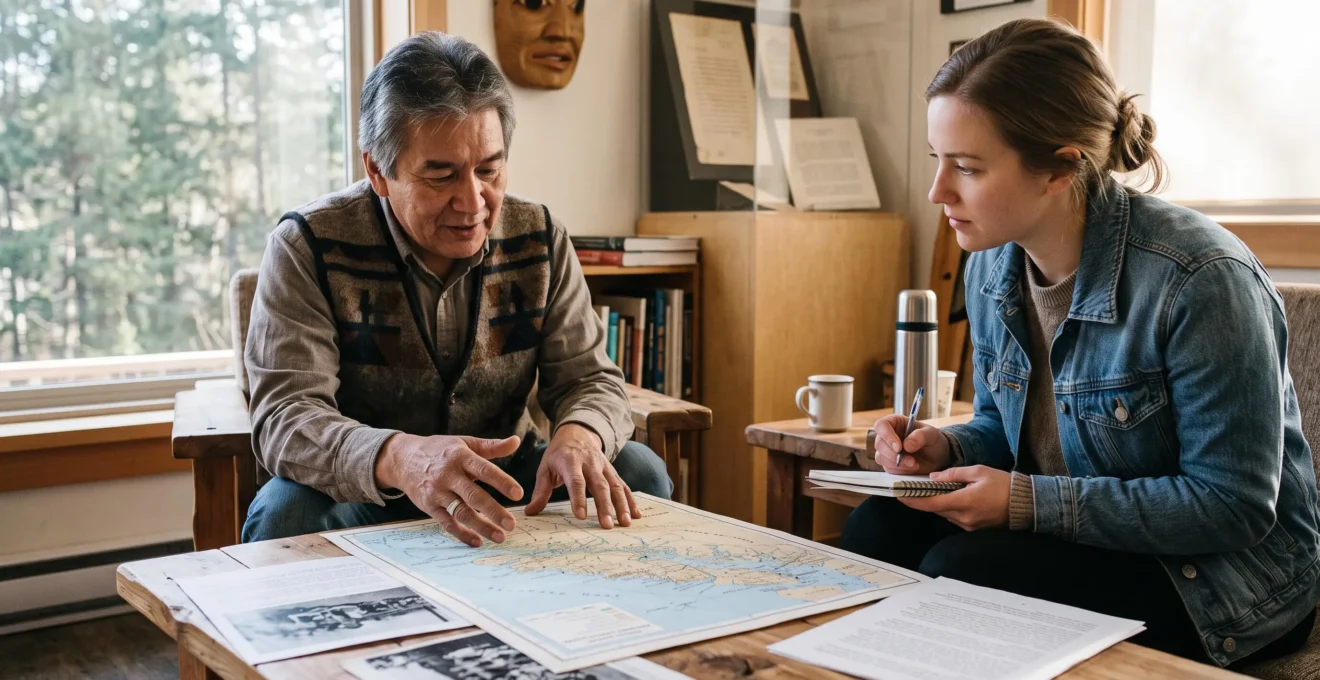
Learning about First Nations traditions in Canada begins with a question that many introductory guides overlook: whose traditions are you learning about? The answer matters because First Nations are not one cultural community. They encompass distinct peoples whose languages, relationships with territory, histories, governance systems, and cultural practices cannot be reduced to a single set of beliefs or ceremonies.
For travellers, students, and people settling in Canada, this diversity can make the first steps feel uncertain. Is a cultural centre more appropriate than a museum? Can visitors attend a powwow? Should someone ask an Elder about a ceremony? What makes an online explanation trustworthy?
Respectful learning does not require knowing every protocol beforehand. It requires identifying the Nation concerned, seeking information from people authorized to share it, distinguishing public cultural education from restricted knowledge, and recognizing that access is never automatic.
The most useful approach is relationship-first: understand where you are, learn who speaks for the knowledge being shared, and participate according to the host community’s expectations.
Learning First Nations Traditions Respectfully: The Essentials
- Identify the particular First Nation, territory, or language community before interpreting a cultural practice. First Nations traditions are not interchangeable.
- Prioritize Nation-created resources, Indigenous-led cultural experiences, and publicly advertised events with clear visitor protocols.
- Ask before photographing, touching, reproducing, or sharing culturally significant material. Public access does not mean unrestricted permission.
- Why Is It Incorrect to Treat First Nations Traditions in Canada as One Shared Culture?
- How to Find Nation-Specific Resources on First Nations Traditions in Canada Without Getting Lost Online?
- What’s the Best Way to Learn First Nations Traditions: Guided Visits, Public Events, or Self-Study?
- The Symbol-and-Souvenir Mistake That Spreads Misinformation About First Nations Traditions
- When Is the Best Time to Seek In-Person Teachings About First Nations Traditions in Canada?
- Which Is the Best First Step: Museum, Cultural Centre, or Land-Based Teaching?
- How to Prepare for a Canadian Powwow as a Visitor Without Feeling Out of Place?
- How to Learn About Indigenous Heritage in Canada Without Crossing Cultural Lines
Why Is It Incorrect to Treat First Nations Traditions in Canada as One Shared Culture?
First Nations traditions in Canada cannot be treated as one shared culture because First Nations are distinct peoples with different languages, territories, histories, governance structures, and cultural authorities. Some practices may be shared or connected through historical relationships, but their meanings and protocols are not automatically identical. Understanding a tradition therefore requires identifying the Nation and context to which it belongs.
Canada’s Indigenous diversity is substantial. According to Statistics Canada‘s 2021 Census findings on Indigenous population diversity, more than 600 First Nations represent their people across Canada, and more than 70 Indigenous languages were reported in the census.
These figures describe the 2021 Census, not a current population estimate or a count of distinct ceremonial systems. They nevertheless demonstrate why a single description of “First Nations spirituality” cannot adequately represent the peoples concerned.
More than 600 First Nations
Statistics Canada’s 2021 Census documentation identifies more than 600 First Nations across Canada. The figure reflects First Nations representation and must not be interpreted as a count of mutually exclusive cultural traditions.
Statistics Canada, 2021 Census of Population, published September 2022.
Even practices that appear similar can carry different meanings. A drum, story, design, gathering, or teaching may have particular historical and community-specific relationships. Similarity alone does not establish that practices are interchangeable or that knowledge shared publicly by one Nation can be applied to another.
It is also important to distinguish Canada’s three constitutionally recognized Indigenous groups:
- First Nations: Distinct Indigenous peoples with their own Nations, territories, languages, political relationships, and cultural traditions.
- Métis: A distinct Indigenous people with particular histories, identities, communities, and cultural practices.
- Inuit: Distinct Indigenous peoples whose homelands, languages, histories, and cultural knowledge include those rooted in Inuit Nunangat.
The broad term “Indigenous” can appropriately include all three groups, but it should not erase their differences. This guide concentrates on First Nations rather than treating Métis or Inuit cultural frameworks as substitutes.
A practical way to evaluate cultural information is to ask three questions: Does the source identify a Nation? Does it explain the relevant territory or community context? Does it identify who is authorized to share the information?
Content referring only to “ancient Native wisdom” or “universal Indigenous ceremonies” without identifying a community deserves closer scrutiny. Such wording does not automatically prove a source is inaccurate, but it provides too little context to establish whose teachings are represented.
Generalizations have consequences beyond terminology. They can cause visitors to misidentify culturally significant objects, attach the wrong meaning to ceremonies, or repeat teachings in settings where they do not belong.
Once that distinction is understood, the next challenge becomes finding reliable information without allowing search engines or social media to erase the very differences that matter.
How to Find Nation-Specific Resources on First Nations Traditions in Canada Without Getting Lost Online?
To find reliable information about First Nations traditions in Canada, begin with the website of the Nation concerned or a cultural organization it operates or authorizes. Look for identifiable authorship, community affiliations, and territorial context. Use broader Canadian institutions to discover relevant organizations, but verify cultural explanations through sources connected directly to the people whose traditions are being described.
Start with the location you want to understand. For example, someone studying Anishinaabe cultural heritage should search for resources associated with an identified Anishinaabe Nation or community rather than relying on a generic collection of “Canadian Indigenous customs.”
A useful search combines the Nation’s name with a specific topic such as language education, cultural centre, history, or visitor programming. This produces a clearer research question than searching for “First Nations traditions” alone.
Before relying on a website, examine its About page, publishing organization, creator affiliations, and relationship to the community discussed.
Several Canadian institutions can help establish context. The Assembly of First Nations offers a national-level organizational starting point. Indigenous Services Canada provides government information, while the National Centre for Truth and Reconciliation is particularly relevant for studying residential schools, historical harms, and reconciliation.
These institutions serve different purposes. None should be assumed to speak on behalf of every Nation about ceremonial knowledge. Nation-operated cultural centres, education authorities, and official community publications are more appropriate starting points for community-specific cultural explanations.
Indigenous-led tourism associations may also help readers locate cultural experiences connected to particular territories, although the provider and its relationship to the relevant Nation should still be checked.
A Five-Step Source Verification Checklist
- Identify the Nation: Write down the specific Nation or community whose traditions you want to understand.
- Locate an official source: Save the address of a Nation-operated or explicitly Nation-authorized cultural or educational resource.
- Verify authorship: Record the publisher, creator affiliation, and any stated community approval.
- Check the cultural context: Note the territory, language, and circumstances to which the information applies, including any stated restrictions.
- Cross-check before sharing: Compare one significant claim with material published or approved by the Nation concerned, and retain the reference.
Social platforms require particular caution. A highly viewed video may combine Plains imagery with Northwest Coast artistic traditions, present a community-specific teaching as universal, or feature someone whose authority is not explained.
Algorithms reward visibility, not necessarily accurate cultural attribution. When an explanation cannot be traced to an identifiable community or knowledgeable source, it should remain an unverified claim rather than become something repeated as fact.
Research creates a foundation, but it cannot replace every form of learning. Direct experiences can add context, provided visitors understand who is teaching and what has been made available for public participation.
What’s the Best Way to Learn First Nations Traditions: Guided Visits, Public Events, or Self-Study?
The most appropriate way to learn First Nations traditions depends on your existing knowledge, location, and the opportunities offered by a particular Nation. Self-study helps establish historical and cultural context, Indigenous-led guided visits allow questions within an organized educational setting, and public events provide opportunities to encounter living cultural expression. These methods work best together rather than as competing choices.
For someone starting with little background knowledge, a guided experience connected to an identified community is often a practical first step. A guide can explain what the program covers, which teachings are appropriate to share, and why particular features of the experience matter.
However, the authority of the person teaching matters more than the format alone. A workshop described as Indigenous-inspired is not automatically an appropriate source for the traditions of a particular First Nation.
Visitors should look for a facilitator who belongs to the Nation represented or has clear authorization to teach the material being offered. Indigenous identity alone should not be treated as universal authority to explain every Nation’s practices.
The following comparison helps match a learning method to the visitor’s needs.
| Learning method | Best use | Important limitation |
|---|---|---|
| Nation-specific self-study | Building vocabulary, historical knowledge, and familiarity with public resources | Limited opportunity to clarify uncertainty; source verification remains essential |
| Indigenous-led guided visit | Learning through explanations, questions, and community-connected interpretation | The guide’s authority, program scope, and cultural permissions must be established |
| Nation-hosted public event | Encountering publicly shared cultural expression in a living community setting | Some activities may be restricted, and the event is not a comprehensive introduction to all traditions |
| Land-based educational program | Understanding relationships among territory, environment, history, and cultural knowledge | Participation depends on authorized programming, access conditions, and local protocols |
Canada offers concrete examples of community-connected learning. Parks Canada’s Indigenous-led tourism experiences include opportunities developed with Indigenous partners in different regions.
Among the First Nations-related examples identified are the Haida Gwaii Watchmen experience at Gwaii Haanas in British Columbia, Anishinaabe cultural programming at Pukaskwa National Park, and Mi’kmaw experiences at Kejimkujik National Park and National Historic Site.
These are distinct experiences connected to particular peoples and places. They should not be described as interchangeable examples of one national tradition. Their current availability, booking requirements, and visitor protocols must be confirmed with the relevant operators.
Self-study remains valuable because it allows visitors to arrive with basic knowledge rather than expecting a guide to explain everything. Public events, meanwhile, can demonstrate that cultural traditions are part of contemporary community life rather than simply subjects of historical research.
More immersive experiences are not necessarily more appropriate for beginners. A land-based program may require preparation or an established relationship, while some teachings are not offered to the public at all.
Whichever format you choose, cultural learning should not become a search for access to increasingly private information. This distinction becomes particularly important when purchasing or interpreting cultural objects.
The Symbol-and-Souvenir Mistake That Spreads Misinformation About First Nations Traditions
The symbol-and-souvenir mistake occurs when culturally significant objects or designs are treated as generic representations of First Nations identity. A dreamcatcher, medicine wheel, animal motif, or piece of regalia may have meanings connected to specific peoples, teachings, families, or contexts. Without that information, visitors risk turning cultural expressions into decorations or repeating inaccurate explanations about their origins.
A dreamcatcher, for example, should not automatically be presented as a universal First Nations object. Dreamcatchers have particular associations with Anishinaabe traditions, although their contemporary production, circulation, and interpretation extend beyond those origins.
Likewise, medicine wheel teachings are not identical across every Nation. The appearance of a circular design or four-part arrangement does not establish one fixed meaning.
Animal designs can also convey relationships, stories, or artistic traditions whose interpretation depends on the creator and cultural setting. Some designs or expressions may involve particular rights or permissions.
Authenticity involves more than appearance. A product featuring feathers, beadwork, or an animal motif is not necessarily Indigenous-made, and a genuinely Indigenous-created work need not conform to stereotypical expectations.
Canadian Heritage’s guidance on Indigenous creative industries emphasizes identifying a creator’s Nation, respecting customary practices, securing appropriate permissions, and compensating Indigenous creators.
“Each Nation has its own customary laws and traditions that should be respected.”
For visitors purchasing artwork or souvenirs, a more thoughtful approach involves asking who created the piece, whether the business is Indigenous-owned, and what information the creator has chosen to share about it.
An artist may explain a technique, material, or publicly shareable cultural connection. That explanation can make the purchase an opportunity for learning rather than an attempt to acquire a symbol of generalized Indigenous identity.
However, artists are not obliged to reveal restricted knowledge or provide personal cultural explanations to every customer. An unwillingness to disclose a particular meaning is not proof that an object is inauthentic.
What deserves caution is marketing that makes sweeping claims about supposedly universal Indigenous meanings without identifying a creator, community, or credible basis for the explanation.
Permission also matters after purchase. Owning an object does not automatically authorize someone to reproduce its design, use it commercially, present it as ceremonial knowledge, or photograph it in a restricted setting.
When photography or reproduction involves culturally significant material, follow the applicable community protocols and seek permission from the appropriate person or authority. Individual consent may not resolve every collective or ceremonial restriction.
A meaningful cultural encounter is not measured by the number of objects collected. It is better measured by what visitors learn about their creators, the boundaries they respect, and the relationships they continue to support.
When Is the Best Time to Seek In-Person Teachings About First Nations Traditions in Canada?
The best time to seek in-person learning about First Nations traditions is when a particular community publicly offers an educational program, cultural event, or visitor experience. Summer often brings publicly advertised powwows and gatherings, while cultural centres may provide programming at other times of year. Event authorization and visitor protocols matter more than the season: a private ceremony does not become open simply because visitors are nearby.
For people planning a trip, Canada’s cultural calendar provides useful starting points. National Indigenous Peoples Day takes place on June 21 and can be an opportunity to discover publicly announced Indigenous-led cultural activities.
Powwows, festivals, exhibitions, and community events may also be scheduled during warmer months, although there is no single nationwide timetable governing First Nations cultural activities.
Some cultural centres organize workshops, exhibitions, and guided experiences outside the busiest summer period. These may provide an appropriate setting for asking questions when the program explicitly welcomes outside participants.
The crucial distinction is between public programming and private or restricted cultural practice.
A publicly advertised powwow may welcome non-Indigenous visitors into designated spaces. A cultural centre may offer a structured workshop intended for learners. A ceremony taking place on community land, however, may be restricted to invited participants or community members.
Not all knowledge is available through tourism or public education, regardless of the visitor’s sincerity or the timing of the visit.
Before travelling, use the following planning sequence:
- Identify the community hosting the activity and locate its official announcement.
- Check the published date, location, registration requirements, and admission arrangements.
- Read any visitor guidelines concerning photography, participation, clothing, seating, or culturally significant items.
- Confirm whether the program is publicly accessible rather than assuming that an online listing implies unrestricted attendance.
- Recheck the organizer’s communications before departure, because arrangements and protocols may change.
Checking several weeks ahead can be useful for planning, but there is no universal booking window. The appropriate lead time depends on the event and operator.
Arriving at a scheduled public activity with an understanding of its purpose is very different from appearing unexpectedly and requesting instruction in private traditions.
Well-timed participation may create opportunities to discover additional publicly offered programs or resources. It should not be understood as earning automatic access to restricted teachings.
Once the timing and access conditions are clear, the next decision is where to begin: a museum, a cultural centre, or a structured opportunity to learn on the land.
Which Is the Best First Step: Museum, Cultural Centre, or Land-Based Teaching?
A Nation-operated cultural centre or Indigenous-led guided experience is often the most useful first step for learning about a particular First Nation, when such an option is available. Museums can provide valuable historical context, while authorized land-based educational programs connect teachings with territory. The appropriate choice depends on what the institution offers, whose knowledge it represents, and whether the experience welcomes learners from outside the community.
Museums can be useful starting points for understanding historical relationships, material culture, political developments, and the effects of colonialism. Exhibitions may introduce visitors to the names of Nations and territories they had not previously encountered.
However, an object displayed behind glass does not, by itself, explain the cultural relationships surrounding it. Older collections or interpretations may also reflect institutional collecting practices rather than the full perspectives of the communities represented.
Some museums and heritage institutions work with First Nations on exhibitions, interpretation, and repatriation-related initiatives. Visitors can look at exhibition credits to identify whether the relevant communities participated in developing the presentation.
A cultural centre associated with a particular Nation may offer a more direct introduction to its publicly shareable history, language initiatives, artistic practices, or contemporary community priorities.
Not every cultural centre operates the same way. Some provide regular visitor programming, while others primarily serve community members or focus on specific educational responsibilities.
Land-based learning adds another dimension. It can help participants understand how knowledge relates to particular landscapes, ecological relationships, language, and responsibilities to place.
Yet land-based teaching is not simply a scenic outdoor alternative to a museum. It may involve designated educators, specific permissions, seasonal conditions, and community-defined limits on what can be shared.
For a traveller beginning from scratch, a reasonable progression is to identify the Nation whose territory is relevant, seek an accessible cultural centre or Indigenous-led introduction, explore credible historical resources, and consider land-based programming only when it is appropriately offered.
A national museum can still be a valuable starting point, particularly where a Nation-operated visitor facility is not easily accessible. The important step is using its information to discover more specific sources rather than treating a broad national exhibition as the final account of a Nation’s culture.
After finding a suitable starting point, visitors may encounter public community gatherings such as powwows. These events call for a different kind of preparation, focused on participation and respectful observation.
How to Prepare for a Canadian Powwow as a Visitor Without Feeling Out of Place?
To prepare for a Canadian powwow, first confirm that the event welcomes visitors and read the organizer’s guidelines. Learn the basic purpose of the Grand Entry, listen to the emcee, respect seating and photography restrictions, and never touch dancers’ regalia or drums without permission. You do not need to know every tradition in advance; attentiveness to the host’s instructions is more important.
A powwow is a gathering that may include dancing, singing, drumming, social interaction, and other activities according to its particular format and host community. Some powwows include dance competitions, while others emphasize different forms of gathering and celebration.
The Grand Entry is an important part of many powwows, but its organization and accompanying protocols vary. Visitors should follow instructions about standing, removing hats, and other forms of respect rather than assuming the same expectations apply everywhere.
Regalia should not be described as a costume. Dancers’ clothing and associated items may carry personal, familial, cultural, or ceremonial significance that cannot be inferred simply from appearance.
The All-Nations Powwow visitor FAQ, published by the University of Toronto Mississauga for its 2026 event, provides a concrete example of public-event etiquette.
The organizers describe the event as open to the public, with free admission requiring a free entry ticket. Their guidance instructs visitors to follow the emcee, ask dancers before taking photographs, and avoid touching regalia or drums.
Photography and videography are prohibited during certain sacred portions of that event. The FAQ also advises that someone encountering an eagle feather on the ground should notify an Indigenous community member rather than pick it up.
These are documented protocols for a particular gathering, not an automatically binding set of rules for every powwow in Canada. Visitors should always prioritize the instructions issued by the event they are actually attending.
Photography requires particular care. Even when general photography is allowed, certain moments may be restricted, and permission from an individual does not override an event-wide prohibition.
For first-time visitors, uncertainty is normal. A practical approach is to remain in designated visitor areas, listen to announcements, and direct necessary questions to an organizer or volunteer at an appropriate moment.
It is generally more respectful to ask how to follow an event’s protocol than to assume that something observed at another gathering applies here.
Powwows are also not representative of every First Nation’s cultural practices. Their presence across many parts of Canada does not mean that all Nations share a single powwow tradition or that attending one event provides a complete introduction to First Nations cultures.
The aim is not perfect familiarity with every cultural detail. It is to be a considerate guest who recognizes that participation takes place within a community-defined setting.
Key Takeaways Before You Begin
- Respectful learning starts by identifying a particular Nation and recognizing that cultural authority belongs to the people and communities concerned.
- An experience being publicly advertised does not mean every activity, explanation, image, or cultural expression can be freely reused.
- Long-term support for Indigenous-led education, cultural organizations, and artists is more meaningful than treating cultural understanding as something completed through one visit.
How to Learn About Indigenous Heritage in Canada Without Crossing Cultural Lines
Learning about Indigenous heritage in Canada without crossing cultural lines requires a relationship-first approach: identify the Nation, consult its own sources, participate only in activities offered to visitors, and respect restrictions on knowledge and cultural expressions. The goal is not to collect traditions or claim expertise after a brief encounter. It is to understand whose knowledge is being shared and act according to that community’s protocols.
The principles apply to First Nations learning specifically, while broader Indigenous heritage education must also respect the distinct identities and authority of Métis and Inuit peoples.
One useful way to approach learning is to move through four connected responsibilities: identification, verification, participation, and continued respect.
Identification means knowing the Nation or community you are learning about and understanding that its teachings are connected to particular histories, places, and relationships.
Verification means being able to identify the creator or organization behind a cultural explanation. It also means recognizing when information has been simplified or removed from its original context.
Participation means entering public educational experiences on the host’s terms. Visitors should never assume that a public event provides access to private ceremonies or that a personal invitation can be transferred to someone else.
Continued respect means applying those principles after leaving. A photograph, souvenir, educational presentation, or social media post can affect how other people understand a Nation’s culture.
Four boundaries are especially worth remembering:
- Do not assume traditions are transferable. Verify which Nation a teaching belongs to before repeating it in another context.
- Do not appropriate restricted expressions. Cultural objects, designs, songs, and teachings may involve permissions that are not automatically granted through observation or purchase.
- Do not enter closed cultural activities without invitation. Respect the difference between a public event and community-specific or restricted practice.
- Do not circulate unverified claims. If the Nation, author, or appropriate cultural context cannot be identified, avoid presenting the information as established knowledge.
Canada’s reconciliation framework provides an important context for this responsibility. The Truth and Reconciliation Commission’s Calls to Action have helped frame public discussion about education, historical accountability, institutional responsibilities, and respectful relationships.
Indigenous-led educational experiences and cultural initiatives offer ways to learn, but they should not be interpreted as unrestricted access to cultural knowledge. The availability of a public program does not change the authority of the community offering it.
A visitor who can name the Nation concerned, identify where an explanation came from, and follow the relevant protocols has developed a more dependable foundation than someone who can repeat many generalized descriptions of Indigenous traditions.
This also changes the role of the learner. Rather than approaching First Nations culture as a collection of experiences to consume, the learner approaches an educational opportunity as a guest whose responsibilities continue beyond the visit.
Choose one First Nation relevant to a place you live in, study, or plan to visit. Find a resource created or approved by that Nation, learn what it offers publicly, and follow its guidance. Continue supporting Indigenous-led cultural centres, educational programs, tourism providers, and artists when appropriate. Meaningful learning develops through sustained attention, respect, and relationships rather than a single encounter.
Can non-Indigenous people learn about First Nations spiritual traditions?
Non-Indigenous people can learn about teachings that a First Nation has chosen to share publicly. However, some spiritual knowledge, ceremonies, stories, and cultural practices may be restricted or require particular relationships and permissions. Public educational material should not be treated as authorization to perform ceremonies or reproduce teachings. The appropriate boundaries are determined by the relevant community and knowledge holders.
Is it appropriate to ask a First Nations Elder questions about traditions?
Questions may be appropriate within an organized educational setting where an Elder or knowledge holder has agreed to teach. It is not appropriate to assume that someone must explain their culture simply because they are an Elder or a First Nations person. Follow the host organization’s guidance on introductions, questions, compensation, and protocols. Respect a decision not to share particular information.
How can newcomers to Canada learn whose traditional territory they live on?
Begin with local First Nations governments, cultural centres, or community-operated educational resources. Universities, municipalities, and museums may provide useful starting points, but their descriptions should be checked against the information published by the Nations concerned. Territories and historical relationships may overlap, and a land acknowledgement should be treated as an invitation to further learning rather than a complete account of local Indigenous history.
Can visitors share photographs from First Nations cultural events on social media?
Only when the organizer’s photography rules and any applicable permissions allow it. Public attendance does not automatically authorize photographing every participant or activity. Some ceremonial moments prohibit photography entirely. Before posting, consider whether the image reveals restricted material, misrepresents its cultural context, or identifies someone who has not agreed to be photographed. If permission is unclear, ask or refrain from sharing.
How can students include First Nations traditions in school projects without misrepresenting them?
Select a clearly identified Nation and a specific, publicly documented topic. Prioritize materials produced or approved by that Nation, identify the source of each cultural explanation, and avoid describing a local teaching as universal to all First Nations. Students should distinguish their own summaries from statements made by community knowledge holders and avoid reproducing restricted cultural material. When possible, include contemporary community perspectives alongside historical context.