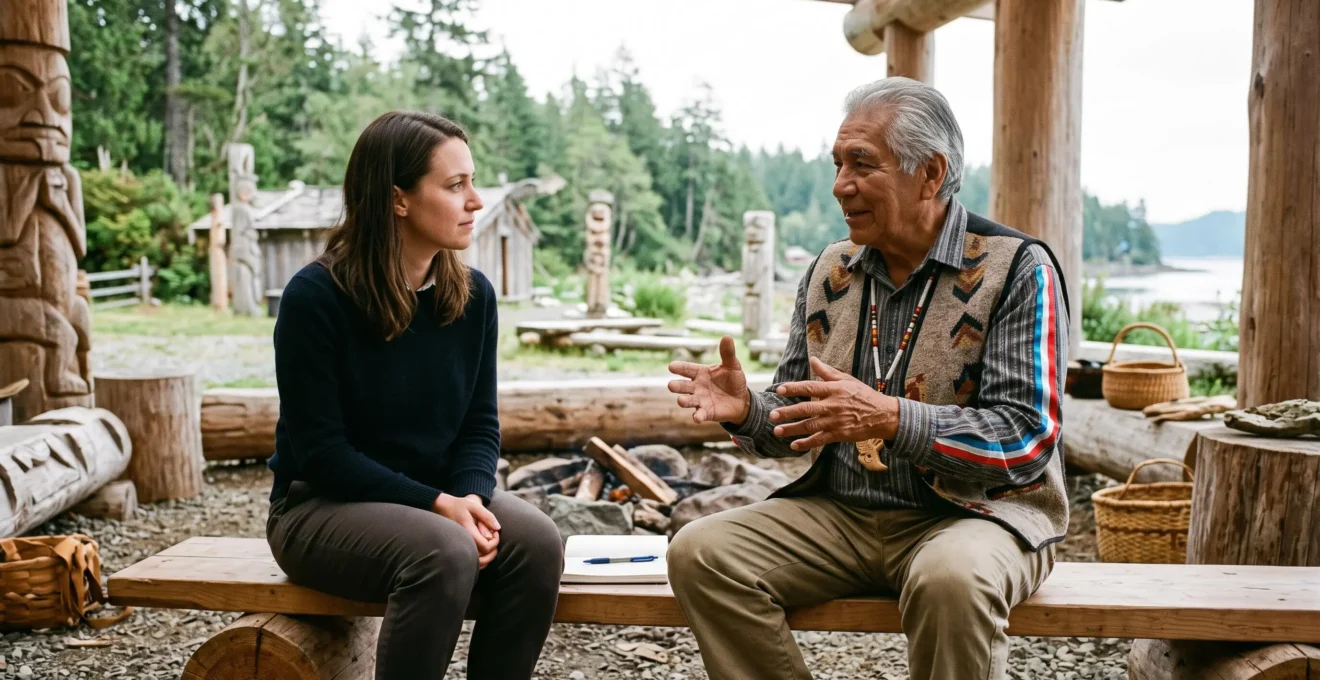
Learning about Indigenous heritage in Canada begins with a simple distinction: Indigenous peoples are not historical subjects whose cultures exist primarily for visitors to examine. First Nations, Inuit and Métis peoples are living communities with their own identities, languages, knowledge systems and cultural protocols. Learning respectfully means recognizing their authority over what they choose to share.
For non-Indigenous Canadians and international visitors, uncertainty is common. Is it appropriate to attend a powwow? Can a teaching be shared online? How can someone tell whether a cultural experience genuinely benefits the people whose heritage it presents?
The practical answer is to choose experiences shaped by Indigenous hosts, follow their instructions and ask permission instead of assuming access. Visitors do not need to master every protocol before participating. They need to recognize that expectations differ across Nations, communities, venues and occasions.
Whether the first encounter happens at a museum, community cultural centre, food workshop or public gathering, the objective is not to collect cultural experiences. It is to develop understanding while respecting the people who make that learning possible.
Respectful Indigenous cultural learning in Canada: the essentials
- Choose Indigenous-led experiences: identify the Nation or community involved, who delivers the teaching and how the experience supports Indigenous participants.
- Respect boundaries around access and sharing: public admission does not automatically permit recording, retelling teachings or participating in every activity.
- Start with accessible learning environments: cultural centres, guided interpretation and explicitly public events offer opportunities to build knowledge before seeking more specialized experiences.
- Why Indigenous Heritage in Canada Feels Different From a Typical Historical Attraction
- How to Verify an Indigenous Cultural Experience in Canada Is Community-Led Before You Book
- Which Is the Best First Step: Museum, Cultural Centre, or Land-Based Teaching?
- The Sharing Mistake That Can Break Trust During Indigenous Cultural Experiences
- When Is It Appropriate to Attend Indigenous Cultural Events in Canada as a Visitor?
- How to Prepare for a Canadian Powwow as a Visitor Without Feeling Out of Place
- Which First Experience Teaches You More: an Indigenous Tasting Menu, Market Foods, or a Workshop?
- How to Attend a Public Powwow in Canada Respectfully if It’s Your First Time
Why Indigenous Heritage in Canada Feels Different From a Typical Historical Attraction
Indigenous heritage in Canada differs from a conventional historical attraction because it belongs to living peoples who continue to practise, interpret and develop their cultures. Visitors may encounter historical knowledge, but they are also engaging with contemporary communities. The essential shift is from treating culture as an exhibit to understanding cultural learning as an interaction governed by its hosts.
A historical attraction may encourage visitors to inspect objects, read explanatory panels and document what they see. Those activities can also be appropriate at Indigenous heritage sites. The difference becomes particularly important when the experience includes living knowledge holders, cultural demonstrations, storytelling or opportunities for participation.
In these settings, being a paying customer does not override being a guest. A ticket may grant admission to a specified program, but it does not establish unrestricted permission to photograph people, record teachings, enter other spaces or request additional cultural knowledge.
The distinction also affects how visitors interpret the information presented. An exhibition developed primarily through an external historical perspective can tell a different story from an experience in which Indigenous people determine how their history and contemporary identity are represented.
For example, the Parks Canada’s Indigenous-led tourism experiences directory presents programs developed with Indigenous partners, including Inuit-guided activities, Inuvialuit-hosted experiences, Haida Gwaii Watchmen programs and Mi’kmaw cultural interpretation. These examples demonstrate opportunities to encounter heritage through Indigenous participation rather than relying exclusively on externally produced interpretation.
Partnership and ownership should not be confused, however. A program developed with an Indigenous partner is not necessarily wholly Indigenous-owned. Visitors interested in community governance should verify that separately.
Some non-Indigenous visitors worry that an unfamiliar question or gesture might cause offence. That concern becomes useful when it encourages listening rather than withdrawal. Instead of seeking a universal etiquette formula, visitors can ask what is appropriate in the particular setting.
They should also avoid expecting one cultural experience to represent all Indigenous peoples in Canada. First Nations, Inuit and Métis histories are distinct, and cultural practices vary within these broad identities.
Once the visitor recognizes the importance of Indigenous authority over cultural storytelling, the next question becomes practical: how can that authority be identified before making a booking?
How to Verify an Indigenous Cultural Experience in Canada Is Community-Led Before You Book
To verify whether an Indigenous cultural experience in Canada is community-led, examine who owns or governs the operation, which Nation or community is identified, who delivers its cultural interpretation and how Indigenous participants benefit. Look for specific, verifiable information rather than relying on Indigenous-inspired branding, decorative imagery or broad claims of authenticity.
An operator’s website is the natural starting point. It should ideally identify the people responsible for the experience and explain their relationship to the cultural knowledge being presented.
Useful indicators include an identifiable Indigenous operator, a named community partnership, Indigenous guides or cultural ambassadors, and transparent descriptions of how the experience is organized.
Membership in an Indigenous tourism organization, such as the Indigenous Tourism Association of Canada or a regional Indigenous tourism body, can provide another useful verification lead. However, directory inclusion alone should not be interpreted as proof of a particular ownership structure, compensation arrangement or community endorsement.
The distinction is especially important when marketing language uses expressions such as “Indigenous-inspired” or “Indigenous-themed.” These phrases may describe the aesthetic inspiration of a product without establishing Indigenous leadership or authorization.
A useful comparison separates the operator’s promotional claims from evidence of Indigenous involvement.
| Verification criterion | Stronger indication | Reason to investigate further |
|---|---|---|
| Community affiliation | A specific Nation or community is identified and its role explained. | Only generic references to Indigenous traditions appear. |
| Cultural interpretation | Indigenous hosts, guides or knowledge holders are identified. | The people responsible for interpreting cultural material are unclear. |
| Governance | Ownership or partnership arrangements are explained. | Branding implies community leadership without supporting information. |
| Economic participation | The operator describes employment, compensation or community benefits. | No information is available about Indigenous participation in the operation. |
| Transparency | Staff can explain the cultural scope and permissions of the program. | Questions about community involvement receive vague or evasive answers. |
These are screening indicators, not a formal certification system. An Indigenous-owned small business may have a limited website, while a professionally presented tourism company may still require further questions about its relationships.
A useful real-world example is the Squamish Lil’wat Cultural Centre in Whistler, British Columbia. According to Indigenous Tourism BC’s profile of the Squamish Lil’wat Cultural Centre, the institution is Indigenous-owned and co-hosted by the Squamish and Lil’wat Peoples. It offers guided cultural interpretation, exhibitions, workshops and food experiences.
A concrete example of community-directed cultural interpretation
The Squamish Lil’wat Cultural Centre’s published profile identifies governance involving both host Nations, programming delivered by Cultural Ambassadors and cultural representation through exhibitions, language and guided activities.
Indigenous Tourism BC also describes employment opportunities, cultural revitalization activities and an authenticity framework intended to support fair compensation for artists. These institution-specific details provide concrete information a visitor can examine when assessing community involvement.
For an unfamiliar operator, three direct questions can reveal important differences: Who will deliver the experience? Which Indigenous community is involved in directing the content? How are the people providing cultural knowledge compensated or supported?
Choosing an unauthorized or misleadingly marketed product risks directing visitor spending away from Indigenous cultural practitioners while rewarding representations over which communities may have little control. The exact consequences depend on the business, so verification should focus on the particular offering rather than assumptions about every third-party operator.
Five checks to complete before booking
- Identify the host: record the operator’s name and any Nation or community affiliation explicitly stated on its website.
- Confirm who teaches: save the program description identifying the guides, cultural ambassadors or instructors, or request clarification.
- Check governance: locate an ownership or partnership statement and record the supporting page or response.
- Verify cultural permissions: obtain the operator’s available guidance about photography, participation and sharing.
- Document the decision: keep the booking confirmation and a short note explaining why the experience meets your criteria.
Verification establishes who is responsible for the experience. Choosing the right type of learning environment is the next step, particularly for visitors who have little previous exposure to Indigenous cultural history or protocols.
Which Is the Best First Step: Museum, Cultural Centre, or Land-Based Teaching?
For many beginners, an Indigenous-led cultural centre or community-run interpretive centre is a strong first choice because it combines historical context with contemporary Indigenous perspectives and structured visitor interaction. Museums can build essential background knowledge, while publicly offered land-based experiences provide learning connected to place. The right starting point depends on the program, its hosts and the visitor’s preparation.
These three formats should not be ranked simply by how immersive they appear. Each can support a different stage of learning, and none automatically guarantees cultural authority or an appropriate experience.
| Consideration | Museum | Indigenous cultural centre | Land-based program |
|---|---|---|---|
| Primary learning opportunity | Historical background, collections and interpretation | Community perspectives, guided exchange and contemporary culture | Knowledge connected to territory, environment and place |
| Visitor interaction | Often self-guided, with guided programs sometimes available | Frequently structured through guides or cultural ambassadors | Depends on the host and the specific activity |
| Protocol considerations | Generally defined through museum and exhibition rules | Guided by the institution and its hosts | May include additional place-specific or activity-specific expectations |
| Useful starting point | Visitors seeking foundational context | Visitors ready to learn directly from Indigenous interpretation | Visitors prepared for the particular published program |
The comparison is a practical selection framework, not a measured assessment of educational effectiveness. An Indigenous-led museum program can be more interactive than a self-guided cultural centre visit, and an introductory land-based tour may be explicitly designed for first-time visitors.
Indigenous direction matters more than the label on the building. A community-run interpretive program can connect historical information with language, art, cultural continuity and current community priorities.
The Squamish Lil’wat Cultural Centre illustrates how one institution can combine exhibition-based interpretation with Cultural Ambassadors, workshops and cuisine, allowing visitors to encounter several learning approaches in one setting.
Land-based programs offer another dimension. At places such as Ivvavik National Park, Auyuittuq National Park and Gwaii Haanas, the Parks Canada directory identifies experiences involving Indigenous hosts or partners and the cultural significance of place.
However, a public land-based tourism program should not be confused with access to private or restricted teachings. Some programs are designed for ordinary bookings; other forms of cultural knowledge may depend on invitation, established relationships or specific permissions.
A constructive learning progression is to begin with background context, move toward guided interaction, and then select an appropriate land-based experience. This is a suggested method, not a requirement imposed by Indigenous communities.
Whichever format comes first, visitors should carry the same principle into the experience: learning directly from someone does not mean everything learned is available for public redistribution.
The Sharing Mistake That Can Break Trust During Indigenous Cultural Experiences
One of the most consequential mistakes a visitor can make is assuming that information shared during a cultural experience can automatically be photographed, recorded, published or retold. A teaching may be offered for learning within a specific context without permission for wider distribution. Respectful visitors distinguish receiving knowledge from acquiring the right to share it.
This distinction can be difficult for people accustomed to documenting travel. A photograph, short video or social media account may feel like an appreciative gesture, especially when the visitor wants others to discover Indigenous cultural experiences.
Good intentions, however, do not determine the permissions attached to cultural material.
Some stories, songs, designs or practices are shared publicly. Others may have restrictions associated with the community, the occasion, the people present or the setting. Visitors should not assume they can recognize those boundaries simply by observing whether something occurs in a public-facing space.
Ask before recording, photographing or retelling cultural material. Permission should be specific enough to address the intended action. Being allowed to take a photograph does not necessarily mean permission to publish it, use it commercially or present the associated explanation as one’s own knowledge.
Host-issued etiquette at the University of Toronto Mississauga All-Nations Powwow illustrates the distinction. Its instructions permit certain photography and social sharing while identifying sacred portions where recording is prohibited, requiring permission before photographing dancers and specifying parental permission for photographs of minors.
These are rules for that particular event, not universal authorization for all powwows or Indigenous cultural experiences.
A useful personal test is: Would the person who shared this teaching be comfortable seeing it publicly repeated with their name attached as the source?
The visitor may not know the answer. That uncertainty is a reason to ask rather than to infer permission.
When permission is unclear, alternatives include describing the overall experience without reproducing the teaching, referring readers to the host’s own public materials, or crediting the community in a general account that reveals no restricted information.
Visitors should also avoid treating unexpected gifts, unsolicited donations or public expressions of gratitude as automatic substitutes for consent. A gift does not resolve uncertainty about whether knowledge may be circulated.
If a boundary is crossed, the appropriate response is straightforward: acknowledge the mistake, stop the problematic action, ask what corrective step is wanted and accept the host’s guidance without demanding reassurance. If content must be removed, do so promptly.
Understanding that distinction makes it easier to approach public cultural events confidently, since the visitor can focus on the invitation and the host’s actual instructions rather than guessing what public visibility permits.
When Is It Appropriate to Attend Indigenous Cultural Events in Canada as a Visitor?
Non-Indigenous visitors may attend Indigenous cultural events in Canada when the organizers explicitly welcome public attendance or confirm that outside guests are permitted. Public festivals, certain powwows and advertised cultural programs may provide appropriate opportunities. Community gatherings with unclear access require verification, while private ceremonies and restricted events should not be treated as visitor attractions.
The key is to distinguish an event being visible to the public from its organizers inviting public participation.
A celebration advertised through an official cultural centre or event organizer may specify admission, registration, visitor expectations and available activities. That information helps establish the boundaries of the invitation.
By contrast, a gathering noticed through a community social media post may be primarily intended for members and invited participants, even when its location or schedule is publicly visible.
Three categories help visitors make a practical decision:
- Explicitly visitor-welcome events: publicly advertised powwows, festivals, cultural demonstrations or National Indigenous Peoples Day activities whose organizers invite outside attendees.
- Community events with uncertain visitor access: gatherings where outsiders may be welcome, but the invitation and expectations have not been established.
- Private or restricted gatherings: ceremonies, family occasions or other activities where public participation is not offered.
When access is ambiguous, contact the organizer. A simple question such as “Is this gathering open to non-community visitors, and are there any protocols guests should know?” is more appropriate than appearing unannounced.
Occasion matters as much as location. Memorial gatherings, healing-related activities and events associated with loss or private community responsibilities may carry expectations that are not apparent to someone passing by.
Even where some visitors are invited, that invitation should not be extended to other activities without permission.
Urban Indigenous cultural centres and Friendship Centres can be useful starting points for finding locally advertised programming. Their public calendars or staff may help visitors identify suitable opportunities, although individual Friendship Centres differ in their services and event access.
Before attending, confirm the event’s official announcement rather than relying solely on a third-party tourism listing. Check whether the event is open to the public, whether registration is required and whether visitor guidance has been published.
At the gathering, the organizer’s directions continue to take precedence over any general guidance found beforehand.
For many visitors, an explicitly public powwow offers a meaningful opportunity to experience a community gathering. Understanding its basic structure beforehand can reduce uncertainty without turning attendance into a checklist of performances to watch.
How to Prepare for a Canadian Powwow as a Visitor Without Feeling Out of Place
To prepare for a Canadian powwow, first confirm that the event welcomes the public, then review its visitor instructions and learn the basic role of the Master of Ceremonies. Arrive with appropriate clothing and practical supplies, expect to listen more than participate initially, and understand that photography and dancing permissions are determined by the host.
Powwows are not identical across Canada. Their organization, cultural practices and visitor rules can differ by community and event. Some include dance competitions, while others have different cultural or ceremonial purposes.
The Indigenous Tourism BC’s powwow visitor guide describes attending as accepting an invitation to be a guest and witness. It also explains basic elements such as Grand Entry, the role of the MC and opportunities to join intertribal dancing.
At many powwows, Grand Entry is an important formal opening. Dancers enter the designated dance area, with Flag Carriers, Veterans and Head Dancers taking part in the procession. Visitors are commonly asked to stand at designated moments.
The Master of Ceremonies, often called the MC or emcee, introduces proceedings and announces instructions. For a first-time visitor, listening carefully to these announcements is usually more reliable than trying to memorize a national set of rules.
Intertribal dances are another useful concept to understand. At some powwows, the MC announces dances that welcome attendees beyond the participating dancers. When the invitation clearly includes visitors, a newcomer may join without needing elaborate dance knowledge.
The invitation does not extend to every dance. When uncertain, remain outside the dance area until the MC or an organizer provides direction.
Regalia deserves particular care. Dance regalia carries personal and cultural meaning and should never be treated as a costume or an object that visitors are entitled to touch. Admiring someone’s regalia is different from asking to handle it.
Permission is important before photographing a dancer closely, including a child. Where minors are concerned, follow the event’s requirements for parental or guardian permission. Never interrupt a procession or dance to obtain a photograph.
Practical planning also makes attendance more comfortable. Depending on the venue and published rules, consider bringing a folding chair, water, sun protection and suitable outdoor clothing. Arriving before Grand Entry can provide time to locate guest areas and become familiar with the event layout.
Some powwows include vendors and food concessions whose sales help support community activities and event costs. Visitors can support those businesses through ordinary, respectful purchases without assuming that a purchase creates special access to participants.
A person attending for the first time does not need to perform familiarity or adopt cultural clothing. Comfortable, modest and unobtrusive everyday dress is generally a sensible starting point, subject to the host’s specific guidance.
The value of preparation lies in making room for attention. Once visitors understand the broad structure, they can spend less time worrying about appearances and more time listening to the people directing the gathering.
Which First Experience Teaches You More: an Indigenous Tasting Menu, Market Foods, or a Workshop?
An Indigenous-led workshop often offers the most direct opportunity for structured learning because participants can hear explanations, ask appropriate questions and practise an activity under guidance. A tasting menu can communicate food stories through a chef’s interpretation, while market foods provide an accessible introduction to everyday foodways. Educational depth depends primarily on who leads the experience and what context they choose to share.
Indigenous foodways are not a single Canadian cuisine. Ingredients, harvesting practices, preparation methods and cultural meanings differ across peoples, territories, families and contemporary culinary traditions.
Food experiences can therefore offer an introduction to both cultural continuity and present-day innovation, rather than presenting Indigenous cuisine as a fixed collection of historical recipes.
A tasting menu may introduce ingredients through a carefully constructed meal and a chef’s narrative. The experience can be especially valuable when the chef explains connections to place, sourcing, seasonal practices or personal culinary interpretation.
However, a sophisticated menu does not necessarily provide extensive cultural teaching. Visitors should distinguish the quality of a meal from the depth of its educational component.
Market foods provide another route. Depending on the region and vendor, visitors may encounter foods involving berries, wild game, bannock or other locally relevant ingredients and preparations. These are examples of possible offerings, not universal or exclusively Indigenous foods.
Market settings can make it easier to encounter food as part of present-day community life. They may also involve busy vendors who are selling products rather than offering formal instruction, so visitors should be considerate about the timing and nature of their questions.
Workshops offer a different form of engagement. An Indigenous-led food preparation or traditional handiwork workshop may combine explanation with participation, helping visitors understand why a technique, material or practice matters in its particular setting.
The Squamish Lil’wat Cultural Centre provides an example of an institution offering multiple formats, including traditional handiwork workshops and Indigenous cuisine through its Thunderbird Cafe. Its published programming illustrates the availability of these approaches, though it does not establish that one produces better learning outcomes than another.
| Experience | Potential learning value | What to check before choosing |
|---|---|---|
| Indigenous tasting menu | Contemporary culinary expression, ingredients and chef-led interpretation | Who creates the menu and whether cultural context is part of the experience |
| Indigenous market foods | Everyday foodways, regional products and community commerce | Vendor identity, sourcing information and whether conversation is welcome |
| Indigenous-led workshop | Guided participation, techniques and contextual teaching | Instructor affiliation, program scope and participation protocols |
Who controls the narrative matters more than how exclusive the experience feels. A workshop shaped by an Indigenous instructor may provide cultural context alongside a practical skill, while a restaurant experience may emphasize culinary creativity rather than formal heritage education. Neither format should be judged without examining the actual program.
When appropriate, visitors can deepen a food experience by asking where an ingredient comes from, whether it is seasonal and how the vendor or instructor understands its significance. The host should be free to decide how much information to share.
Questions about sourcing should not become demands for harvesting locations, private family knowledge or practices the host has not offered to discuss.
Food and workshops show that living cultural knowledge can be encountered through ordinary experiences as well as major public events. When visitors move from these smaller settings into a public powwow, the same principles of attention, permission and host authority remain essential.
What to remember before attending your first public powwow
- Confirm that the specific gathering welcomes outside visitors; published etiquette for one powwow should not be assumed to apply everywhere.
- Let the MC’s instructions determine when to stand, photograph or enter the dance area, even if general advice suggests otherwise.
- Approach the event as a guest witnessing a community gathering, not as an audience member entitled to every activity or cultural explanation.
How to Attend a Public Powwow in Canada Respectfully if It’s Your First Time
At a public Canadian powwow, respectful first-time attendance means following the MC’s announcements, observing the designated dance area, standing when requested and participating only when visitors are invited. Ask permission before close-up photography, never touch regalia or sacred items, and accept correction calmly. The host’s instructions always take priority over general visitor advice.
Once the powwow begins, visitors should focus on what is happening in the moment rather than trying to anticipate every possible rule.
During Grand Entry, follow the direction to stand and remain attentive to the procession. If the MC asks attendees to remove hats, remain standing or avoid photography, follow those instructions. Not every gathering uses identical procedures.
Visitors should avoid walking through the arbour or designated dance area unless authorized. When songs or formal proceedings are underway, remain in the appropriate viewing area and avoid disruptive movements.
Remaining attentive through a song or activity is courteous, particularly during formal moments. If a visitor needs to leave, choosing an appropriate transition is generally preferable to crossing an active ceremonial or dance space.
Photography requires active attention. An announcement permitting general photography should not be treated as permission to take close-up images of every participant or record every part of the event.
The University of Toronto Mississauga’s powwow etiquette rules give a specific example of host-directed practice. They instruct attendees to follow the MC, obtain permission before photographing dancers, respect restrictions on sacred portions and avoid picking up fallen eagle feathers or regalia.
At that event, guests are directed to notify the Arena Director if such an item falls. This is an example of why asking event staff is safer than acting on assumptions about an unfamiliar situation.
When the MC announces an intertribal dance open to everyone, visitors may join if they wish. Participating modestly and following the direction of those leading the dance is more appropriate than treating the invitation as a performance opportunity.
If it is unclear whether a dance is open, remain outside the dance area and ask an organizer or nearby knowledgeable attendee when doing so will not interrupt proceedings.
Visitors may also encounter honour dances, blanket dances or other forms of community recognition and contribution. Practices differ by gathering, so any invitation to contribute or participate should be understood through the host’s explanation.
A contribution requested during a particular activity should not automatically be interpreted as a commercial tip. Likewise, visitors should not assume that they must contribute money simply because others are doing so. Listen to the explanation and respond within the scope of the invitation.
If a dancer, Elder or organizer approaches, ordinary courtesy is appropriate: listen, respond respectfully and avoid assuming that their approach provides permission for photography, personal questions or additional participation.
Should a visitor accidentally cross a boundary, the best response is usually brief acknowledgment and immediate correction. Extended apologies, arguments about intention or attempts to make the interaction emotionally reassuring can place an unnecessary burden on the person providing guidance.
Respect is demonstrated by following instructions, not by appearing to know everything. This approach also respects the fact that no single article can fully describe the protocols of every Indigenous community or event.
For a practical next step, choose one explicitly visitor-welcome Indigenous-led experience, read the organizer’s guidance and prepare a few questions that leave room for the host to decide what is appropriate to share. That combination of preparation, attention and humility can support learning well beyond a first powwow.
Do visitors need to know the specific Indigenous Nation before attending a cultural experience?
Visitors do not need extensive prior knowledge, but identifying the Nation or community involved is an important first step. It helps avoid treating First Nations, Inuit and Métis cultures as interchangeable and provides context for the host’s specific history, language and protocols. The event description or cultural centre’s public materials may provide an appropriate introduction.
Is it appropriate to ask an Indigenous guide questions about colonization or residential schools?
Such questions may be appropriate when the subject falls within the guide’s published program or when the guide invites discussion. Visitors should not assume that an individual Indigenous host is responsible for explaining traumatic history or sharing personal and family experiences. Questions can be framed around the educational material being presented, while respecting the host’s decision not to discuss a subject.
Can non-Indigenous visitors buy and wear Indigenous-made art or clothing?
Purchasing art or clothing directly from Indigenous makers can support their work, but purchasing an item does not automatically establish that it is appropriate to wear or use in every setting. Everyday garments, artworks and culturally significant ceremonial items should not be treated as interchangeable. Ask the maker or seller about the item’s intended use when uncertain, and avoid assuming that purchasing a design transfers cultural permissions.
Are land acknowledgments necessary before every Indigenous cultural experience?
Visitors are not automatically expected to deliver a land acknowledgment before attending a cultural program. Learning whose territory an experience takes place on can provide useful context, but the appropriate form of recognition depends on the occasion and host. Follow any guidance offered rather than improvising a formal acknowledgment that the organizers have not requested.
What should a visitor do if an Indigenous cultural experience has no published etiquette rules?
Contact the organizer before attending and ask whether there are expectations concerning access, photography, recording, clothing or participation. At the venue, follow the host’s verbal instructions and ask staff when uncertain. The absence of written restrictions should not be interpreted as unrestricted permission, particularly for cultural teachings, private activities or ceremonies.