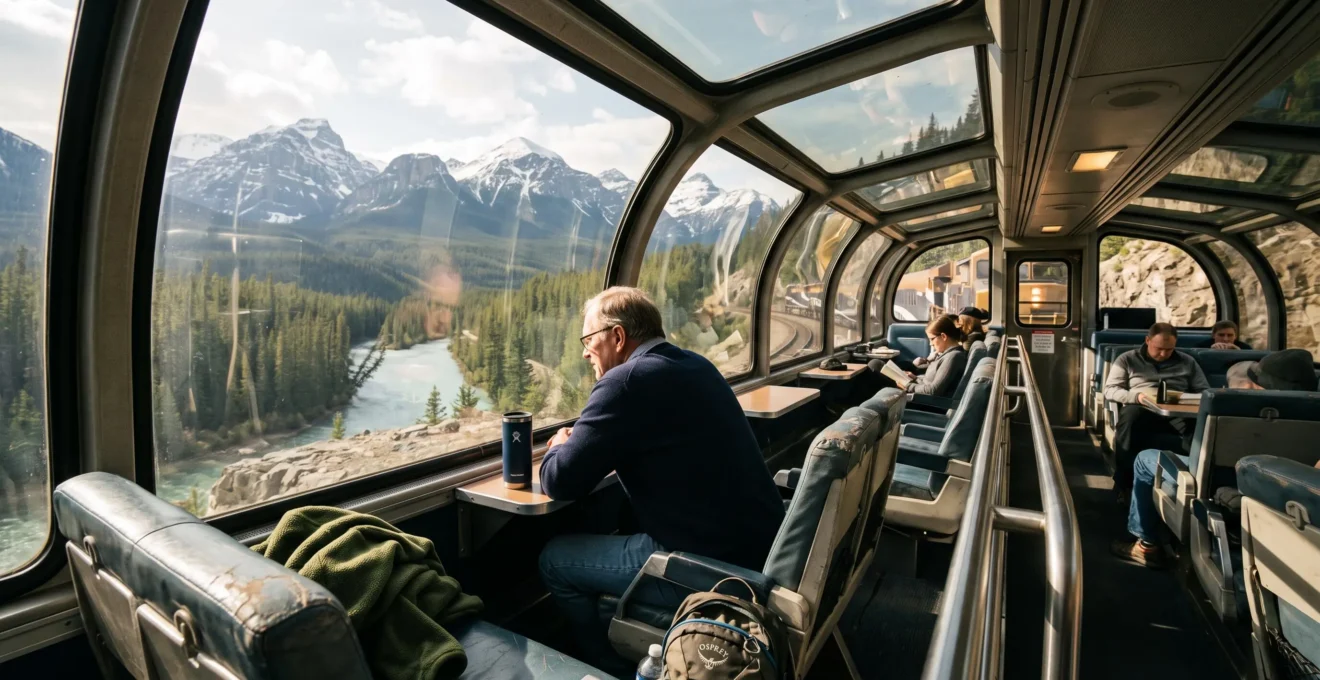
A Canadian scenic train ticket can cost a few hundred dollars or several thousand, yet the most expensive seat does not automatically deliver the best views. What matters is how much remarkable scenery passes your window during daylight, whether you can reach a panoramic observation car, and how comfortably you spend the hours between highlights.
For travellers prioritizing value, VIA Rail‘s The Canadian offers an attractive starting point: Economy passengers can access a panoramic dome without purchasing a sleeper cabin. Sleeper Plus becomes more compelling when the journey lasts several nights and a proper bed, included meals and shower facilities meaningfully improve the experience. Rocky Mountaineer serves a different purpose, concentrating sightseeing into dedicated daylight journeys through Western Canada.
The choice should therefore begin with the scenery you want to see, not the accommodation category you want to buy. A carefully scheduled Economy journey may feel more rewarding than an expensive cabin on an inconvenient departure, while a daylight-focused premium itinerary can suit travellers unwilling to spend days crossing less dramatic terrain.
Canadian scenic train value at a glance
- Best budget-oriented approach: Book VIA Rail Economy, check daylight windows and use the Skyline panoramic dome when space is available.
- Best comfort-oriented approach: Compare Sleeper Plus against Economy after accounting for included meals, sleeping facilities and the number of nights aboard.
- Best concentrated sightseeing approach: Consider a dedicated daylight Rocky Mountaineer itinerary if mountain scenery matters more than experiencing the entire country by rail.
- Why Some Scenic Train Trips in Canada Look Boring From Your Seat
- How to Get the Best Views on a Canadian Scenic Train Without Upgrading Classes
- Day Train, Sleeper Cabin, or a 1-Day Luxury Segment — Which Should You Choose?
- The Booking Mistake That Leaves You Sleeping Through the Best Canadian Train Scenery
- When Should You Add Buffer Days Around Long Canadian Train Routes?
- Is a Sleeper Cabin Worth It on Canada’s Long Rail Trips If You Want Real Sleep?
- How to Plan an Ocean-and-Mountains Week in Canada Using 2 Bases and 1 Transition Day
- How to Survive a 3-Night National Rail Journey Across Canada Without Feeling Miserable
Why Some Scenic Train Trips in Canada Look Boring From Your Seat
Some Canadian train journeys feel visually disappointing because spectacular sections are separated by long periods of relatively repetitive landscape, or because the train crosses important scenery after sunset. A route celebrated for mountain views can still deliver hours of forest, farmland or darkness. The problem is often the timing and concentration of scenery rather than the quality of the route itself.
VIA Rail’s The Canadian runs between Toronto and Vancouver across forests, lakes, prairies and the Rocky Mountains. Those environments create a varied cross-country experience, but they do not provide the same intensity of sightseeing throughout the journey. Travellers expecting uninterrupted mountain panoramas may find the quieter stretches underwhelming.
The distinction is between scenery quality and scenery density. An exceptional mountain valley can be worth seeing even if it occupies only part of a multi-day itinerary. However, someone purchasing the ticket primarily for dramatic views might prefer a shorter experience in which sightseeing is the central activity.
Direction also matters. Eastbound and westbound trains pass locations at different scheduled times, which changes the probability of seeing particular landscapes in daylight. There is no reliable universal rule that one direction always provides better scenery.
Before booking, consult VIA Rail’s Toronto–Vancouver train timetable. Identify the expected dates and times around Jasper, the mountain approaches and other personally important locations. Compare these against local sunrise and sunset times for the travel dates, accounting for time-zone changes.
Seasonal conditions change the experience further. Summer offers longer daylight windows, while winter can bring snow-covered landscapes but fewer hours of visibility. Spring and autumn introduce their own combinations of colour, weather and available daylight. None guarantees clear mountain views.
A long journey is worth the ticket when the less dramatic sections are part of the experience you want. When they feel like time spent waiting for the scenery to begin, a more concentrated route is usually the better comparison.
How to Get the Best Views on a Canadian Scenic Train Without Upgrading Classes
Passengers on VIA Rail’s The Canadian can enjoy panoramic scenery without purchasing Sleeper Plus or Prestige. Economy tickets include access to the Skyline car and its elevated dome, although a particular viewing seat is not guaranteed. The most effective strategy is to identify daylight highlights, visit the dome early and remain flexible about where you sit as the landscape changes.
This is an important distinction because the standard coach window is not your only viewing option. VIA Rail confirms that Economy passengers can access the Skyline panoramic dome in its official guide to The Canadian.
That access does not mean every passenger can occupy a dome seat whenever desired. Seating capacity is limited, and the operator does not provide a universally guaranteed seat-allocation or rotation system in the supplied information. Ask onboard staff about the arrangements applicable to your departure.
A practical viewing strategy has three components:
- Plan your viewing windows: Mark the landscapes you care about on the timetable rather than spending the entire journey searching for a better seat.
- Use the panoramic car strategically: Arrive ahead of an anticipated highlight, allowing for other passengers and operational delays.
- Change your vantage point when appropriate: River bends, mountain slopes and lakeshores can shift from one side of the train to the other.
There is no verified permanent best side for the whole Toronto–Vancouver journey. A seat offering an excellent view through one valley may be less advantageous after the track curves. Choosing one side at booking cannot replace actively observing the landscape.
Meal periods may create opportunities to find an available viewing seat, but crowding varies and there is no guaranteed quiet period. Train staff may also help identify upcoming points of interest or clarify access restrictions.
The Skyline dome should not be confused with the Park car. Park car access is subject to accommodation-class rules and seasonal restrictions, with special privileges for Prestige passengers. Economy access to Skyline does not confer access to every premium observation space.
Premium sightseeing products can also offer larger viewing areas, specialized hospitality and a more structured sightseeing experience. Economy passengers cannot assume those services are included simply because they can visit a dome car.
For scenery-focused travellers, exploiting included viewing facilities can improve the experience substantially before spending an additional dollar on accommodation.
Day Train, Sleeper Cabin, or a 1-Day Luxury Segment — Which Should You Choose?
Choose the train experience according to what you want from the journey. VIA Rail Economy is appropriate for price-conscious travellers willing to tolerate long hours in a seat. Sleeper Plus suits those who value beds, meals and comfort over multiple nights. A dedicated daylight luxury journey suits travellers who prioritize concentrated sightseeing, but a one-day premium segment should not be assumed available on every route.
The cost difference is significant. VIA Rail published the following starting fares for Toronto–Vancouver, based on its summer 2026 season and its subsequent winter season.
| Accommodation | Summer 2026 | Winter 2026–2027 |
|---|---|---|
| Economy Escape | $514 | $514 |
| Sleeper Plus upper berth | $1,750 | $1,083 |
| Sleeper Plus cabin for two | $3,241 | $1,960 |
| Prestige cabin for two | $7,592 | $6,040 |
Summer refers to May 1–October 31, 2026; winter refers to November 1, 2026–April 30, 2027. These are published starting fares, not live quotations or guaranteed prices for the same departure. Their availability, taxes and booking conditions require checking.
At the published starting-price level, the upper-berth premium over Economy was $1,236 in summer and $569 in winter. The difference illustrates how season and sleeping arrangements can influence value, rather than establishing one fixed upgrade cost.
$569 CAD
Difference between the published winter 2026–2027 Toronto–Vancouver Economy Escape and Sleeper Plus upper-berth starting fares. The two prices may not be available together on a particular departure.
To compare actual value, start with the fare difference and subtract the Economy expenses that Sleeper Plus replaces, such as onboard food purchases. Then assign a personal value to sleeping in a bed, shower access and better rest. Do not subtract hotel nights that you would not otherwise have booked.
There is also a hybrid approach: travel part of a journey with VIA Rail and purchase a separate premium sightseeing itinerary for a mountain-focused section.
However, the documented Rocky Mountaineer Journey Through The Clouds service between Vancouver and Jasper takes two daylight rail days via Kamloops. It is not evidence that an interchangeable single-day luxury ticket is offered. Availability, required overnight arrangements and separate-operator connections must be checked individually.
| Primary goal | Best option to investigate | Main trade-off |
|---|---|---|
| Lowest rail fare | VIA Rail Economy | Several nights without a dedicated bed |
| Sleep and onboard comfort | VIA Rail Sleeper Plus | Higher fare without guaranteed additional scenic visibility |
| Concentrated mountain sightseeing | Rocky Mountaineer daylight itinerary | Separate premium pricing and itinerary constraints |
| Combination of transport and sightseeing | Separately booked rail segments | Connection and disruption risks |
A sleeper is less compelling for travellers who comfortably sleep seated, prefer stopping overnight in towns or would rather redirect the fare difference toward experiences outside the train. It is more compelling when several consecutive nights in Economy would undermine the holiday.
The key distinction is whether extra spending buys something you personally value: better sleep, more predictable daylight sightseeing or a different style of travel.
The Booking Mistake That Leaves You Sleeping Through the Best Canadian Train Scenery
The most consequential scenic booking mistake is choosing a departure direction and date without checking when the train is scheduled to pass the landscapes you most want to see. A sleeper cabin cannot compensate for a mountain section crossed in darkness. Before choosing a berth or cabin location, compare the itinerary, local daylight hours and your preferred viewing periods.
On long-distance Canadian routes, arrival and departure times at major stations provide a useful framework for planning. They do not reveal the precise time of every canyon, mountain pass or lake view, but they help estimate which broader regions are likely to be visible.
The Canadian’s published timetable uses local times at different stations. That matters because calculating daylight using a single time zone can produce misleading results. Sunrise and sunset must be matched to the local date and location along the route.
For example, a traveller prioritizing mountain scenery should first inspect the scheduled travel windows around the western mountain sections, rather than assuming a westbound ticket is inherently superior to an eastbound one.
The same principle applies to other routes: identify the main scenic stretches and compare their expected daylight windows. On a multi-day journey, one particularly important stretch might outweigh several hours of ordinary scenery.
Five checks before confirming your Canadian train ticket
- Download the applicable timetable: Save the schedule for your intended travel dates and direction, including station time zones.
- Choose three scenic priorities: Write down the mountain, river or lakeshore sections you most want to experience.
- Mark the daylight windows: Record approximate local sunrise and sunset times beside the relevant timetable locations.
- Compare directions and accommodation: Create a two-direction comparison noting likely daylight exposure, class availability and quoted CAD fares.
- Document your chosen itinerary: Save the booking conditions, connection requirements and viewing priorities before payment.
Berth orientation is a secondary issue. A cabin window may face one side of the train, but the accessible panoramic car offers a separate viewing option. There is no verified guarantee that travellers can request or change a particular cabin side, so confirm availability with the operator before relying on it.
If you have already booked an inconvenient departure, review the ticket’s change conditions. A different travel date or direction may improve likely visibility, but changes can involve availability restrictions or additional charges.
When changes are impractical, organize meals and rest around the expected highlights. An early sleep period can sometimes be more valuable than staying awake through an unremarkable section.
Even a carefully selected departure can run late or encounter poor weather. The objective is to improve the odds of seeing your priorities, not to promise a flawless viewing schedule.
When Should You Add Buffer Days Around Long Canadian Train Routes?
Add a buffer day when a delayed long-distance train could cause you to miss an expensive or difficult-to-replace commitment, such as an international flight, cruise departure or prebooked tour. A same-day connection is much less concerning when the onward activity is flexible. The right buffer depends on the consequence of a delay, not simply the train journey’s distance.
Canada’s long-distance passenger trains share parts of the rail network with freight operations and are exposed to disruptions that can accumulate over multi-day journeys. Scheduled arrival times should not be treated as guaranteed transfer times.
Network frequency creates an additional complication. Where passenger trains operate only on selected days, missing a connection can require substantially more replanning than missing a frequent urban service.
A useful way to size your buffer is to divide onward commitments into two categories:
- Flexible: A refundable hotel, independent sightseeing day or activity that can be moved without major expense.
- Fixed: A flight, scheduled cruise embarkation, expensive nonrefundable excursion or event with limited replacement opportunities.
For flexible plans, accepting a possible change may be reasonable. For fixed departures, an overnight gap is a practical starting point, with additional margin worth considering when the financial consequences of missing the event are substantial.
These are planning judgments rather than guaranteed safe connection thresholds. No specific number of buffer hours can eliminate delay risk.
At places such as Jasper, a missed onward rail departure may have a greater effect than missing a frequent local service. Verify actual operating days and alternative transport options before treating a connection as reliable.
There is also a cost to excessive padding. Extra hotel nights in Vancouver, Toronto or another gateway can consume the savings achieved by choosing a lower rail fare.
Instead of automatically adding accommodation at both ends, schedule the most important fixed commitment after the rail arrival and use intervening time for flexible local sightseeing.
Build the itinerary around what cannot be moved. That usually produces a more efficient travel plan than treating every scheduled train arrival as either perfectly reliable or inherently unusable.
Is a Sleeper Cabin Worth It on Canada’s Long Rail Trips If You Want Real Sleep?
A Sleeper Plus cabin can be worth its higher fare when you spend several nights on The Canadian and need a proper sleeping surface, privacy and convenient access to included meals and showers. However, a bed does not guarantee hotel-quality sleep. Track movement, noise, confined space and personal sensitivity can still make a sleeper journey tiring, particularly on the first night.
Accommodation layouts matter. An upper berth involves climbing into an elevated sleeping space, whereas a lower berth is easier to access. A cabin for one prioritizes private accommodation in a compact space, while a cabin for two is designed to accommodate two travellers with sleeping arrangements adapted for nighttime use.
Before booking, compare the specific product’s dimensions, berth configuration, facilities and suitability for mobility needs. Do not assume all sleeping accommodation offers identical privacy or ease of access.
For light sleepers, the main concern may not be mattress comfort at all. Train movement, vibration, mechanical noise and changes in speed can remain noticeable after the lights are off.
The financial argument becomes stronger as the number of nights aboard increases. An upgrade that seems excessive for one night may offer greater personal value over three nights, particularly if poor rest would compromise subsequent activities.
VIA Rail’s Sleeper Plus includes meals, shared shower facilities and access to the Skyline car. Its dining arrangements differ from Economy, where passengers purchase food separately. Lunch and dinner reservations are required in the Sleeper Plus dining car under the documented service arrangements.
These inclusions should feature in a proper comparison, but they should not be treated as universally equivalent to restaurant meals and hotel rooms. Their value depends on what a traveller would otherwise spend and what level of convenience matters personally.
Prestige adds further private amenities, including an ensuite shower, yet the substantial premium requires a separate justification. Paying for superior accommodation does not create extra daylight or guarantee clear views.
A cabin may also appeal to travellers who benefit from having a private space to retreat to during repetitive sections of the journey. Conversely, sociable travellers who tolerate sleeping upright may consider the extra fare better spent on accommodation at their destination.
Choose a sleeper because it makes the entire journey more comfortable, not because it promises superior scenery. For travellers who sleep lightly on moving vehicles, that distinction is essential.
How to Plan an Ocean-and-Mountains Week in Canada Using 2 Bases and 1 Transition Day
For an ocean-and-mountains holiday in Western Canada, choose Vancouver as the coastal base and Jasper as the mountain base, then build the rail transfer around the available timetable. This avoids repeatedly switching hotels, but the train journey may require more than one calendar day. The simplest plan keeps arrival evenings free and treats rail travel as a major part of the holiday.
Vancouver provides the Pacific-coast starting point, while Jasper offers a base for exploring the Canadian Rockies. The two destinations create a clear geographic contrast without requiring a succession of unrelated rail connections.
The important limitation is travel duration. Rocky Mountaineer’s Journey Through The Clouds between Vancouver and Jasper is a two-day daylight rail experience through Kamloops, rather than a single-day transfer.
The operator’s Vancouver–Jasper rail itinerary establishes the route and its SilverLeaf and GoldLeaf service categories. Specific departures, accommodation arrangements and prices must be checked for the chosen dates.
A realistic seven-day example using that two-day sightseeing transfer could be organized as follows:
| Day | Base or transfer | Planning focus |
|---|---|---|
| 1 | Vancouver | Arrival, light coastal sightseeing and rest |
| 2 | Vancouver | Flexible city and waterfront activities |
| 3 | Vancouver | Additional coastal exploration and preparation |
| 4 | Train to Kamloops | First daylight sightseeing day and intermediate overnight |
| 5 | Train to Jasper | Second daylight sightseeing day, with no fixed evening activity |
| 6 | Jasper | Flexible mountain sightseeing, subject to local conditions |
| 7 | Jasper | Final activities or onward travel with appropriate connection margin |
This is a planning illustration, not a confirmed bookable package. It requires matching actual train operating dates, local accommodation and onward transportation.
A strict one-transition-day version is possible only if a suitable train or other transport service fits the required date and timing. The documented two-day Rocky Mountaineer journey cannot simply be compressed into a single travel day.
Sequence the bases around arrival fatigue and weather flexibility. Spending the first days in Vancouver can allow recovery from a long flight, while leaving at least some uncommitted time in Jasper protects mountain plans against poor visibility.
Travellers departing from a different Canadian city should also investigate how many additional rail days are required. Adding a long-distance leg can change the character of a week-long holiday considerably.
The rail journey should contribute to the scenery, not consume the time required to enjoy both destinations. If the transfer becomes too long, extend the holiday or simplify the route.
What matters before committing to a long Canadian train journey
- Preserve energy for the landscapes that matter most instead of treating every hour aboard as an equally important sightseeing opportunity.
- Choose sleeping accommodation based on the effect several nights of rest will have on the remainder of the trip.
- Prepare for limited connectivity, variable temperatures and schedule changes before boarding rather than trying to solve them during the journey.
How to Survive a 3-Night National Rail Journey Across Canada Without Feeling Miserable
A three-night journey on The Canadian is considerably easier when you treat it as several distinct travel days rather than one continuous sightseeing marathon. Sleep consistently, move around when permitted, manage meals and hydration, and reserve your attention for the landscapes you most want to see. Comfort depends as much on pacing and preparation as on the ticket class.
The journey’s psychological rhythm is important. During the opening hours, the novelty of train travel can make even ordinary surroundings engaging. Later, extended stretches of forest or prairie may begin to feel repetitive, particularly if passengers expect constant dramatic scenery.
The solution is not to remain in the observation car indefinitely. Use quieter periods for reading, conversations, rest and entertainment. When the scheduled route approaches a personally important landscape, return to active sightseeing.
A practical onboard routine could look like this:
- Morning: Wake at a consistent time, eat, check the approximate route position and plan the day’s scenic priorities.
- Late morning: Use daylight for observation, with breaks to stand and move around permitted passenger areas.
- Afternoon: Alternate scenery watching with reading, offline entertainment or social time.
- Evening: Eat, prepare for the next day’s likely highlights and establish a manageable sleep routine.
- Overnight: Prioritize rest rather than trying to remain awake for every possible view.
Pack for actual onboard conditions rather than the romantic image of a luxury train. Layers are useful because different carriages can feel warmer or cooler. A refillable water bottle, comfortable clothing, earplugs, an eye mask, snacks and a small offline entertainment library can reduce avoidable discomfort.
Passengers prone to motion sickness should plan suitable remedies in advance, ideally with professional advice when medication is involved.
Connectivity deserves particular attention. VIA Rail states that Wi-Fi is not available onboard The Canadian, although some major stations offer connectivity. Mobile reception may also be inconsistent along remote sections. Download reading, maps, films and work materials before departure rather than assuming streaming or video calls will be practical.
For Economy travellers, budgeting for purchased meals and snacks is especially important. Sleeper Plus passengers have included meal service, but should still plan personal essentials around the times and facilities available aboard.
Most importantly, do not let the less dramatic middle portion determine your final judgment prematurely. A cross-country journey is deliberately broader than a mountain sightseeing excursion; forests, prairie landscapes and the slower pace are part of its identity.
There is no guarantee that the most anticipated scenery will arrive in perfect conditions. Delays, clouds and personal fatigue all influence what passengers eventually see. A worthwhile experience therefore needs enough comfort and enjoyment outside the headline viewpoints to stand on its own.
Before booking, choose your two or three essential scenic highlights, confirm when they are likely to occur, and compare the real CAD cost of Economy, Sleeper Plus and a shorter sightseeing itinerary. The most satisfying ticket is the one that matches both your viewing priorities and your tolerance for the hours in between.
Can Economy passengers use a panoramic dome on The Canadian?
Yes. VIA Rail includes access to the Skyline car and its panoramic dome for Economy passengers on The Canadian. However, access does not guarantee a particular seat at every moment, and the Skyline dome should not be confused with the Park car, which has different class and seasonal access rules.
Are Canadian scenic train fares shown in Canadian dollars?
The VIA Rail starting fares discussed in this comparison are expressed in Canadian dollars (CAD). They reflect specified seasonal fare tables rather than guaranteed live prices. Confirm the currency, taxes, fare conditions and final total before completing a booking, especially when comparing different operators.
Is Rocky Mountaineer the same train as VIA Rail’s The Canadian?
No. The Canadian is VIA Rail’s long-distance passenger service connecting Toronto and Vancouver. Rocky Mountaineer operates dedicated sightseeing itineraries, including a two-day daylight journey between Vancouver and Jasper through Kamloops. Accommodation, included services, schedules and ticketing arrangements differ between the operators.
Can you combine VIA Rail and Rocky Mountaineer on one trip?
It may be possible to arrange separate tickets as part of a broader itinerary, subject to operating dates and availability. However, the supplied operator information does not establish a protected through-ticket, guaranteed connection or coordinated baggage transfer between the services. Allow suitable transfer time and verify each booking independently.
Does a more expensive cabin guarantee better views of the Canadian Rockies?
No. Higher accommodation classes can provide sleeping facilities, meals, privacy and additional onboard privileges, but they cannot guarantee daylight at a particular location or clear weather. To improve the likelihood of seeing the Rockies, check the timetable, seasonal daylight and relevant observation-car access before choosing the fare class.