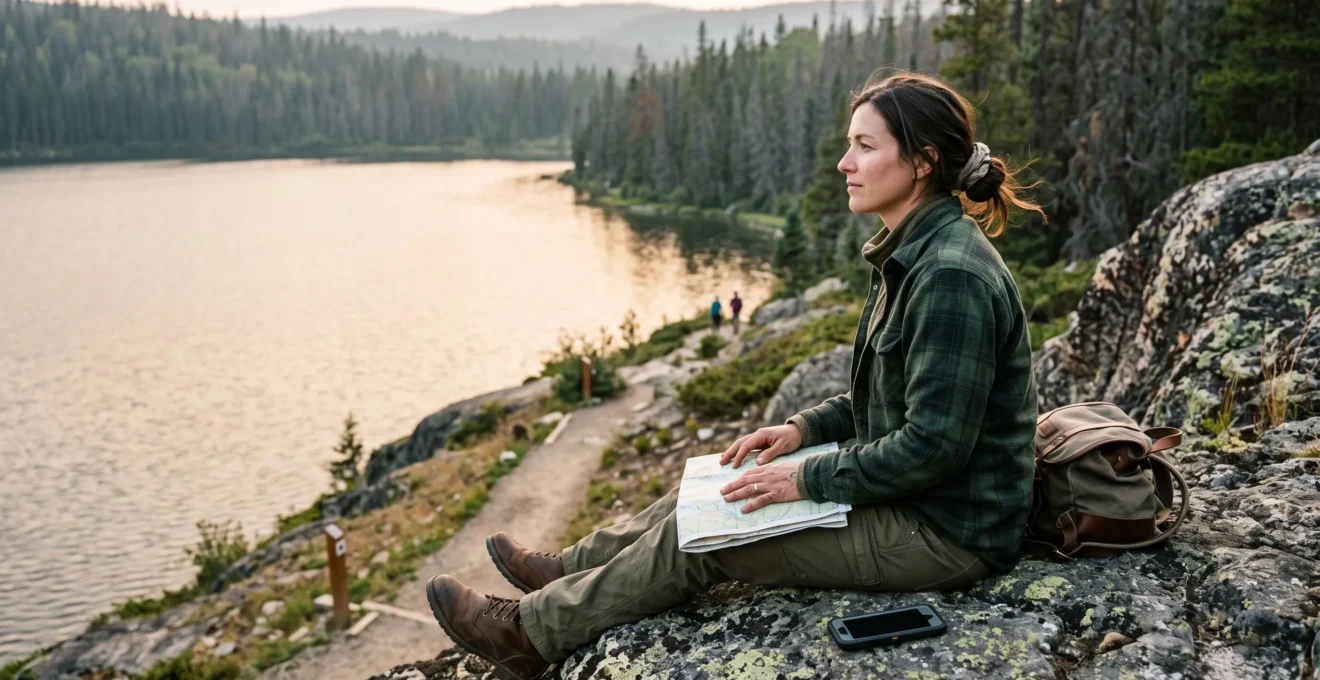
The best wild space in Canada for an overwhelmed city dweller is often a quiet, accessible provincial park or a serviced national park campground—not a remote lake requiring advanced navigation skills. The ideal escape offers enough distance from traffic, notifications and everyday obligations to feel different, while keeping marked trails, practical facilities and a manageable route back.
For someone living in Toronto, Montréal or Vancouver, wilderness can promise an appealing psychological reset. Yet the moment cellphone reception disappears, the forest grows unusually quiet or an unfamiliar animal makes a noise, that promise can turn into anxiety.
The solution is not necessarily to become a more adventurous camper. It is to choose a setting where the feeling of wilderness exceeds the demands of wilderness survival. A relaxed afternoon beside a forest lake, a night in a roofed park shelter or a modest mountain viewpoint can deliver meaningful time away from urban stimulation without requiring a backcountry expedition.
The practical question is how much solitude feels restorative before it starts feeling unsafe.
Canada’s wild spaces: the short answer
- Start with managed nature: Choose marked trails, accessible provincial parks or frontcountry campgrounds before attempting remote wilderness.
- Separate solitude from isolation: A quiet setting can feel remote without requiring you to give up emergency planning, established routes or nearby services.
- Match the escape to your energy: Consider accommodation, weather, daylight, trail difficulty and your comfort without cellphone coverage—not just scenery.
- Why Do Wild Places Make Some People Anxious Instead of Calm?
- How to Choose the Right Level of Canadian Wilderness If You’re Not an Expert Camper?
- Where Should You Go for Wild Space in Canada: National Parks, Provincial Parks, or Crown Land?
- The Isolation Mistake That Turns a ‘Quiet Nature Day’ Into a Search-and-Rescue Call
- When Is the Best Time to Visit Canada’s Wild Spaces for Solitude Without Extreme Weather?
- Why Do Canadian Mountain Hikes Feel Harder Than the Distance Suggests?
- Which Is Better for a Simple Outdoor Day: National, Provincial, or City Parks?
- Which Canadian Mountain Peak Hike Is Realistic for Your Fitness Level Without Turning Risky?
Why Do Wild Places Make Some People Anxious Instead of Calm?
Wild places can feel unsettling because they remove the familiar signals that make urban environments predictable. Limited cellphone coverage, unfamiliar wildlife sounds, fewer people and unclear escape routes can increase vigilance rather than encourage relaxation. That response does not mean someone dislikes nature. It often means the environment demands more confidence and preparation than they currently have.
The idea that nature automatically reduces stress is appealing, but the scientific evidence deserves careful interpretation. A 2024 systematic review of nature-based therapies and mental health examined eight publications and found mixed psychological outcomes. The authors concluded that evidence supporting these interventions as a primary treatment for stress, anxiety and depression remained limited.
That finding does not mean a forest walk cannot feel restorative. It means that simply entering a natural environment does not guarantee a particular mental health outcome.
For first-time wilderness visitors, understanding the source of discomfort is more useful than treating every anxious response as the same problem.
| Concern | What makes it uncomfortable | A more reassuring choice |
|---|---|---|
| Getting lost | Unmarked junctions, unfamiliar terrain or uncertain directions | A short, clearly marked trail with a downloaded map and a straightforward return route |
| Wildlife encounters | Uncertainty about bears, other animals or unfamiliar forest sounds | A managed park with local wildlife guidance, appropriate food storage and established visitor routes |
| Social disconnection | Cellphone dead zones, long distances from services or the absence of other visitors | A quieter trail within a serviced park, visited with a companion |
A useful approach is a gradual wilderness tolerance ramp. Begin with an afternoon in a substantial conservation area, then try a longer outing on established trails, followed by a frontcountry overnight stay if the earlier experiences feel manageable.
This is a practical progression, not a clinically validated exposure-therapy protocol. Its purpose is to help travellers identify which conditions feel comfortable before increasing their commitment.
For example, a Montréal resident who feels uneasy about sleeping far from other people might enjoy a quiet forest walk in a managed park, then return to familiar accommodation that evening. A Toronto resident who enjoys daytime solitude but dislikes unpredictable overnight sounds might prefer a roofed campsite over a tent.
Pushing straight into remote camping can undermine the intended break. An uncomfortable night dominated by fear, poor sleep and uncertainty may make another nature trip less appealing.
The better starting point is an experience that builds confidence. Once the main sources of anxiety are understood, choosing an appropriate wilderness setting becomes considerably easier.
How to Choose the Right Level of Canadian Wilderness If You’re Not an Expert Camper?
Choose your level of Canadian wilderness according to navigation experience, comfort with limited facilities, reaction to cellphone dead zones and whether you are travelling alone. Beginners generally benefit from frontcountry camping, accessible roofed accommodation or established day-use trails. A genuinely wild atmosphere does not require remote camping, expensive equipment or complete self-sufficiency.
Canadian outdoor destinations offer a much wider range of experiences than the usual choice between a busy city park and a remote tent beside a lake.
A simple way to find the right fit is to distinguish three practical levels of wilderness.
| Wilderness level | Typical experience | Best suited to |
|---|---|---|
| Frontcountry | Vehicle-accessible campground, established facilities and nearby visitor areas | First-time campers who want outdoor immersion with convenient access |
| Semi-wild comfort | Roofed shelter, yurt, accessible cabin or lodge near natural landscapes | Travellers who want a quiet overnight without managing a complete camping setup |
| Backcountry | More remote camping accessed by hiking or paddling, with greater self-reliance | Visitors with suitable preparation, equipment and wilderness experience |
These are practical planning categories rather than formal safety ratings. A roofed shelter can still be remote, while a maintained trail can lead into challenging terrain. The individual location matters more than the accommodation label.
Before choosing, ask yourself four questions: Can you follow a trail without continuous phone navigation? Would a night without running water or nearby washrooms feel manageable? How would you react to losing reception? Would you feel comfortable handling a problem without a companion?
If several answers reveal uncertainty, choose a setting that retains more infrastructure.
Canada has an especially useful middle ground: roofed accommodation in managed parks.
According to Parks Canada‘s camping and overnight accommodation options, visitors can choose among frontcountry campsites, equipped camping, oTENTiks, yurts and cabins at participating destinations.
An oTENTik combines elements of a tent and a cabin, including beds and furniture. Other roofed options may provide heating or additional shelter features. These choices can reduce the need to own a tent or assemble an entire sleeping setup.
However, roofed does not necessarily mean fully equipped. Bedding, cooking supplies, potable water, washrooms and cellphone service vary by location. Check the specific accommodation listing rather than assuming that a cabin-like structure provides hotel-level amenities.
Fitness is another misleading shortcut. Someone who regularly exercises may be physically capable of a long hike while lacking the navigation, weather judgment or equipment needed for an unexpected delay. Physical endurance and wilderness self-sufficiency are different skills.
For an initial overnight escape, look for a location where a short forest walk, lakeside time and comfortable shelter are all available without complicated travel between them.
The next decision is where to find that experience. Canada’s national parks, provincial parks and Crown land operate differently, and those differences directly affect how peaceful—or demanding—a trip becomes.
Where Should You Go for Wild Space in Canada: National Parks, Provincial Parks, or Crown Land?
Provincial parks are often the most practical starting point for urban Canadians seeking quiet wilderness without extreme isolation. National parks provide established visitor experiences and, at selected sites, roofed accommodation. Crown land can offer flexible, low-cost recreation, but requires more independent planning. The best choice depends on local facilities, access, rules and your comfort with uncertainty.
These three options differ in management, booking procedures and visitor infrastructure. They should not be treated as interchangeable simply because all three can contain forests, lakes and quiet natural settings.
| Planning factor | National parks | Provincial parks | Crown land |
|---|---|---|---|
| Reservations | Often required for accommodation and certain activities | Depend on the provincial system and individual park | Rules depend on jurisdiction and location; may not use campground-style reservations |
| Costs | Applicable entry, camping or accommodation fees | Applicable provincial entry or accommodation fees | Some recreation is free, but restrictions and permits may apply |
| Facilities | Established at selected visitor areas; variable elsewhere | Range from serviced campgrounds to remote wilderness | Should not be assumed to exist |
| Cell coverage | Not guaranteed | Not guaranteed | Not guaranteed |
| Staff and assistance | Depend on the site, activity and operating conditions | Depend on the park and operating conditions | No routine visitor assistance should be assumed |
| Beginner suitability | Good at appropriately selected developed sites | Good at appropriately selected developed sites | Generally better after gaining self-sufficiency experience |
Parks Canada manages federal national park destinations, while provincial park systems are administered separately. Ontario Parks, BC Parks and Québec’s Sépaq-managed destinations illustrate how booking procedures, facilities and accommodation options can differ across Canada.
For someone in Toronto, a serviced Ontario provincial park may offer an appealing alternative to travelling farther for an iconic national park. Montréal residents can investigate accessible Québec park destinations, while Vancouver residents can compare BC provincial parks with more heavily visited national park locations.
The choice should reflect travel time, available facilities and the intensity of the experience rather than the prestige of the destination.
Banff and Jasper can provide spectacular natural environments, but their recognition does not make them automatically better for someone escaping crowds. Busy visitor areas may reproduce the traffic, queues and scheduling pressure the traveller wanted to leave behind.
A lesser-known provincial park with a maintained lakeside trail may offer a more useful combination of quiet surroundings and manageable logistics. However, a little-known park is not necessarily less crowded on a particular weekend, so local conditions still need checking.
Crown land requires especially careful consideration. The Ontario government‘s Crown land recreation rules explain that recreational camping is free on most Ontario Crown land, subject to land-use restrictions and eligibility requirements.
In Ontario, private non-commercial camping is generally limited to 21 days at one site during a calendar year, after which campers must move at least 100 metres away. Certain locations have additional restrictions, and permit requirements can apply to non-residents of Canada.
These are Ontario-specific rules, not nationwide permissions. Crown land policies vary by jurisdiction, and not every public parcel permits camping.
More importantly, a low-cost campsite without established services transfers practical responsibility to the visitor. Access, water, navigation, waste management, wildlife precautions and emergency planning may all require independent arrangements.
That trade-off can make Crown land rewarding for prepared outdoor enthusiasts but less suitable for someone whose main objective is recovering from an exhausting workweek.
For a first psychological reset, a managed park with quieter areas is usually a more reassuring choice than deliberately seeking the most isolated setting available. The distinction becomes crucial when planning how to return safely.
The Isolation Mistake That Turns a ‘Quiet Nature Day’ Into a Search-and-Rescue Call
The dangerous isolation mistake is treating a quiet outdoor trip as a reason to leave no itinerary or emergency contact. If a hiker becomes lost, injured or delayed without cellphone coverage, nobody may know when or where to begin looking. Sharing a route and expected return time preserves the feeling of solitude while making an overdue return easier to recognize.
Someone seeking relief from messages, schedules and constant availability may feel tempted to disappear completely for the day. Turning off notifications can support that goal. Removing every practical communication safeguard does not.
Consider an explicitly hypothetical situation: a Vancouver resident chooses a quiet forest trail, tells nobody the destination and assumes the phone will work throughout the walk. A confusing junction leads to a longer route, daylight fades and reception disappears. Even without a serious injury, the combination creates a difficult decision about continuing or returning.
The problem is not that the hiker wanted peace. It is that the plan relied on several unverified assumptions.
That distinction matters because solitude and isolation are not the same condition.
Solitude can mean walking for a while without seeing other people on an established trail. Isolation means assistance, communication or a straightforward exit may be difficult to access. A marked route does not guarantee patrols, and a developed park does not guarantee cellphone reception.
Canadian weather makes preparation particularly important. A manageable daytime walk can become uncomfortable or dangerous when rain, wind, falling temperatures or fading daylight complicate the return.
Mountain conditions may change rapidly, while shoulder-season trips can involve shorter days and unexpectedly difficult trail surfaces. Water crossings require special caution, and a crossing that appears easy earlier in the day may not remain safe under changing conditions.
Official Parks Canada hiking guidance emphasizes planning for trail conditions, weather, navigation and communication limitations. It also recommends sharing a trip plan with a trusted person. These measures cannot eliminate risk, but they reduce dependence on luck when circumstances change.
Your five-step pre-departure safety check
- Share your trip plan: Send a trusted person the trail name, starting location, intended route, expected return time and instructions for what to do if you are overdue. Your deliverable is a message the recipient has acknowledged.
- Save navigation resources: Download an appropriate offline trail map, identify the return route and carry a suitable backup. Your deliverable is navigation information you can access without mobile data.
- Check current conditions: Review the weather forecast, trail notices, expected daylight and any local hazards before leaving. Your deliverable is a recorded go/no-go decision based on the actual conditions.
- Confirm emergency arrangements: Identify the appropriate local emergency contact procedure, including 911 where available, and understand the limitations of cellphone service. Your deliverable is an emergency contact note accessible offline.
- Set a turnaround time: Choose a latest departure-from-destination time that allows for a conservative return before darkness, including delays. Your deliverable is a written turnaround time shared with your contact.
Carry clothing suitable for changing conditions, water, food and essential safety supplies appropriate to the trail. A phone with downloaded maps is useful, but it should not be the only navigation or emergency plan where reception is unreliable.
A trailhead register, when available, can supplement these measures. It should not replace telling a trusted person when you expect to return.
With the basic safeguards in place, solitude becomes easier to enjoy. The remaining question is when to go, because the season can change both the atmosphere and the difficulty of the same destination.
When Is the Best Time to Visit Canada’s Wild Spaces for Solitude Without Extreme Weather?
Late spring and early fall can provide a useful balance of quieter parks, manageable conditions and pleasant outdoor experiences in many accessible parts of Canada. Neither season is universally safest or most comfortable. The right timing depends on regional weather, daylight, elevation, trail conditions and whether visitor services remain available during your trip.
Choosing a season means balancing three competing factors: how many people are likely to visit, how predictable the weather may be and how much daylight is available for the intended activity.
No single month optimizes all three across the country.
| Period | Potential advantage | Important limitation |
|---|---|---|
| Late spring | Opportunities to visit before the busiest summer periods | Wet trails, insects, lingering snow at elevation and possible seasonal closures |
| Summer | Long daylight hours and more seasonal visitor services | Higher demand at popular locations, possible heat, wildfire smoke and weather hazards |
| Early fall | Potentially quieter trails and comfortable conditions in suitable regions | Shortening daylight, colder evenings and changing operating schedules |
| Late fall and winter | Potential for fewer visitors at accessible locations | Cold-weather hazards, snow, ice, limited services and greater equipment requirements |
For a Toronto resident seeking a relaxed forest weekend, a suitable spring or early-fall visit to a serviced park may offer an appealing alternative to a busy summer holiday. Québec’s forest destinations can also be attractive outside peak vacation periods, provided trails and facilities are operating.
A Vancouver traveller needs to consider the difference between coastal conditions and higher-elevation routes. A lowland trail and a mountain trail can have very different snow and weather conditions on the same date.
Shoulder season should mean lower demand, not lower preparation. Early snow, cold rain and shorter days can complicate trips that appear straightforward in summer.
Wildfire activity and smoke may also affect outdoor plans in some regions. Conditions should be checked close to departure rather than judged solely by the calendar.
Reservations create another practical trade-off. Well-known national park destinations and popular accommodation types can require advance planning, particularly during high-demand periods. Booking availability and release procedures depend on the specific park system and location.
That makes lesser-known provincial parks valuable for people who do not want their mental reset to become a complicated booking project. An accessible destination with available accommodation can be more useful than an iconic location requiring months of coordination.
However, empty facilities or trails in late fall should not be mistaken for effortless solitude. Seasonal closures may remove access to washrooms, water, staffed visitor areas or maintained routes.
Beginners seeking a peaceful trip should generally prefer an operating season with appropriate services rather than pursuing the quietest possible period regardless of conditions.
Once the season and destination are settled, the most important remaining variable is the activity itself. A peaceful forest trail and a steep mountain hike can demand very different amounts of energy.
Why Do Canadian Mountain Hikes Feel Harder Than the Distance Suggests?
Canadian mountain hikes often feel harder than their distance suggests because elevation gain, steep grades, uneven footing and changing weather increase the effort required. A 10 km mountain trail is not equivalent to a 10 km walk through a city park. Beginners should compare total elevation gain, terrain and expected hiking time before choosing a route.
Distance remains useful, but it is only one part of trail difficulty.
A relatively short route with sustained climbing can demand more physical effort than a longer trail across gentle terrain. Loose rock, roots, uneven steps and limited opportunities to recover can make the experience more tiring.
For an urban traveller whose goal is to feel mentally refreshed, that distinction matters. A hike that consumes every available reserve of energy may leave little opportunity to sit beside a viewpoint, listen to the forest or enjoy the quiet.
Instead of asking how far you can walk, ask how much effort you can comfortably sustain while still enjoying the surroundings.
Consider an explicitly hypothetical comparison: one trail is a 10 km route along relatively level terrain, while another covers the same distance with substantial climbing over rough ground. Although the distances match, the second route creates additional physical demands, particularly for someone unfamiliar with mountain hiking.
These factors deserve attention when reading a trail description:
- Elevation gain: How much total climbing is involved, rather than only the height of the destination.
- Terrain: Whether the surface is maintained, rocky, slippery, exposed or difficult to follow.
- Steepness: Whether climbing is gradual or concentrated into demanding sections.
- Conditions: Whether snow, rain, wind or damaged trail sections have changed the expected difficulty.
- Return effort: Whether the descent requires sustained concentration after fatigue has developed.
The descent should be included in the energy budget. Tired legs and reduced attention can make uneven downhill sections difficult even when the climbing portion felt manageable. There is no need to assume that injuries predominantly occur on descents to recognize this practical concern.
In western Canadian mountains, lingering snow can affect higher trails into early summer. Trailhead elevation, weather exposure and route conditions can also make a seemingly modest outing harder than expected.
Parks Canada advises first-time hikers to choose shorter routes with limited elevation gain and to match hiking plans to both experience and physical ability. Its general beginner walking-speed guidance is not a guarantee of travel time on steep mountain terrain.
A conservative choice leaves room for breaks, photography, unexpected delays and an unhurried return. It also reduces the pressure to continue simply because reaching the destination has become the day’s main objective.
A mountain summit is not a prerequisite for a restorative outdoor experience. For many people, a simple day in a nearby park offers a more reliable first step toward enjoying larger wilderness settings.
Which Is Better for a Simple Outdoor Day: National, Provincial, or City Parks?
City and regional parks are often best for a spontaneous, low-effort nature break because they minimize travel, planning and equipment needs. Provincial parks can provide greater immersion with manageable facilities, while national parks may suit a more deliberate day trip. The right choice depends on how much natural quiet you want relative to the time and preparation required.
A restorative day outdoors does not need to involve sleeping away from home. For someone already exhausted by work, traffic and family obligations, eliminating complicated logistics may be more valuable than travelling to a famous landscape.
City parks are particularly useful because they make nature accessible on ordinary days rather than only during planned holidays.
| Factor | City or regional park | Provincial park | National park |
|---|---|---|---|
| Spontaneity | Often high, subject to local access rules | Variable; some visits require advance arrangements | Variable by destination and activity |
| Cost | Often low, though fees may apply | Entry, parking or activity fees may apply | Entry or activity fees may apply |
| Facilities | Depend on the municipality and park | Range from basic trails to developed visitor areas | Depend on the national park and specific location |
| Nature immersion | Accessible greenery with possible urban noise | Potentially extensive natural settings | Potentially extensive natural settings |
| Planning effort | Usually relatively low | Depends on travel distance and the activity | Depends on travel distance and the activity |
For an overwhelmed Toronto resident, a quiet session in a substantial urban ravine or conservation area may deliver a satisfying break without leaving the metropolitan region. In Montréal, an accessible wooded area can offer the same low-commitment opportunity. Vancouver residents can similarly use local forested parks as an introduction to more natural terrain.
These choices are not inferior versions of wilderness travel. They serve a different purpose.
A simple outdoor day might involve walking slowly along an established path, finding a suitable place to sit and spending time away from work-related notifications. The activity is easy to repeat, which matters for someone who cannot regularly arrange overnight escapes.
City parks do have limitations. Traffic noise, crowds, sports facilities and nearby development can interrupt the sense of separation from everyday life. Easy cellphone connectivity may also make it tempting to resume checking messages.
When the goal changes from taking a pleasant break to feeling genuinely removed from the city, moving toward an accessible provincial or national park can provide a stronger sense of immersion.
Even then, the best destination is not necessarily the largest. A nearby provincial park with a sheltered lakeside route may be more relaxing than a long drive followed by an ambitious hike.
A useful progression is to begin with local outings, discover which natural settings feel comfortable and reserve more substantial trips for occasions when time and energy permit.
For some travellers, regular simple nature days will be enough. Others will gradually want a more challenging experience, such as reaching a mountain summit—an objective that requires a separate assessment of fitness, skill and terrain.
Key takeaways before choosing a summit hike
- Choose an established trail that matches your demonstrated hiking experience, not an impressive-looking peak.
- Evaluate elevation gain, terrain, exposure and return time together; distance alone cannot establish whether a summit is appropriate.
- Build confidence through progressively harder hikes while retaining the freedom to turn around without reaching the top.
Which Canadian Mountain Peak Hike Is Realistic for Your Fitness Level Without Turning Risky?
A realistic Canadian peak hike is a maintained, clearly marked route whose elevation gain, terrain and expected completion time fit your proven ability. Beginners should favour modest summit or viewpoint trails without scrambling, exposed ridgelines or complex navigation. No summit is risk-free, and choosing a popular or officially maintained trail does not eliminate changing weather or personal limits.
The most useful way to select a first summit is to match published route characteristics with previous hiking experience.
Someone who comfortably completes short, gently graded forest walks has not necessarily demonstrated readiness for a steep mountain ascent. Similarly, running or cycling fitness does not automatically establish experience with loose rock, route-finding or exposed terrain.
A sensible progression starts with familiar, maintained trails and gradually increases physical or technical demands without changing every variable at once.
| Experience level | Suitable objective | What to avoid initially |
|---|---|---|
| New to hiking | Short marked woodland trails with modest climbing and straightforward return access | Remote summit objectives, steep exposed routes and difficult navigation |
| Comfortable day hiker | Maintained uphill trails with manageable elevation gain and established viewpoints | Unfamiliar scrambling, uncertain route-finding and extreme weather exposure |
| Experienced mountain hiker | More demanding marked mountain routes compatible with existing skills and current conditions | Technical objectives beyond actual training, equipment or conditions |
For accessible mountain objectives, look first at established routes within managed national and provincial parks.
In the Vancouver region, for example, maintained lower-elevation trails and managed viewpoints can provide an introduction to mountain terrain before attempting more demanding summit objectives. In Québec, established hiking destinations can offer progressively steeper walks and elevated viewpoints.
The name of a mountain is not sufficient to establish that its summit is appropriate. Official route descriptions, current trail conditions, operating restrictions and the specific path selected matter more than social-media photographs.
Parks Canada uses a published hiking difficulty classification that distinguishes easy, moderate, difficult and route-level terrain. This provides a more useful starting point than subjective labels such as beginner-friendly or Instagram-worthy.
Pay particular attention to the point where a maintained hiking trail becomes a route requiring additional technical judgment.
- Exposed ridgelines: A fall may have serious consequences, especially in poor weather.
- Scrambling: Progress may require hands for balance or climbing on rocky terrain.
- Route-finding: Marked paths may give way to less obvious terrain requiring independent navigation.
- Changing surface conditions: Snow, ice, loose rock or wet ground can substantially alter difficulty.
These features do not automatically make a mountain inaccessible to all hikers. They do mean that the objective may require skills beyond ordinary walking fitness.
Social pressure can complicate the decision. A famous summit photographed on a clear summer day may look approachable, but an image rarely communicates elevation gain, weather exposure, route-finding demands or the effort required to descend.
The most effective confidence-building approach is to complete progressively harder marked trails under suitable conditions before choosing a summit that introduces additional challenges.
Turning around should remain an ordinary part of the plan. A change in weather, unexpectedly slow progress, fatigue or an uncomfortable section is sufficient reason to abandon the summit without treating the trip as a failure.
For someone seeking a psychological reset, the reward is the quality of the outdoor experience, not the elevation reached.
For your next escape, choose one accessible park, one trail comfortably below your maximum ability and one place where you can spend time quietly without rushing. Confirm conditions, share your return plan and leave enough energy to enjoy the landscape. A successful unplugged trip is one you can appreciate while it is happening—and finish feeling ready to experience nature again.
Can you experience Canadian wilderness without camping overnight?
Yes. A day visit to an accessible national or provincial park can provide forest trails, lakeside scenery and time away from urban stimulation without overnight equipment. Choose a marked route, confirm opening conditions and leave enough time to return comfortably before darkness.
Is it safe to visit bear country if you have never camped before?
A first-time visitor can choose a managed park in bear country, but safety depends on local conditions, behaviour and preparation rather than beginner status alone. Review the park’s current wildlife advisories, learn how to avoid attracting wildlife, follow food-storage requirements and understand the recommended response to encounters with species present in the area. Never approach or feed wildlife, and do not assume a busy trail is free of bears.
Do you need cellphone reception to enjoy a quiet Canadian park safely?
Continuous reception is not always necessary, but lack of coverage changes how a trip should be planned. Carry appropriate navigation resources, share your route and return time with a trusted person, and understand local emergency arrangements. Beginners uncomfortable with complete disconnection may prefer an accessible visitor area, while recognizing that coverage is never guaranteed throughout a park.
Do Parks Canada oTENTiks have bathrooms, bedding and electricity?
Facilities vary by location. An oTENTik provides a tent-and-cabin-style structure with beds and furniture, but visitors should not assume that bedding, electricity, cooking equipment, running water or a private bathroom are included. Check the exact accommodation description and packing requirements before reserving.
How can you avoid feeling isolated when travelling alone in nature?
Start with short, popular, well-marked routes near developed visitor areas, ideally during normal operating hours. Tell a trusted person where you are going and when you will return, and choose a route you can complete comfortably without relying on mobile reception. Parks Canada generally discourages solo hiking for inexperienced visitors except on suitable easy, popular trails. Joining a companion or organized group may provide a more reassuring introduction.