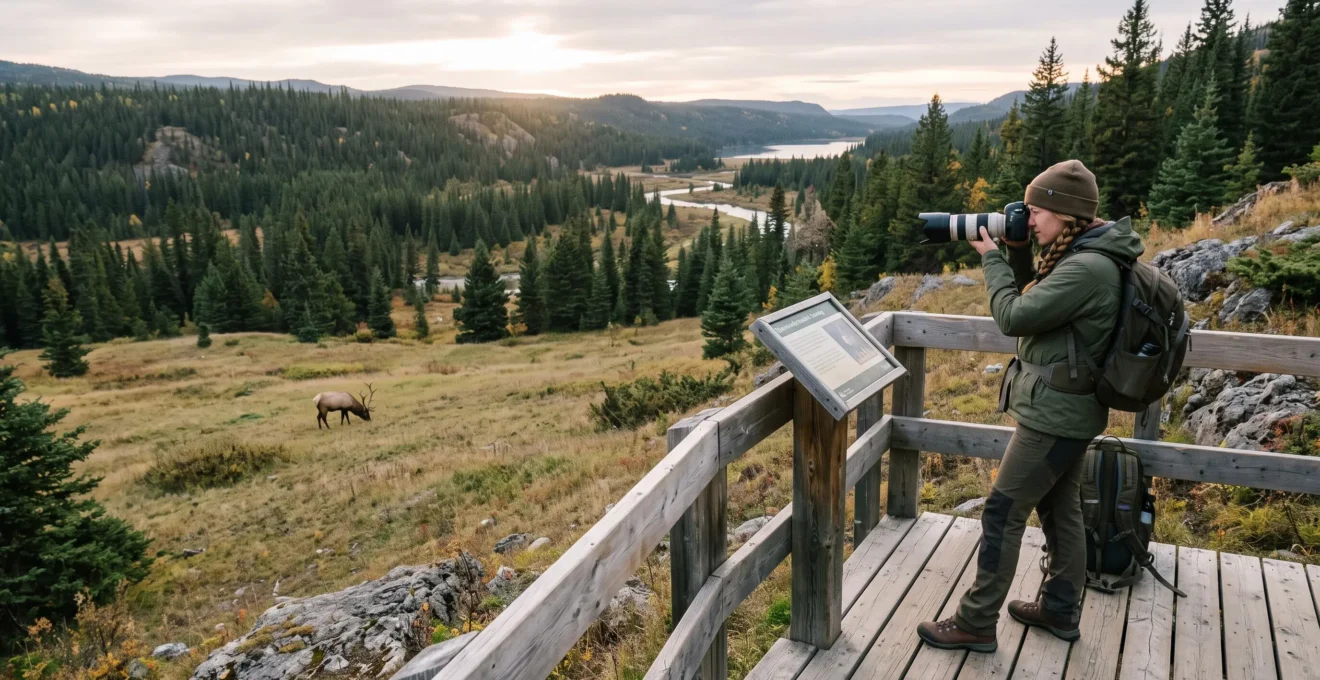
In Canada, conservation culture is something visitors participate in through everyday decisions. It means respecting wildlife, staying on designated trails, managing food and waste carefully, and following the rules of whichever protected area you enter. You do not need to join an environmental organization or undertake a conservation project to contribute during a one-week holiday.
Imagine visiting a national park in the Canadian Rockies, canoeing through an Ontario lake, or spending an afternoon in an urban nature reserve. The environments differ, but the central principle remains useful: enjoy nature without leaving problems for the animals, ecosystems, park staff, or visitors who come after you.
Canada’s national, provincial, territorial, regional, and municipal parks have different management systems. Responsible travel therefore involves both understanding shared conservation principles and checking the specific rules at each destination.
The most useful starting point is to treat low-impact travel as a series of practical choices rather than a statement about personal values.
Canadian conservation culture: what visitors need to know
- Your behaviour matters immediately: stay on marked trails, never feed wildlife, keep your distance from animals, and remove your waste.
- Park rules are location-specific: check official information about closures, dogs, drones, camping, fires, and access before visiting.
- Responsible travel starts with planning: choose suitable destinations, respect visitor-management systems, and store food properly during outdoor stays.
- Why Is Canadian Conservation So Focused on Visitor Behaviour Instead of Big Fundraisers ?
- How to Have a Low-Impact Day in a Canadian Park Using a 5-Point Routine ?
- What Makes More Sense in Canada: Donating, Volunteering, or Booking Local Eco-Operators ?
- The Photo Mistake That Can Get You Fined in Canadian Parks
- When Should You Visit Popular Canadian Nature Spots to Reduce Impact and Still Enjoy Them ?
- The Campsite Mistake in Shield Country That Attracts Wildlife Overnight
- Which Is Better for a Simple Outdoor Day: National, Provincial, or City Parks ?
- Which Outdoor Activity in Canada Should You Choose If You Hate Crowds or Extreme Cold ?
Why Is Canadian Conservation So Focused on Visitor Behaviour Instead of Big Fundraisers ?
In Canada’s protected areas, visitors are expected to contribute to conservation primarily by following rules that protect habitats, wildlife, and other visitors. Donations can support conservation projects, but they cannot replace responsible conduct on the ground. For someone spending only a week in Canada, daily choices are the most immediate contribution within their control.
This emphasis reflects how public protected areas are managed. National parks operate under federal administration, while provincial, territorial, and municipal parks have their own governing authorities. These systems combine public funding, regulation, visitor services, and conservation responsibilities.
Private donations and nonprofit partnerships also contribute to conservation in Canada. There is no basis for treating donations as unimportant or claiming that every Canadian conservation organization prioritizes visitor etiquette over fundraising.
The distinction is simpler: a traveller can make a donation from almost anywhere, but only the person physically visiting a sensitive habitat can control what happens during that visit.
Consider what happens when a visitor leaves a marked trail. A shortcut may trample vegetation and contribute to erosion. Other walkers may follow the same route, gradually widening the disturbance.
Food waste creates a different problem. Animals attracted to food or garbage may begin associating people with easy meals. This can increase the likelihood of encounters requiring intervention by wildlife managers.
Park authorities may use temporary closures or restrictions to protect wildlife corridors and sensitive habitats or manage safety concerns. However, an individual shortcut or piece of litter does not automatically trigger a closure, relocation, or wildlife removal.
The expectations are summarized in Parks Canada’s ten rules for a responsible visit, which address trails, garbage, wildlife, pets, and temporary restrictions.
Conservation culture therefore turns an abstract goal into practical responsibilities: respect the boundary, manage your belongings, and leave animals undisturbed.
Once that principle is understood, the next question becomes operational: what should a responsible visitor actually do from the moment they start planning a park day?
How to Have a Low-Impact Day in a Canadian Park Using a 5-Point Routine ?
A low-impact day in a Canadian park follows five practical steps: check local conditions, prepare food and equipment, stay on designated routes, protect wildlife from human disturbance, and leave the site clean. Repeating this routine throughout a one-week trip makes responsible behaviour manageable without requiring specialist conservation knowledge.
Start the evening before your visit. Open the official page for your destination and check trail conditions, temporary closures, fire restrictions, wildlife advisories, and access requirements. Confirm whether parking, entry, or particular activities require reservations.
Pay attention to who manages the park. Rules for dogs, fires, drones, and overnight activities can differ between federal, provincial, and municipal properties. A practice permitted in one park should not automatically be assumed legal in another.
Prepare meals and snacks that are easy to carry and pack away. Reusable containers can reduce loose packaging, but the more important conservation requirement is ensuring that nothing is left behind.
During the outing, stay on the designated trail even when it is muddy. Walking around puddles can gradually widen trails and damage surrounding vegetation. Where a route is impassable or closed, choose another authorized route rather than creating a bypass.
Pack out all waste, including fruit peels, apple cores, and other biodegradable scraps. Natural food waste is still an unnatural food source for wildlife in a visitor area.
When an animal appears, observe without approaching, feeding, following, or blocking its movement. Binoculars and camera zoom are more appropriate than moving closer for a better view.
Before leaving, inspect your rest area for food fragments, packaging, and misplaced equipment. Check that any cooking or picnic area is clean and that nothing attractive to wildlife remains accessible.
Your five-point low-impact park-day checklist
- Verify park conditions: check the official destination page and save the relevant closure, access, and wildlife advisories.
- Prepare a waste plan: pack snacks, a reusable container, and a waste bag; confirm that every item can leave with you.
- Confirm your route: identify an open, designated trail and save a map showing its start, finish, and authorized alternatives.
- Prepare for wildlife: identify the park’s viewing guidance and pack binoculars or a camera with sufficient zoom.
- Complete a departure check: inspect the picnic or rest area and account for all food, packaging, and personal belongings before leaving.
The routine works for an urban forest walk, a provincial park excursion, or a national park visit because it separates universal good habits from rules that require local verification.
Once the everyday behaviour is covered, travellers who want to contribute further can consider how their spending, donations, or time might support conservation work.
What Makes More Sense in Canada: Donating, Volunteering, or Booking Local Eco-Operators ?
For a one-week visitor to Canada, paying applicable park fees and choosing responsible local operators are often the most practical ways to support protected areas while travelling. Donations can fund additional conservation work, while volunteering is worthwhile when a suitable short-term opportunity exists. No single option is automatically the most effective in every destination.
Understanding the role of admission fees helps clarify the decision. Parks Canada collects entrance fees at most of its national parks and national historic sites. Revenue supports visitor services, facilities, programs, and conservation efforts.
According to Parks Canada’s admission passes and fees, regular admission charges resumed on September 8, 2026, after the Canada Strong Pass promotional period ended on September 7.
Children aged 17 and under qualify for free admission at Parks Canada destinations, and certain additional exemptions or activity-specific fees may apply. Provincial park fee systems are separate and should be checked individually.
Paying a required entrance fee is therefore one way to support the operation of a protected area. It should not, however, be confused with making a donation dedicated exclusively to habitat or wildlife protection.
The most suitable option depends on your available time and the type of contribution you want to make.
| Option | Best suited to | What to verify |
|---|---|---|
| Park admission or activity fees | Visitors planning regular sightseeing or outdoor activities | Applicable charges, exemptions, reservations, and the managing authority |
| Conservation donation | Travellers supporting a particular species, habitat, or local initiative | The recipient’s purpose, accountability, and intended use of funds |
| Local eco-operator | Visitors wanting guided wildlife or nature experiences | Required permits, group practices, wildlife policies, and conservation claims |
| Short-term volunteering | Travellers with flexible schedules and a confirmed opportunity | Eligibility, training, duration, and available places |
When choosing an operator, look beyond descriptions such as “eco-friendly” or “sustainable.” Ask whether the business holds the necessary permits, how guides maintain wildlife-viewing distances, whether groups are limited in size, and what happens if an animal approaches.
A smaller group can make an experience easier to manage, but group size alone does not prove that an operator delivers measurable conservation benefits. Claims about certification or funding should be checked rather than assumed.
Volunteering deserves similar scrutiny. Some projects require training, repeat attendance, or longer commitments. Others, such as particular community cleanups or public citizen-science activities, may allow one-day participation.
Contact the organizer in advance rather than arriving without an arrangement. A legitimate short-term opportunity should explain what participants do and what preparation is required.
Whatever financial or voluntary contribution you choose, it does not exempt you from everyday park rules. That becomes particularly important when the attraction is an unforgettable wildlife photograph.
The Photo Mistake That Can Get You Fined in Canadian Parks
The wildlife photography mistake most worth avoiding is approaching an animal to obtain a closer picture. In Canadian national parks, disturbing, feeding, or otherwise interfering with wildlife can violate enforceable regulations. Recreational drone use without authorization and entering restricted areas for photographs can also lead to enforcement action. A good photograph is never a reason to disregard wildlife protections.
A visitor may see an elk beside a road and assume that a few extra steps will do no harm. Yet animals need space to feed, rest, move, and respond naturally to potential threats.
Repeated close encounters can encourage animals to tolerate human presence or associate people with food. These changes can increase the risk of dangerous interactions.
The consequences can extend beyond a single visitor. Wildlife managers may need to introduce restrictions or other interventions when animals and people repeatedly come into conflict. The appropriate response depends on the circumstances; relocation or destruction should not be presented as an inevitable result.
Parks Canada provides practical viewing-distance recommendations.
30 m / 100 m
Parks Canada recommends staying at least 30 metres from large animals such as elk, moose, and deer, and at least 100 metres from bears, wolves, coyotes, and cougars. These are general safety recommendations, not universally identical legal limits across every Canadian park.
Parks Canada wildlife-viewing guidance.
For a more intuitive reference, 30 metres is approximately three bus lengths, while 100 metres is approximately ten bus lengths. If an animal changes its behaviour because of your presence, give it additional space.
The recommendations and their context are explained in Parks Canada’s wildlife safety and viewing recommendations.
Recommended distances are not automatically the same as enforceable limits. Individual parks may impose specific restrictions through posted notices or legal orders. Visitors should follow whichever applicable requirement is more protective.
In national parks, certain offences may attract substantial penalties, potentially reaching 25,000 CAD for specified violations. That figure represents a possible maximum for applicable offences, not a standard fine for every wildlife photograph.
There are several straightforward ways to take better pictures without creating disturbance:
- Use a telephoto lens, binoculars, or your camera’s zoom rather than approaching.
- Photograph animals from designated viewing platforms and authorized roadside observation areas.
- Keep roads and animal movement routes clear; do not follow wildlife in a vehicle or on foot.
- Respect all posted closures, barriers, and wildlife-management notices.
- Leave recreational drones at home when visiting Parks Canada locations unless you have the necessary authorization.
Drone regulations and wildlife restrictions in provincial or municipal parks depend on the relevant authority. Permission to fly in one location does not establish permission elsewhere.
Planning your visit around quieter conditions may improve your experience, but it never removes the need to follow wildlife rules.
When Should You Visit Popular Canadian Nature Spots to Reduce Impact and Still Enjoy Them ?
To avoid the busiest conditions in popular Canadian nature destinations, consider less crowded dates, quieter times of day, or alternative authorized trails. Late spring and early autumn can offer appealing experiences in some regions, but weather, wildlife restrictions, and seasonal closures matter. The lowest-impact option is the one that respects local conditions, not simply the least popular date.
Summer is a common travel period for well-known national parks, particularly destinations with accessible lakes, mountain viewpoints, and roadside attractions.
At busy sites, congestion can concentrate visitors around parking areas, shoreline viewpoints, and short trails. Selecting a less crowded time or location may help distribute that pressure.
However, the effect of timing depends on the destination. Wildlife sensitivity is not confined to July and August. Spring can involve nesting or calving, autumn can include mating activity, and other seasonal circumstances may prompt protective restrictions.
For a one-week itinerary, consider the following planning choices.
| Timing option | Potential benefit | Important limitation |
|---|---|---|
| Peak summer | Access to many popular seasonal services and activities | Busy destinations may require reservations or alternative plans |
| Late spring | Potentially quieter conditions at some destinations | Snow, mud, nesting restrictions, and seasonal openings vary |
| Early autumn | Potentially quieter trails and changing scenery | Weather, daylight, and wildlife activity require attention |
| Earlier in the day | May reduce crowding at some unreserved destinations | Does not override opening hours, bookings, or wildlife restrictions |
| Later in the day | May avoid part of the busiest daytime visitor period | Reduced daylight and return-time requirements can create risks |
In heavily visited areas around Banff and other prominent destinations, access systems may include reservations, organized transport, or specific parking arrangements. These vary by location and can change, so consult the destination’s current official access information.
A reservation requirement cannot be solved simply by arriving earlier. Where controlled access applies, the appropriate low-impact choice is to use the designated system.
For popular trails without timed entry, a quieter period may make navigation and parking easier. This does not guarantee lower ecological impact, especially when sensitive wildlife is active nearby.
Choose a visit time only after checking whether the route is open and suitable. A closed trail remains closed even if few people are present.
An overlooked alternative is to substitute a nearby, less heavily visited park for a famous viewpoint. It can offer an enjoyable day outdoors without adding to crowding at the same small number of locations.
If your trip includes overnight camping, timing has another practical implication: wildlife-safe campsite organization must be completed before you settle in for the night.
The Campsite Mistake in Shield Country That Attracts Wildlife Overnight
One of the most consequential camping mistakes in Canadian Shield backcountry is keeping food, garbage, or scented toiletries inside or near the tent. These items can attract animals searching for food or investigating smells. Proper storage means using the campsite’s designated facilities or an appropriate food-storage method away from sleeping areas, following the rules of the particular park.
Canadian Shield landscapes include extensive rocky lake country across parts of central and eastern Canada. Many backcountry trips involve canoe routes, forested shorelines, and campsites on exposed rock or limited patches of suitable ground.
At these sites, available camping space may be compact. That makes deliberate separation between sleeping, cooking, and food-storage areas especially important.
The rocky landscape itself should not be assumed to increase wildlife incidents. The relevant concern is access to human food and scented items, wherever a campsite is located.
Campers often recognize the need to secure meals but underestimate everything else that can attract wildlife.
The scent inventory includes:
- Fresh food, snacks, and leftovers.
- Food packaging, garbage, and cooking waste.
- Toothpaste, deodorant, and other scented hygiene products.
- Sunscreen and insect repellent.
- Cookware and containers with food residue.
Ontario Parks recommends that these items stay out of tents and be properly secured. Its backcountry guidance also advises removing scraps such as apple cores, coffee grounds, and cooking fat.
For backcountry camping in Ontario, official food-hanging advice describes choosing a suitable tree at least 100 metres from the sleeping area, with a branch at least four metres above the ground and the suspended food container at least two metres from the trunk.
These specifications are recommendations for the relevant Ontario backcountry context, not universal Canadian legislation. Proper hanging also depends on appropriate equipment, suitable trees, and local park requirements.
Some campsites provide metal storage lockers, while others require campers to arrange their own acceptable storage. A food barrel is a container, not automatically a wildlife-resistant storage solution simply because it is called a barrel.
Campers should identify approved storage arrangements before departure rather than improvising after arriving at a campsite.
The practical guidance is detailed in Ontario Parks’ backcountry food-storage advice.
For a single overnight stay, prepare the cooking area separately from the sleeping area where site conditions and applicable rules permit. Where practical, consider prevailing wind and avoid carrying cooking residues into the tent. These are planning precautions, not guarantees against wildlife encounters.
After preparing food, clean equipment and secure food, waste, and toiletries immediately. Do not postpone storage until after dark or leave attractants unattended.
Before sleeping, check the tent and surrounding ground for forgotten snacks, food wrappers, or hygiene products.
Travellers who would rather avoid backcountry logistics altogether can still experience Canadian nature through national, provincial, and city parks with simpler day-use facilities.
Which Is Better for a Simple Outdoor Day: National, Provincial, or City Parks ?
For a straightforward outdoor day in Canada, the best park is usually the one that fits your location, activity, available time, and comfort level. National parks offer well-known protected landscapes, provincial parks provide varied outdoor opportunities, and city parks can make nature accessible without extensive travel. None is automatically the most sustainable or enjoyable choice.
The distinction matters because Canada does not operate every park under a single set of rules.
National parks are administered by Parks Canada. Provincial parks are governed by provincial authorities, while municipal parks and many regional green spaces follow local or regional management systems.
Each authority may establish requirements for access, dogs, fires, camping, wildlife encounters, and permitted activities.
Compare the three main choices before planning a short visit.
| Decision factor | National parks | Provincial parks | City parks |
|---|---|---|---|
| Typical experience | Protected landscapes, established visitor facilities, and outdoor interpretation | Hiking, lakes, day use, camping, and regional ecosystems | Urban forests, walking paths, green spaces, and accessible recreation |
| Management | Federal, through Parks Canada | Provincial authorities | Municipal or local authorities |
| Admission | Fees apply at most Parks Canada destinations, with exemptions | Fees and permits depend on the province and park | Often open without admission charges, but parking or facility fees may apply |
| Reservations | May be required for certain activities, facilities, or access arrangements | May apply to day use, camping, or specific facilities | Often unnecessary for ordinary walks; some facilities require bookings |
| Wildlife and activity rules | Federal rules and park-specific restrictions | Provincial regulations and site-specific restrictions | Local bylaws and applicable wildlife protections |
| Best fit | Visitors prioritizing particular protected landscapes | Travellers seeking varied regional outdoor experiences | Visitors wanting an accessible, flexible nature outing |
For a one-week stay based in a major city, a nearby municipal forest or regional park can provide a satisfying outdoor day without the travel required to reach a distant national park.
That decision may also avoid adding pressure to a heavily visited attraction. The actual environmental benefit depends on transportation choices, site conditions, and how the visitor behaves.
Municipal green spaces are not conservation-free zones. Wildlife, habitat protections, posted closures, and local rules still matter even where there is no entrance gate.
Likewise, city parks should not be assumed to have fewer wildlife restrictions. Their rules are simply administered differently, and relevant federal or provincial wildlife laws may still apply.
Before choosing, ask four questions:
- How long will it take to reach the park and return?
- Does the activity require admission, parking, or a reservation?
- Is the desired experience hiking, swimming, wildlife observation, or a picnic?
- Are the trails, facilities, and rules suitable for everyone travelling together?
The best choice may be a national park on one day and a quiet municipal green space on another. A varied itinerary need not concentrate every outdoor experience in the country’s most recognizable destinations.
Once the destination type is clear, the final decision is choosing an outdoor activity that matches your tolerance for crowds, seasonal weather, and the level of preparation you are willing to undertake.
What to remember before choosing your next outdoor activity
- Choose the experience, not just the landmark: a quieter regional trail or urban forest may meet your needs better than a busy signature viewpoint.
- Match the activity to actual conditions: trail access, weather, daylight, and equipment requirements matter more than the season’s name.
- Keep wildlife and habitat protection consistent: a less crowded setting still requires responsible food handling, designated routes, and respectful observation.
Which Outdoor Activity in Canada Should You Choose If You Hate Crowds or Extreme Cold ?
If you dislike crowds or extreme cold, consider short hikes in accessible regional parks, urban nature walks, or guided wildlife observation from established viewing areas. In warmer conditions, suitable paddling routes may offer quieter experiences. During colder months, choose activities according to local forecasts, available equipment, and park access rather than assuming all Canadian outdoor destinations remain open.
Canada’s most heavily visited natural attractions represent only a portion of its outdoor opportunities. Famous mountain viewpoints and popular national park corridors can receive concentrated visitor interest, while many regional trails and municipal green spaces offer different experiences.
Choosing less crowded locations is not a licence to venture into unmarked or sensitive areas. The goal is to use legitimate alternatives with appropriate facilities and access.
For visitors who prefer quiet surroundings, consider these options:
- Regional or provincial park hiking: choose an authorized trail with a manageable distance and clearly stated conditions.
- Canoeing or paddling: use suitable designated access points and obtain any required permits, with skills and safety equipment appropriate to the water conditions.
- Fixed-point wildlife observation: watch from permitted platforms or viewpoints without following animals.
- Urban nature walks: explore established paths through local forests, wetlands, or river corridors.
Seasonal comfort varies dramatically across Canada. Conditions in coastal British Columbia, southern Ontario, the Prairies, northern regions, and the Canadian Rockies cannot be summarized by a single national weather pattern.
Instead of treating a particular activity as suitable everywhere during a given month, match it to the destination’s actual forecast and operating conditions.
| Conditions | Activities to consider | Preparation and limitations |
|---|---|---|
| Mild, snow-free weather | Nature walks, short hikes, and permitted paddling | Check trail conditions, water safety, insects, and wildlife advisories |
| Wet spring or autumn weather | Established walking routes and accessible observation platforms | Expect mud, variable temperatures, possible closures, and shorter daylight |
| Cold with manageable snow | Short winter walks or designated snowshoe routes | Use appropriate insulation, footwear, traction, and a conservative return plan |
| Frozen conditions | Maintained outdoor skating facilities or approved winter trails | Verify official opening and surface conditions; never assume natural ice is safe |
| Severe cold or hazardous weather | Postpone outdoor plans or choose a suitable indoor alternative | Do not substitute an unfamiliar wilderness activity for a cancelled outing |
Visitors who dislike cold should not feel obliged to undertake extreme winter activities to experience Canada’s landscapes. A short, suitable walk can be more enjoyable and safer than an ambitious excursion requiring unfamiliar equipment.
Winter hiking, snowshoeing, and animal-track observation can be rewarding where access is permitted, but conditions must be checked before departure. Snow-covered trails may be harder to navigate, and winter closures can restrict facilities or entire routes.
During shoulder seasons, changing weather and reduced daylight can make even familiar-looking outings more demanding. Carry suitable layers, identify the return route, and plan to finish before conditions become difficult.
From a conservation perspective, choosing an appropriate lesser-visited destination can help avoid concentrating visits at the same popular sites. That benefit depends on staying within established routes and respecting the destination’s ability to accommodate visitors.
For your next outdoor day in Canada, choose one suitable park, verify its official rules and access conditions, and plan an experience that allows you to enjoy nature without disturbing the place you came to see.
Do tourists need conservation training before visiting Canadian parks?
Ordinary park visits generally do not require formal conservation training. Visitors should nevertheless review official destination rules, follow posted signs, and understand basic wildlife and waste-management precautions. Specific activities, volunteer projects, or organized experiences may have additional training or participation requirements.
Can you feed wild animals if the food is natural?
No. Feeding wildlife is prohibited in Parks Canada locations, and leaving food accessible can also create problems. Fruit, nuts, bread, and other apparently harmless foods can change animal behaviour and attract wildlife to places used by visitors. Follow the applicable park’s waste and wildlife rules.
Is a reusable water bottle enough to make a park visit low-impact?
A reusable bottle can help reduce disposable packaging, but low-impact travel also involves remaining on designated routes, packing out waste, keeping food away from wildlife, respecting closures, and following site-specific restrictions. Equipment choices complement responsible conduct rather than replacing it.
Are dogs allowed on every Canadian nature trail?
No. Dog access varies by park and trail. Parks Canada requires dogs to remain controlled and leashed where permitted, while specific areas may prohibit them to protect wildlife or habitats. Provincial and municipal parks establish their own applicable requirements. Check the individual destination before bringing a pet.
What should you do if you notice an injured or unusually behaving wild animal?
Keep your distance, do not feed or handle the animal, and contact the relevant park authority or wildlife staff through its official reporting channel. Explain where the animal was seen and what you observed. Do not attempt an intervention unless authorized personnel specifically instruct you to do so.