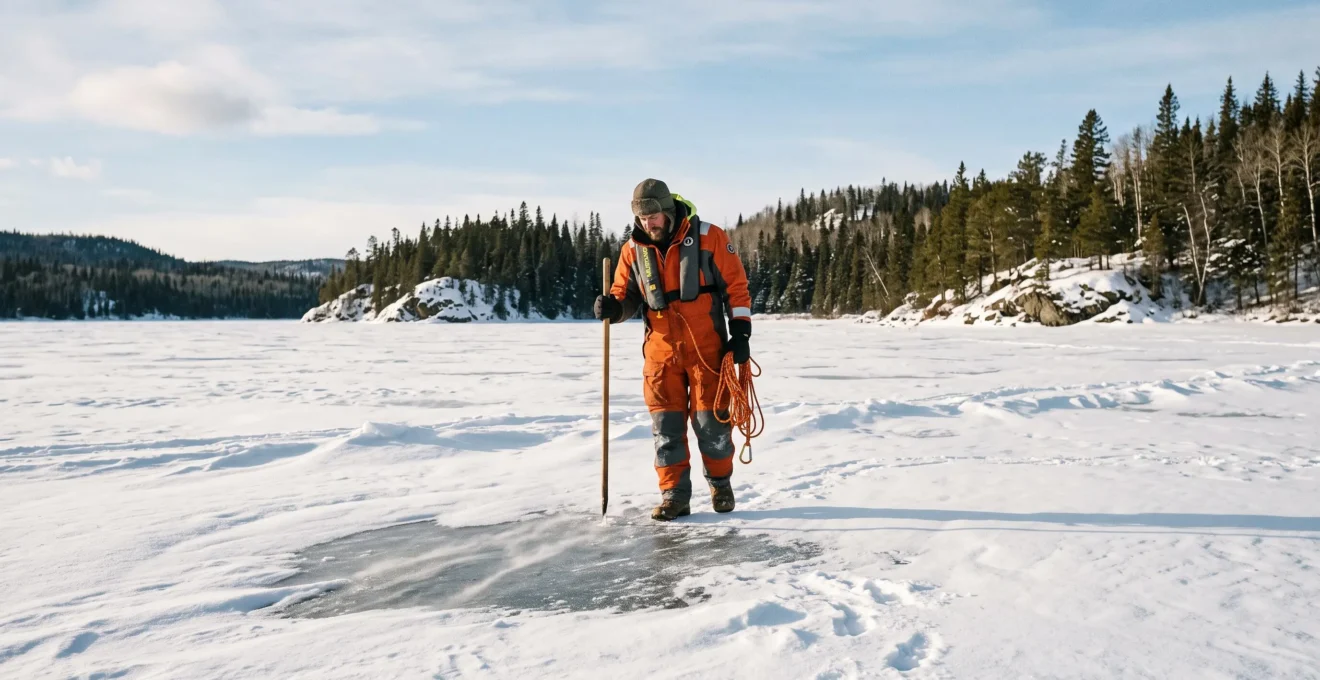
A Canadian lake can look completely frozen while hiding ice too weak to support a person. Snow can conceal cracks, flowing water can prevent ice from thickening, and a recent thaw can weaken a surface that appeared reliable only days earlier.
To judge whether a frozen lake is suitable for walking, you need more than a visual inspection. You must consider current local conditions, ice quality, repeated thickness measurements, nearby hazards, and your ability to respond if something goes wrong. Even then, no assessment can guarantee safety.
For families and newcomers experiencing their first Canadian winter, the most important distinction is between a maintained skating surface and an unmanaged lake. A supervised or officially maintained facility offers a more appropriate starting point. Unmanaged ice demands knowledge, suitable equipment, and a willingness to turn back.
The goal is not to become confident enough to ignore uncertainty. It is to recognize when the evidence is insufficient and choose another winter activity.
Frozen lake safety: What matters most
- Ice thickness varies: One safe-looking area does not establish that the entire lake can support a person.
- Check conditions before stepping out: Consult local advisories, assess ice quality, and arrange competent thickness testing rather than relying on appearance or footprints.
- Choose maintained surfaces when possible: Officially open rinks and skating trails are a more suitable option for beginners than unmonitored lake ice.
- Why Can One Part of a Frozen Lake Be Safe and Another Part Dangerous?
- How to Check Frozen Lake Safety in Canada Using a Simple 6-Step Checklist?
- Where Should You Skate in Canada: Outdoor Rinks, Maintained Lake Trails, or Wild Ice?
- The Footprints Mistake That Causes Ice Incidents on Canadian Lakes Every Winter
- When Does Lake Ice Become Most Dangerous in Canada Even Though It Still Looks Solid?
- The Cold-Water Clothing Mistake That Turns a Kayak Tip-Over Into an Emergency
- Which Winter Sport Is Easiest to Start in Canada: Skating, Skiing, or Snowshoeing?
- Which Winter Sport Should You Try First in Canada If You’ve Never Liked Cold?
Why Can One Part of a Frozen Lake Be Safe and Another Part Dangerous?
One area of a frozen lake can support a person while another area remains dangerously weak because water does not freeze uniformly. Currents, depth, snow cover, underwater springs, and changing temperatures influence ice formation. A thick, solid-looking surface near shore does not prove that the ice farther out has comparable strength.
One major difference is moving water beneath the ice. Streams entering a lake, outlets, narrow channels between islands, and underwater springs can maintain water movement that interferes with ice formation. These hazards may remain invisible beneath an apparently continuous frozen surface.
A sheltered, shallow bay may freeze earlier than deeper or moving-water areas. However, shallow water is not automatically safe: local inflows, changes in water level, and other conditions can still undermine the ice.
Snow creates a second problem. A thick snow layer acts as insulation, slowing the transfer of heat from lake water to cold air. Snow can therefore delay the growth of strong ice while concealing slush, cracks, and weak sections.
Lake geography and human activity introduce additional hazards. Areas around docks, marinas, boat launches, aerators, and ice-fishing holes require particular caution. Equipment that circulates water may prevent reliable freezing, and a previously drilled fishing hole can refreeze differently from the surrounding surface.
Ice quality also matters. Clear blue or black ice is generally stronger than opaque white ice. Grey ice indicates unsafe conditions. Recent thawing can further weaken ice regardless of its apparent thickness.
According to Parks Canada‘s guidance on activities on frozen water bodies, water depth, currents, changing water levels, shoreline objects, and air-temperature fluctuations all affect ice conditions.
These variations explain why testing a single location cannot establish a safe route across an entire lake.
Before considering a crossing, assess the specific route rather than treating the frozen lake as one uniform surface. The next step is knowing what evidence to check and when to reject an outing.
How to Check Frozen Lake Safety in Canada Using a Simple 6-Step Checklist?
Checking frozen lake safety requires six decisions: verify local conditions, inspect visible ice quality, obtain an initial thickness measurement, reassess conditions along the proposed route, identify warning signs, and prepare for an emergency. This sequence is a practical decision framework, not an official certification procedure. If conditions cannot be verified reliably, stay off the ice.
Thickness recommendations are meaningful only alongside ice quality and environmental conditions. The Canadian Red Cross emphasizes that ice varies in strength across the same body of water and that no ice can be considered completely safe.
Six checks before using an unmanaged frozen lake
- Consult current local information. Look for park notices, municipal restrictions, local authority advisories, and information from experienced local operators. A report from several days earlier does not establish today’s conditions.
- Inspect colour and texture from a safe position. Clear, solid ice is generally stronger than white ice. Avoid grey ice, slush, suspicious cracks, and surfaces affected by thawing.
- Obtain a reliable initial thickness measurement. A properly used ice auger or chisel can expose the ice profile for measurement, but an inexperienced person should not enter questionable ice merely to perform a test. Arrange assessment by a knowledgeable local professional instead.
- Recheck throughout the proposed route. Ice thickness changes over short distances. Measurements near shore cannot replace checks farther along the route or near areas with different conditions. No universal recreational testing interval establishes safety.
- Identify locations that invalidate the route. Flowing water, open water, fresh cracks, unstable ice, unusual colour changes, and thaw-refreeze damage are reasons to stop rather than continue testing toward them.
- Confirm an emergency plan. Avoid travelling alone. Establish how to contact emergency services, tell someone your route and expected return, and ensure suitable rescue equipment is accessible.
When competent personnel measure ice, they may drill through the complete ice sheet using an auger and measure the thickness with a suitable marked tool. The measurement must distinguish strong clear ice from weaker ice layers. A single number without information about ice quality is insufficient.
Canadian organizations publish different recreational thickness recommendations. These are not interchangeable guarantees.
| Activity | Parks Canada guidance | Canadian Red Cross guidance |
|---|---|---|
| Walking or individual skating | At least 15 cm | The cited recreational advice recommends at least 20 cm for skating |
| Group skating or games | At least 20 cm | At least 20 cm recommended for skating |
| Unknown, deteriorating, or visibly unsafe ice | Thickness alone cannot establish safety | Avoid unsafe ice regardless of the measured thickness |
The Canadian Red Cross ice-safety advice recommends skating only on ice at least 20 cm thick and warns against relying on recently thawed and refrozen ice. These general recommendations do not authorize access to a specific lake.
Five practical checks to complete before leaving home
- Find a current local advisory and record its date, source, and any restrictions.
- Identify the intended access point and mark known currents, inlets, and restricted areas on a route map.
- Confirm whether a competent local assessment is available; record the verified ice quality and measurements, or mark the information as unknown.
- Agree on emergency contacts, companions, and a return time; share the plan with someone staying ashore.
- Make an explicit go/no-go decision and record any unanswered safety questions. Choose a maintained rink if verification is incomplete.
A useful automatic rejection rule is straightforward: unknown thickness, snow-covered ice, recent mild temperatures, and no reliable local confirmation mean no entry. Any serious warning sign can independently justify cancelling the outing.
For inexperienced visitors, arranging a trip to an officially maintained skating surface is often a better decision than attempting to perform complex ice assessments independently.
Where Should You Skate in Canada: Outdoor Rinks, Maintained Lake Trails, or Wild Ice?
Outdoor community rinks are usually the most suitable choice for beginner skaters in Canada. Officially maintained natural-ice trails offer a scenic alternative when operators declare them open. Wild ice on unmonitored lakes requires considerably more knowledge, equipment, and personal responsibility. The best option depends on experience, current conditions, and the level of uncertainty you can manage safely.
These three options may look similar in photographs, but their safety responsibilities differ substantially.
| Consideration | Outdoor rink | Maintained natural-ice trail | Wild lake ice |
|---|---|---|---|
| Ice assessment | Managed by facility operator | Managed within the designated open area | Requires independent assessment |
| Beginner suitability | High when officially open | Suitable on permitted routes, subject to conditions | Not recommended without specialist preparation |
| Access | Facility opening times | Weather-dependent openings | No managed assurance of safety |
| Freedom of movement | Defined skating area | Marked route | Potentially extensive, but with greater uncertainty |
| Emergency preparation | Follow facility procedures | Follow operator rules and emergency guidance | Requires a comprehensive independent rescue plan |
Community and refrigerated outdoor rinks are particularly useful for families. They allow new skaters to practise balance, stopping, and controlling speed without needing to interpret natural lake ice. Conditions must still be respected, including closures and facility rules.
A maintained natural-ice skating route offers a different experience. The Rideau Canal Skateway in Ottawa demonstrates the work required to operate a natural skating surface.
According to the National Capital Commission explanation of Rideau Canal Skateway ice maintenance, teams drill ice samples to assess thickness and quality, monitor ice movement, and perform ongoing maintenance. The public must stay off the surface until it is officially opened.
Even at a managed facility, visitors must respect marked boundaries. Ice outside a cleared corridor has not necessarily received the same assessment, and an opening announcement does not remove all recreational risks.
Wild skating is different. On unmanaged lakes in Ontario, the Yukon, Manitoba, or elsewhere in Canada, a beautiful ice surface may have no operator, no designated route, and no current safety inspection.
Such outings require route-specific knowledge, appropriate companions, accessible rescue equipment, and the discipline to abandon the activity when conditions are uncertain. Wild ice is not a beginner substitute for a maintained skating trail.
Choosing a maintained facility also avoids a common source of misplaced confidence: assuming that evidence of previous human activity proves a natural ice surface is safe.
The Footprints Mistake That Causes Ice Incidents on Canadian Lakes Every Winter
Following footprints across a frozen lake is dangerous because tracks are not evidence of current ice strength. They reveal where someone previously travelled, not whether the ice was properly checked or remains reliable. Temperature changes, hidden cracks, moving water, and snow-covered weak spots can make a previously crossed route hazardous.
Imagine a visitor arriving at a Canadian lake after snowfall. Footprints lead away from shore, pass around a small point of land, and disappear into the distance. The visitor assumes that another person must have found a safe crossing.
That conclusion overlooks several possibilities. The earlier walker may have crossed without testing anything. Conditions may have deteriorated since the footprints formed. The track might also pass close to hazards that are impossible to identify from shore.
Snow is particularly misleading. It can hide pressure cracks, slush, and previously drilled fishing holes. Tracks around fishing areas may lead across surfaces with widely varying ice thickness.
Following vehicle or snowmobile tracks is no better. A machine’s previous passage does not verify current conditions for another traveller, and ice strength is not determined by track visibility.
An abrupt end to a visible track deserves caution, but it does not establish what happened. Someone may have turned back, changed direction, or encountered a problem. Never approach suspicious ice just to investigate footprints.
The correct alternative is to treat tracks as unverified information. Current local assessments, ice quality, and competent route-specific measurements matter far more than evidence of previous traffic.
Groups should establish this rule before the outing. Children often follow adults without questioning their route choice. The leading adult must not treat other people’s tracks as permission to continue, and a group should never move onto questionable ice merely because someone has stepped ahead.
Rescue equipment, including accessible ice picks and a throw rope, belongs in the preparation plan, but it does not make a questionable crossing acceptable.
That principle becomes especially important during freeze-up and thaw, when ice can appear familiar while its underlying strength changes significantly.
When Does Lake Ice Become Most Dangerous in Canada Even Though It Still Looks Solid?
Frozen lakes can be especially dangerous during early winter freeze-up and spring thaw. In early winter, a continuous-looking surface may not have developed adequate thickness. During spring, ice can lose internal strength while remaining visibly extensive. Above-freezing temperatures, moving water, and repeated thaw-refreeze cycles further increase uncertainty, even when the surface appears solid.
Early-season ice often creates a false sense of security. A cold spell may cover a sheltered bay while deeper areas, outlets, or sections affected by currents remain weak. The first appearance of an unbroken ice sheet is not evidence that the lake is ready for recreation.
Spring presents a different hazard. Melting can damage the internal structure of ice, producing what is commonly called rotten, candled, or honeycombed ice. It may retain substantial thickness while losing the strength needed to support weight.
Darkened or grey ice, water on the surface, deteriorating texture, and changing conditions are warning signs. However, the absence of visible warning signs does not prove spring ice is strong.
Daily temperature changes also matter. An overnight freeze may harden the surface without restoring the quality of deteriorated ice underneath. A route that seemed usable earlier should never be assumed safe for an afternoon return.
Consider a hypothetical cabin visitor who walks across a lake during a cold morning and plans to return after several hours of sunshine and above-freezing temperatures. The outbound crossing provides no assurance that the return conditions will remain acceptable. A safe alternative route must be planned before departure.
Seasonal traditions can be misleading as well. A family may remember skating on a lake at the same time each year, but past opening dates are not measurements. Weather and ice development must be reassessed each season, regardless of local memories or expected winter patterns.
Current local information is therefore more useful than calendar assumptions. Even a genuinely cold winter can produce hazardous areas where moving water or other environmental factors interfere with freezing.
Because uncertainty cannot always be eliminated, people using natural ice must also understand what happens if the surface fails and why clothing matters immediately.
The Cold-Water Clothing Mistake That Turns a Kayak Tip-Over Into an Emergency
One of the most dangerous cold-water clothing mistakes is dressing only for the air temperature while ignoring the possibility of immersion. Cotton clothing absorbs water and provides poor insulation when soaked. Whether a person falls from a kayak or breaks through lake ice, sudden exposure to near-freezing water can quickly impair breathing, movement, and self-rescue ability.
This matters because a person who feels comfortably warm on a frozen lake may be poorly equipped to survive an unexpected fall through the surface.
Cold-water immersion begins with an involuntary physiological response. Sudden cooling can trigger gasping and uncontrolled breathing. If a person’s airway is underwater during that initial reaction, the immediate danger is severe.
The Canadian Safe Boating Council explains this through its 1-10-1 cold-water immersion principle: an initial cold-shock phase lasting approximately one minute, progressive cold incapacitation over roughly the following ten minutes, and a later hypothermia phase.
These are approximate educational stages, not guaranteed survival times. Actual responses vary with conditions and individual circumstances. The practical lesson is that the first moments of immersion are critical.
1–10–1
An educational framework describing approximate phases of cold shock, cold incapacitation, and hypothermia. It is not a countdown or a guarantee of survival.
Canadian Safe Boating Council, cold-water immersion education.
For clothing, moisture management is essential. Wool, fleece, and suitable synthetic insulating layers generally retain more useful insulation when damp than cotton. However, ordinary winter clothing is not equivalent to properly selected immersion protection.
When considering unmanaged ice, experienced participants may use specialized flotation suits or other appropriate flotation equipment. Such equipment must be suitable for its intended use and properly fitted; flotation and thermal protection are separate considerations.
Essential emergency equipment must remain accessible, including ice picks positioned so they can be reached during immersion, a whistle, and an appropriate throw rope. Dry spare clothing can be protected in a waterproof bag, but it should not substitute for the equipment needed during immediate self-rescue.
Before departure, ask whether your clothing allows effective movement, whether you could reach your ice picks with cold hands, and whether your flotation equipment would help maintain your airway above water.
If someone breaks through the ice, the Canadian Red Cross advises controlling breathing, working toward a horizontal position, and crawling or rolling away from the opening if escape is possible. Rescuers should avoid entering unsafe ice, call emergency services, and prioritize assistance from a secure location.
Anyone rescued from cold water needs prompt shelter, removal of wet clothing when safe, and appropriate medical assessment. An apparent recovery from the initial shock should not be mistaken for the absence of danger.
The most reliable way for a beginner to reduce this risk is to choose a winter activity that does not require travelling over unmonitored frozen water.
Which Winter Sport Is Easiest to Start in Canada: Skating, Skiing, or Snowshoeing?
Snowshoeing is generally the easiest of these three winter sports for a complete beginner because its basic movement resembles walking. Skating requires more balance and stopping skills, while cross-country skiing introduces equipment handling and gliding technique. For newcomers concerned about frozen-lake safety, snowshoeing on an established land-based trail offers a practical starting point without needing to assess lake ice.
Each sport offers a different balance between equipment, technique, and the kind of winter experience it provides.
| Factor | Snowshoeing | Skating | Cross-country skiing |
|---|---|---|---|
| Initial technique | Walking with adjusted steps | Balance, gliding, braking | Gliding, coordination, braking |
| Typical equipment | Snowshoes and suitable boots | Skates and protective gear | Skis, boots, bindings, poles |
| Beginner learning curve | Usually gentle | Balance practice required | Technique develops with practice |
| Suitable starting location | Marked land-based trail | Open, maintained rink | Groomed beginner trail |
| Natural lake ice assessment needed? | No, when using land trails | No, when using maintained rink facilities | No, when using land-based ski trails |
Snowshoeing appeals to beginners because the basic movement is intuitive. However, deep snow, steep slopes, difficult terrain, and severe weather can still make an outing challenging. Choose an appropriately graded trail and check its conditions before setting out.
Skating is an attractive choice for anyone hoping to enjoy Canadian frozen lakes eventually. An officially open community rink allows beginners to develop control before considering more demanding natural-ice environments.
Cross-country skiing suits people interested in exploring longer routes. Basic technique takes practice, but beginner lessons and maintained trails can make the sport approachable.
Renting equipment is often a sensible first step. Depending on the destination, municipal recreation programs, parks, trail centres, and outdoor retailers may offer rental equipment or instruction. Availability and costs vary, so check the specific facility rather than assuming rentals are provided.
For families, the decision also depends on children’s ages, balance, endurance, and willingness to learn. A short, successful experience is more useful than an ambitious outing that leaves everyone exhausted or uncomfortable.
Snowshoeing on frozen lakes is not automatically safer than skating on those lakes. Any activity that travels over frozen water requires appropriate ice assessment. The advantage discussed here applies to snowshoeing on established land-based routes.
Once the location and sport are appropriate, managing cold exposure becomes the next factor in creating an enjoyable first Canadian winter outing.
Key takeaways before your first winter outing
- Choose an activity with an easy exit and a dependable place to warm up, especially if you are new to Canadian winters.
- Start on managed land-based trails or officially open rink facilities rather than unmonitored lake ice.
- Build cold-weather confidence gradually; discomfort, fatigue, and deteriorating weather are reasons to shorten an outing.
Which Winter Sport Should You Try First in Canada If You’ve Never Liked Cold?
If you dislike cold weather, start with a short snowshoe walk on a maintained land-based trail near a warm indoor facility. Steady movement generates body heat, the technique is simple, and you can turn back whenever necessary. Cross-country skiing is another option once you feel comfortable outdoors, while skating is best learned on an officially open rink.
Disliking the cold does not necessarily mean winter recreation is unsuitable. The experience often depends on exposure time, wind, clothing, exertion, and whether a warm place is available nearby.
Activities involving continuous moderate movement can help maintain warmth. Snowshoeing allows beginners to control their pace, take a short route, and return without needing extensive technical skills.
Cross-country skiing can also generate considerable body heat, but beginners may spend time learning equipment and technique. For an initial outing, a short lesson on a beginner trail is preferable to a demanding route.
Skating presents different challenges. Wind exposure on open surfaces, periods of standing still, and unfamiliar balance demands can make it less comfortable for someone who already struggles with winter temperatures.
A practical first outing could follow this progression:
- Choose a clearly marked, easy land-based snowshoe trail near a visitor centre or warming facility.
- Wear adjustable layers with a moisture-managing base layer, insulating mid-layer, and weather-appropriate outer layer.
- Begin with a short route that allows an uncomplicated return to shelter.
- Monitor your comfort, footing, and weather instead of trying to reach a distant destination.
- After gaining confidence, try a beginner cross-country ski session or skating lesson at a maintained rink.
For land-based winter sports, clothing should balance warmth and moisture control. Avoid becoming soaked with perspiration, since damp clothing can cause discomfort when activity slows. Bring appropriate spare layers and adjust clothing as conditions change.
The flotation and ice-rescue precautions discussed earlier apply to activities where accidental immersion is a realistic hazard. They are not a reason to move a beginner snowshoe route onto an unverified frozen lake.
Families should also plan around children who may become cold or tired faster than expected. An easy return route, snacks, warm drinks where appropriate, and a nearby shelter can help keep the outing manageable.
Enjoying winter is not a test of endurance. A modest first experience can build useful confidence without requiring exposure to the most demanding Canadian winter conditions.
For your next winter outing, choose an officially open rink or an easy land-based trail, check the conditions on the day, and plan a short return route. Learning to enjoy Canadian winter safely begins with choosing an activity whose risks you can understand and manage.
Can a frozen lake be unsafe even when the ice is thicker than 20 cm?
Yes. Thickness alone does not determine whether ice can support a person. Deteriorated ice, moving water, temperature changes, and weak layers can create hazardous conditions even when a measurement exceeds general recreational guidelines. No single thickness reading guarantees safety across an entire lake.
Is clear black ice safe to walk on?
Clear black or blue ice is generally stronger than opaque white ice, but its colour is not a safety certificate. Thickness, quality, local water movement, recent weather, and conditions along the entire route still matter. Never rely on appearance alone.
What should I do if my dog runs onto an unsafe frozen lake?
Do not follow the animal onto questionable ice. Call for trained emergency assistance if the dog is in danger, and follow the responding service’s instructions. Keep pets on a leash near frozen waterways to reduce the risk of an animal entering an unsafe area.
Does a maintained skating trail mean the entire lake is safe?
No. Operator assessments apply to the designated area under their management and current operating conditions. Ice beyond marked boundaries may be untested or dangerous. Always respect closures, signs, and the limits of the officially open skating route.
Can I rely on a frozen lake safety report from last weekend?
No. Ice conditions can change after snowfall, warming, thawing, or changes in water flow. An older report may provide background information, but it cannot establish current safety. Obtain up-to-date local confirmation before considering an outing, and stay off the ice if reliable verification is unavailable.