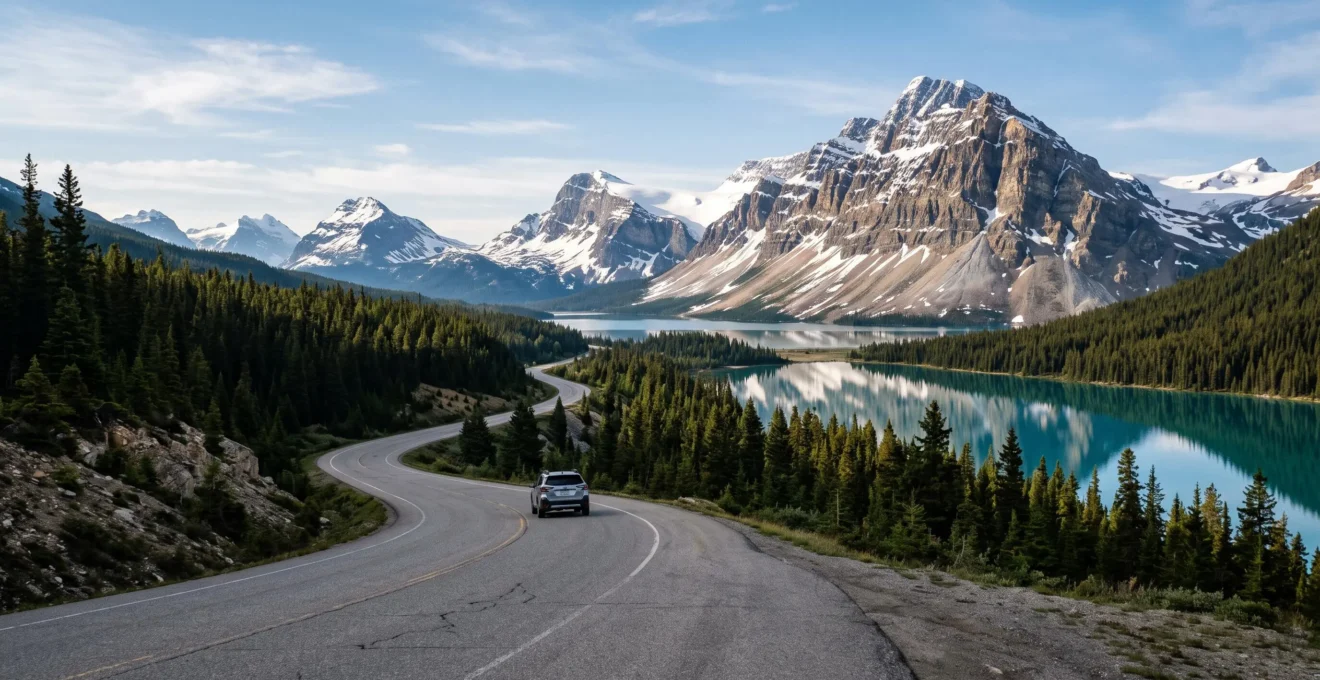
Five to seven days is a practical starting point for experiencing both Banff and Jasper without turning every day into a driving marathon. Four days can work with careful priorities and a one-way route. Eight to ten days provide more flexibility for longer walks, weather changes and genuinely relaxed mornings. Three days is usually better spent exploring one park rather than racing between both.
The challenge is not simply the distance between Banff and Jasper. It is the way travellers arrange their accommodation, sightseeing stops and transport connections. A week based entirely in Banff can involve more driving than a shorter trip that moves gradually north through Lake Louise and the Icefields Parkway before finishing in Jasper.
The most useful planning decision is therefore not how many famous lakes fit into the itinerary. It is how to divide the trip into geographic zones, with enough time in each to experience the landscape instead of repeatedly crossing it.
Banff and Jasper trip planning at a glance
- Five days: Allocate approximately two days to Banff and Lake Louise, one sightseeing day to the Icefields Parkway, and two days to Jasper.
- Seven days: Add breathing room for hiking, changing weather, quieter viewpoints and flexible lake visits.
- Three to four days: Choose fewer locations, split accommodation strategically, and avoid returning to the same base after every excursion.
- Why Do Banff and Jasper Trips Feel Like “All Driving” Even When You Stay a Week?
- How to Split Banff and Jasper Into 3 Zones So You Don’t Backtrack All Day?
- Where Should You Stay for a Banff-and-Jasper Trip if You Hate Crowded Towns?
- The Late-Booking Mistake That Adds 2 Hours of Driving per Day in Banff and Jasper
- When Should You Drive the Icefields Parkway to Avoid Bus Crowds and Bad Light?
- Which Rockies Base Makes Sense With 3 Days: Banff, the Parkway, or Jasper?
- Where to Base Yourself Outside the Hotspots: Quiet Alternatives With Manageable Drive Times
- How to Experience the Canadian Rockies Without Losing Half Your Day to Parking
Why Do Banff and Jasper Trips Feel Like “All Driving” Even When You Stay a Week?
Banff and Jasper trips often feel dominated by driving because travellers repeatedly return to the same accommodation after visiting distant attractions. The problem is usually itinerary geography rather than the total number of days. Staying in one town while visiting Lake Louise, the Icefields Parkway and Jasper creates repeated highway journeys that a progressive route could avoid.
Three main destinations shape the trip: Banff townsite in the Bow Valley, Lake Louise farther northwest, and Jasper at the northern end of the Icefields Parkway. They form a long travel corridor rather than three nearby attractions that can comfortably be visited from a single central hotel.
Parks Canada identifies the Icefields Parkway itself as a 232 km mountain route between Lake Louise and Jasper. That distance does not include the drive from Banff townsite to Lake Louise, scenic detours or the time spent stopping along the highway.
232 km
The official length of the Icefields Parkway between Lake Louise and Jasper. This is the road distance, not an estimate of sightseeing time or a complete Banff-to-Jasper journey.
Consider a hypothetical traveller sleeping in Banff for seven nights. Driving to Lake Louise on one day, exploring the northern Parkway on another, and making a separate excursion towards Jasper can mean covering some of the same highway sections repeatedly. The extra days have not eliminated fatigue because the overnight location never changes.
Driving time also hides several smaller delays. Finding a parking space, waiting for a lake shuttle, stopping for photographs and slowing down for wildlife-related traffic can consume substantial portions of the day. A navigation app’s estimated journey duration rarely captures the complete sightseeing experience.
To audit an itinerary, write down the starting location, main attraction, next destination and overnight location for each day. Count every highway segment travelled in both directions. Then add realistic allowances for parking, transfers, meals and stops.
The biggest warning sign is a day that crosses the same long section of highway in the morning and again in the evening, especially when the following day repeats that journey.
A comfortable Rockies journey begins by changing the route structure, not simply by adding another attraction-free day to an inefficient itinerary.
How to Split Banff and Jasper Into 3 Zones So You Don’t Backtrack All Day?
Divide a Banff-and-Jasper itinerary into three geographic zones: Banff and Lake Louise, the Icefields Parkway, and Jasper. Give each zone dedicated time and move between them progressively. For a five-day trip, an effective starting allocation is two days in the southern zone, one Parkway travel-and-sightseeing day, and two days in Jasper.
The main advantage is that each day has a clear geographic purpose. Instead of waking up in Banff and trying to reach distant attractions before returning to the same room, the journey advances naturally through the mountains.
| Zone | Main areas | Planning role |
|---|---|---|
| Zone 1: Southern Rockies | Banff townsite, Bow Valley, Lake Louise and Moraine Lake | Concentrate popular lakes, accessible walks and town-based activities |
| Zone 2: Icefields Parkway | Waterfowl Lakes, Columbia Icefield, Wilcox area and scenic viewpoints | Turn the transfer into a dedicated sightseeing experience |
| Zone 3: Jasper | Jasper townsite, Maligne Valley and accessible northern park attractions | Explore the northern landscape without commuting from Banff |
Trip length determines how deeply each zone can be explored. The following splits are illustrative planning recommendations, not official Parks Canada itineraries.
| Trip length | Suggested allocation | Realistic experience |
|---|---|---|
| 4 days | 2 southern days, 1 Parkway day, 1 Jasper day | Possible but selective, with limited flexibility |
| 5 days | 2 southern days, 1 Parkway day, 2 Jasper days | Balanced introduction to both parks |
| 7 days | 3 southern days, 1 Parkway day, 3 Jasper days | More relaxed exploration and hiking opportunities |
| 10 days | 4 southern days, 2 Parkway-area days, 4 Jasper days | Longer trails, rest days and alternative activities |
These allocations assume the trip’s main purpose is sightseeing within the parks. Travellers arriving late or departing early should count usable sightseeing days separately from travel days. A seven-night booking does not necessarily mean seven complete days outdoors.
Northbound travel from Banff towards Jasper is convenient when arriving through Calgary and continuing north afterwards. Southbound travel works equally well when the arrival and departure arrangements favour Jasper first. The important decision is avoiding unnecessary round trips, not choosing one direction for supposedly superior scenery.
On the Parkway transition day, depart with enough time for scenic stops rather than treating the road as a standard intercity motorway. Select a few meaningful viewpoints and one walk instead of attempting every attraction marked on the map.
Some travellers may prefer an overnight stay near the Parkway corridor, where accommodation is available and appropriate for their dates. Others will find that travelling directly between southern and northern bases leaves more flexibility in their lodging budget.
Once the geographic split is settled, accommodation becomes a tool for protecting sightseeing time rather than simply somewhere to sleep.
Where Should You Stay for a Banff-and-Jasper Trip if You Hate Crowded Towns?
Travellers who dislike crowded towns should consider Canmore, Field, smaller accommodation areas around Lake Louise, or Jasper rather than automatically choosing central Banff. However, the quietest base is not always the most convenient. A good choice balances evening atmosphere, restaurant access, accommodation availability and the driving required to reach planned attractions.
Banff townsite provides a wide range of services and the convenience of walking between restaurants, shops and local activities. Its popularity also means busy streets and considerable visitor activity during peak periods. For travellers who want a lively evening without using the car, that trade-off may be worthwhile.
Canmore offers another southern base, with a different town atmosphere and accommodation options outside Banff National Park. It can suit visitors spending time around Banff and the Bow Valley, but departures towards Lake Louise or Moraine Lake involve an additional approach compared with accommodation farther west.
Lake Louise village is strategically positioned for lake visits and the southern entrance to the Icefields Parkway. It is a small settlement, however, and proximity to heavily visited attractions does not guarantee uncrowded days. Field, in nearby Yoho National Park, provides a smaller-community alternative with fewer visitor services.
Jasper townsite makes sense for travellers concentrating on the northern park. Its atmosphere can appeal to visitors seeking a different experience from central Banff, although no universal claim that Jasper is always less crowded is justified. Visitor volumes, events and seasonal conditions matter.
| Base | Evening atmosphere | Main trade-off |
|---|---|---|
| Banff | Active, service-rich town centre | More visitor activity |
| Canmore | Alternative town setting with services | Additional driving to northern Banff attractions |
| Lake Louise | Small village near major sights | Limited accommodation choices and busy nearby destinations |
| Field | Small-community mountain setting | Limited dining and lodging options |
| Jasper | Walkable northern park base | Long distance from Banff-area highlights |
A practical compromise is to split accommodation between southern and northern bases. For example, spend the first part of the trip near Banff or Lake Louise, then move north to Jasper during the Parkway sightseeing day.
Accommodation inside national parks does not remove normal entry requirements. Visitors spending time in Banff or Jasper must have an applicable national park pass, while camping reservations and relevant camping permits are separate requirements. A park pass is not a universal hotel accommodation licence.
The lodging decision also needs to reflect Jasper’s continuing recovery from the 2024 wildfire. Parks Canada reported extensive trail reopenings during 2026, but some visitor infrastructure and areas remained closed. Its Jasper wildfire recovery updates provide the relevant official context. Access conditions should be checked again for the intended travel dates.
Peaceful accommodation is valuable, but a quiet evening should not come at the cost of an exhausting commute every morning.
The Late-Booking Mistake That Adds 2 Hours of Driving per Day in Banff and Jasper
Late accommodation booking can add considerable driving to a Banff-and-Jasper itinerary when travellers are left with rooms far from their intended sightseeing areas. An extra two hours per day is a plausible hypothetical outcome, not a verified average. The actual penalty depends on where the hotel is located, which attractions are planned and whether the journey must be repeated.
The mistake usually begins with an apparently attractive accommodation listing. A hotel in Golden, Hinton or Radium Hot Springs may appear suitable because it serves the wider Rockies region. But being within reach of the national parks does not mean being conveniently located for every planned excursion.
Consider a hypothetical traveller who chooses a distant base that adds 60 minutes to the morning journey and another 60 minutes to the return drive compared with a closer alternative. That decision creates two additional hours in the car on that day. This is a simple illustrative calculation, not a measured result for any particular town or accommodation.
Before booking, compare accommodation based on door-to-attraction travel time, not regional labels such as “near Banff” or “close to Jasper.” A base that works beautifully for Yoho National Park may be inconvenient for consecutive early mornings at Lake Louise.
Transport reservations can make late planning more complicated. During the 2026 visitor season, Parks Canada opened its Lake Louise and Moraine Lake shuttle reservations on April 15, with additional seats released two days before departure. These were 2026-specific arrangements, not guaranteed rules for future seasons.
For future trips, confirm the applicable reservation calendar before making non-refundable activity plans. A sensible booking sequence begins with the overnight locations, followed by essential lake transport and campground arrangements where relevant. More flexible sightseeing choices can be finalized afterwards.
Five checks before confirming your Rockies accommodation
- Mark your overnight bases: Create a map showing each proposed hotel and its exact location.
- Choose daily anchor attractions: Record the main destination for each day, such as Lake Louise, Columbia Icefield or Maligne Valley.
- Calculate return journeys: Save estimated morning and evening driving times for every accommodation option.
- Check transport restrictions: Record whether a shuttle reservation, parking plan or campground booking is needed.
- Compare the real trade-offs: Make a shortlist showing location, driving burden, cancellation conditions and your preferred accommodation atmosphere.
If suitable hotels are already unavailable, reduce the geographic ambitions of the itinerary rather than trying to recover every missed opportunity through longer days. Group attractions by area, dedicate a full day to the Parkway and consider spending more time in whichever park has the most convenient remaining accommodation.
A less ambitious itinerary with sensible overnight locations will generally feel more rewarding than a packed schedule that begins and ends with a lengthy commute.
When Should You Drive the Icefields Parkway to Avoid Bus Crowds and Bad Light?
Drive the Icefields Parkway on a day when road conditions are suitable, with enough daylight for unhurried scenic stops. An early departure can create flexibility and may help you reach popular viewpoints before some organized groups, but there is no verified universal best direction or departure hour. Weather, seasonal daylight and your chosen stops matter more than a fixed schedule.
The Parkway connects Lake Louise and Jasper through remote mountain terrain, with opportunities to stop at lakes, glaciers, viewpoints and walking trails. Driving its 232 kilometres should be treated as a sightseeing activity in its own right, not simply a transfer to be completed as quickly as possible.
One practical approach for a northbound summer trip is to depart the Lake Louise area early, choose a small number of stops in advance and allow a substantial portion of the day for the Columbia Icefield area. If a particular tour is important, use the actual reserved admission or departure time as the schedule’s anchor.
Southbound travel can be organized the same way. Neither direction guarantees better photographic lighting because the sun’s position, mountain shadows, valley orientation and cloud cover vary by location and time of year.
Likewise, organized tours may influence congestion at major visitor facilities, but assuming that every tour bus arrives at the Columbia Icefield at the same time would be misleading. Travellers who prefer quieter stops can build flexibility into their day and use less crowded viewpoints when a popular location is busy.
A useful strategy is to reserve longer walks for suitable conditions and keep short roadside viewpoints available as alternatives. That way, a weather change or unexpected delay does not force the entire itinerary to collapse.
Mountain-road preparation is essential. The Parkway has limited services and no dependable cellular coverage. Parks Canada advises checking 511 Alberta for road conditions and Environment and Climate Change Canada forecasts before travelling. Fuel availability, seasonal facilities and road restrictions also deserve attention.
Outside summer, snow, ice, reduced daylight and temporary closures may significantly change what is realistic. An early start is only advantageous when it is safe, with sufficient visibility and suitable road conditions.
The most memorable Parkway day is often the one with enough flexibility to linger at an unexpected viewpoint without worrying about the next appointment.
Which Rockies Base Makes Sense With 3 Days: Banff, the Parkway, or Jasper?
With only three days in the Canadian Rockies, choose a single primary base unless the journey between Banff and Jasper is itself your main objective. Banff suits first-time visitors seeking accessible attractions and services, the Parkway suits scenic-drive enthusiasts, and Jasper suits travellers prioritizing the northern park. Attempting all three areas leaves little margin for extended exploration.
Three days is enough for a meaningful Rockies experience, but not for a comprehensive tour of both national parks. The main decision is what kind of journey you want, rather than how many famous landmarks you can photograph.
| Primary base | Best suited to | Main limitation |
|---|---|---|
| Banff | First-time visitors, accessible sightseeing, restaurants and transport choices | Popular attractions and parking demand |
| Parkway corridor | Travellers prioritizing mountain-road scenery, roadside viewpoints and walking | Limited accommodation, services and seasonal flexibility |
| Jasper | Travellers primarily interested in northern park landscapes and local exploration | Far from Lake Louise and the Bow Valley |
For a first visit arriving through Calgary, a Banff-area base is often the more straightforward option. Three days can include the Bow Valley, a carefully planned Lake Louise visit and another day exploring nearby landscapes without requiring a transfer to Jasper.
Travellers who are especially interested in the Icefields Parkway can organize a one-way scenic journey and spend nights at opposite ends of the route. However, the accommodation choices must support this plan, and the trip should not rely on reaching every viewpoint.
Jasper becomes the stronger choice when the northern park is the main attraction or the wider travel route already passes through the area. The town provides a practical base for exploring accessible nearby destinations, subject to current recovery-related restrictions.
A common temptation is to visit Jasper from Banff and return on the same day. Since the Parkway alone runs 232 km between Lake Louise and Jasper, such a journey means considerable driving before adding the Banff–Lake Louise section, sightseeing stops or return traffic. A typical one-way journey between Banff and Jasper is often planned at roughly three to four hours of driving without substantial stops, but actual duration varies.
With only three days, drop one park if the journey itself would consume the time you hoped to spend outside. A visitor eager for longer hikes, spontaneous stops or relaxed meals will usually gain more from concentrating on one area.
Adding days becomes valuable when those days allow you to explore a new zone properly, rather than simply extending the number of rushed excursions.
Where to Base Yourself Outside the Hotspots: Quiet Alternatives With Manageable Drive Times
Canmore, Field, Golden and Hinton can be useful alternatives to accommodation in Banff or Jasper, especially when availability or a quieter evening setting matters. Their suitability depends on where you plan to sightsee. The right alternative base minimizes unnecessary travel to your main attractions rather than simply offering a room away from the busiest tourist centres.
Canmore is a practical choice for travellers spending most of their time in Banff and the southern Bow Valley. It provides a substantial town setting outside the national park boundary, although repeated trips to Lake Louise and farther north will increase driving compared with a more centrally positioned base.
Field provides access to the Yoho side of the Rockies and can suit travellers looking for a small-community atmosphere. The trade-off is limited services and accommodation selection. It can be appealing when your itinerary includes Yoho and Lake Louise rather than frequent trips back to central Banff.
Golden, farther west in British Columbia, offers an alternative for travellers combining the Rockies with destinations on the western side of the mountains. It can be convenient for some routes but should not automatically be treated as a nearby substitute for a hotel in Banff townsite or Jasper.
Hinton, east of Jasper, can provide an alternative northern overnight base. It is better suited to itineraries concentrating on Jasper’s eastern approaches than to repeated excursions towards Lake Louise or the southern Icefields Parkway.
Accommodation prices and availability vary by date and property, so none of these towns should be assumed to be consistently cheaper. The apparent saving needs to be weighed against additional fuel, driving time and the practical burden of longer days.
Hypothetical example: Measuring the cost of a quieter base
Imagine two accommodation options. The quieter property adds 40 minutes of driving in the morning and another 40 minutes in the evening on each of three sightseeing days.
That creates 80 extra minutes per day, or four additional hours across those three days. These are illustrative assumptions, not verified travel times between any specific Rockies towns.
The decision is whether those four hours are an acceptable price for the accommodation’s atmosphere, space or other benefits.
This is the quiet-hour cost: the time exchanged for a less crowded place to stay. To evaluate it, map two daily anchors—the first planned activity and the evening return—against each candidate accommodation location. Include any shuttle meeting point rather than only the attraction itself.
Seasonal timing changes the calculation. Outside the busiest summer period, some central locations may feel less congested, reducing the reason to stay farther away. Conversely, shorter daylight, seasonal service reductions and winter road conditions can make a distant accommodation base less convenient.
A good base should feel comfortable both when you return in the evening and when you leave for your next destination in the morning.
Key takeaways before planning your sightseeing days
- Choose accommodation and sightseeing zones together so that a quieter hotel does not create repeated long journeys.
- Secure essential lake transportation before committing to a tightly timed day around Lake Louise or Moraine Lake.
- Use walking, local transit and clustered attractions to reduce the number of parking searches and vehicle movements.
How to Experience the Canadian Rockies Without Losing Half Your Day to Parking
To reduce parking delays in Banff and Jasper, plan transport before choosing your sightseeing schedule. Use reserved shuttles where appropriate, consider public transit from Banff, and group nearby activities into one visit. At Lake Louise and Moraine Lake, understanding access restrictions is especially important because arriving with a car does not guarantee access to the lakes.
Moraine Lake Road is closed to personal vehicles year-round, with specified exceptions for authorized transport and registered Moraine Lake Lodge guests. Travellers cannot generally drive their own vehicle directly to Moraine Lake and expect to park there.
Lake Louise Lakeshore is different: private vehicles are permitted, but parking is limited and can be difficult to obtain during busy periods. Driving there without a fallback plan risks spending time searching for a space or changing the day’s activities.
During the 2026 season, Parks Canada operated reservation-based shuttles to Lake Louise Lakeshore and Moraine Lake. Shuttle reservations included access to the selected first lake, the Lake Connector and the return journey to the Park and Ride at the Lake Louise Ski Resort. The park entry fee was separate.
Parks Canada advised allowing at least 30 minutes for shuttle waiting during that season, with waits potentially reaching one hour during busier periods. These allowances illustrate why a shuttle reservation does not necessarily mean immediate boarding. Future operating dates, reservation releases and service arrangements require fresh verification.
The official Parks Canada Lake Louise and Moraine Lake shuttle information explains the access arrangements and is the appropriate starting point for checking the rules applicable to your visit.
For travellers staying in Banff townsite, Roam public transit provides another option for accessing Lake Louise. Combining public transport with walking can remove the need to find parking at every destination, although service schedules and ticket arrangements should be checked before departure.
The same principle applies beyond the famous lakes. Walk between compatible attractions in Banff townsite rather than driving a short distance between them. In Jasper, organize town-based stops on foot where practical and reserve vehicle travel for destinations that genuinely require it.
Park once, explore a cluster, then move on. This simple approach can recover time that would otherwise disappear into repeated parking searches, short vehicle trips and unnecessary transfers.
Very early arrivals may sometimes improve the chance of parking at locations where private vehicles are still permitted, but they are not a guarantee. Late-afternoon visits can be appealing when conditions and access hours allow. Neither tactic should override road safety, daylight availability or official restrictions.
For a seven-day trip, a sensible rhythm might include a town-and-transit day around Banff, a reserved lake-access day, a dedicated Parkway day and geographically clustered excursions around Jasper. That arrangement reduces repeated car movements while leaving opportunities to adapt to weather and energy levels.
Start by choosing how many complete days you can spend in the Rockies, assign those days to the three zones, and reserve the essential transport and accommodation. Then select fewer activities than the map suggests you could fit. The reward is more time in the mountains and less time managing the journey between them.
Is five days enough to visit both Banff and Jasper?
Five days can provide a satisfying introduction to both parks if the itinerary follows a progressive route. A practical example is two days around Banff and Lake Louise, one dedicated Icefields Parkway day and two days around Jasper. It will not cover every major attraction, and additional time is helpful for extended hiking or weather flexibility.
Can you visit Banff and Jasper without renting a car?
Some attractions around Banff and Lake Louise can be reached by public transit or booked shuttle services. Travelling between Banff and Jasper and exploring the Icefields Parkway without a personal vehicle requires more careful planning through suitable transport or organized tours. Verify available connections and operating dates before booking accommodation in both parks.
Do you need a separate national park pass for Banff and Jasper?
Not necessarily. Parks Canada daily passes cover participating mountain national parks, including Banff and Jasper, for the applicable validity period. Annual Discovery Passes are another option. Travellers using the Icefields Parkway need valid park entry authorization, while campground bookings and shuttle tickets are separate arrangements. Check current fees and any applicable admission promotions or exemptions.
Is the Icefields Parkway suitable for a winter road trip?
The Icefields Parkway is a remote mountain road where winter conditions can be demanding. Snow, ice, variable visibility and temporary closures may affect travel. Appropriate winter driving preparation and checking official road conditions are essential. Travellers uncomfortable with winter mountain driving should not build a rigid itinerary around an assumed departure or arrival time.
Should you book accommodation in Banff or Jasper first?
Begin by deciding how many nights belong in the southern and northern zones, then compare availability in both areas before committing. The more geographically constrained part of your itinerary may determine the best booking sequence. Flexible cancellation conditions are helpful, particularly when shuttle availability, access restrictions or seasonal road conditions could influence the final route.